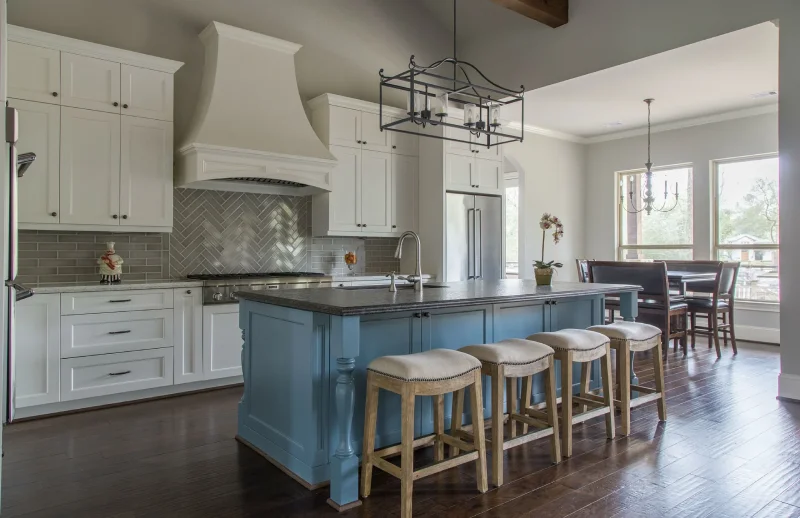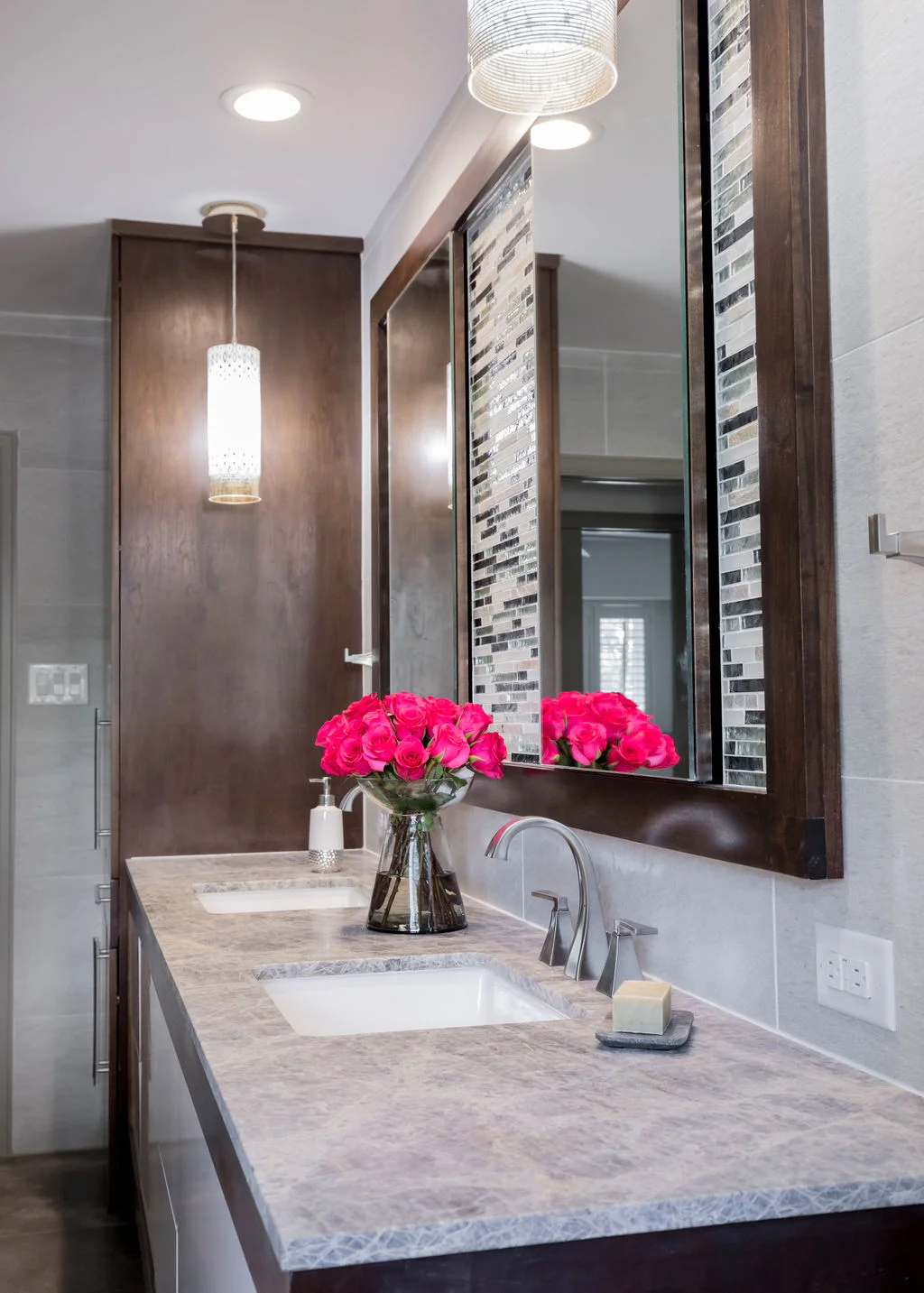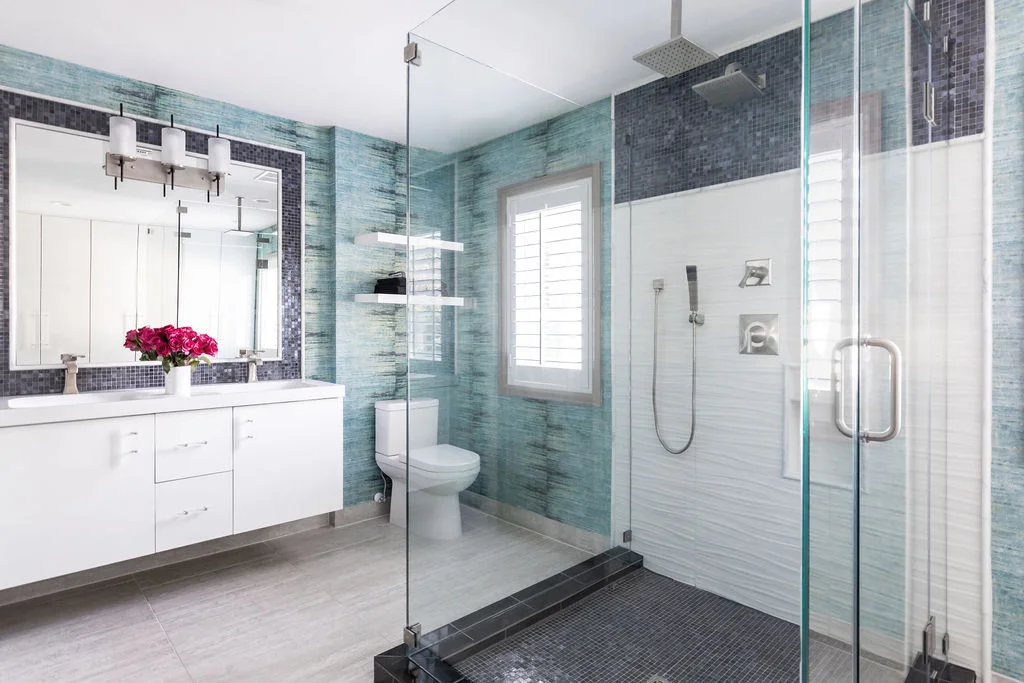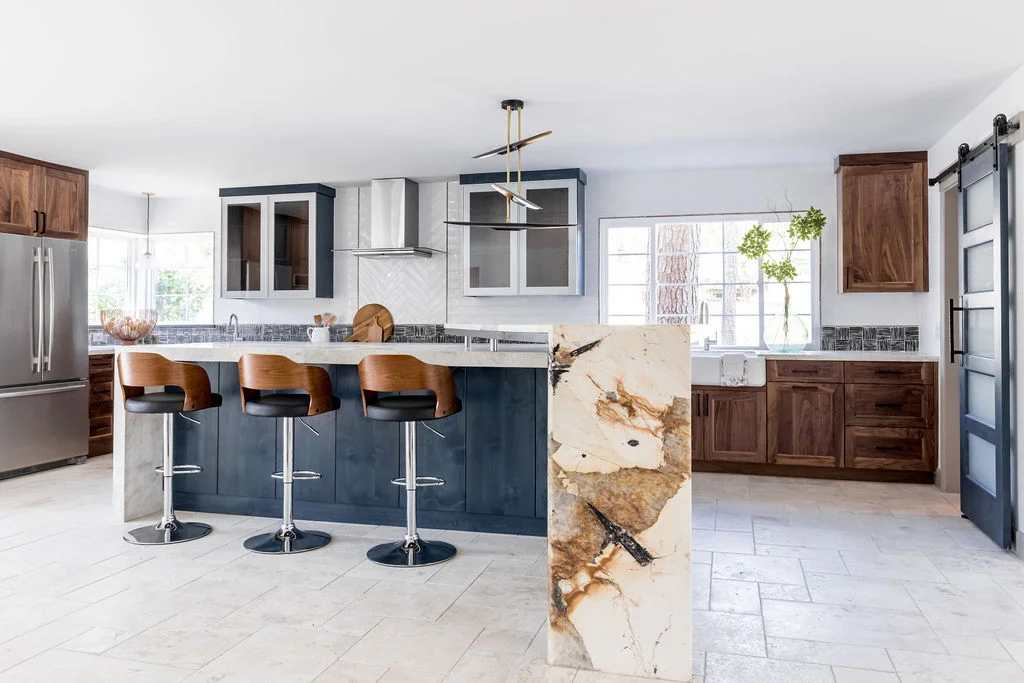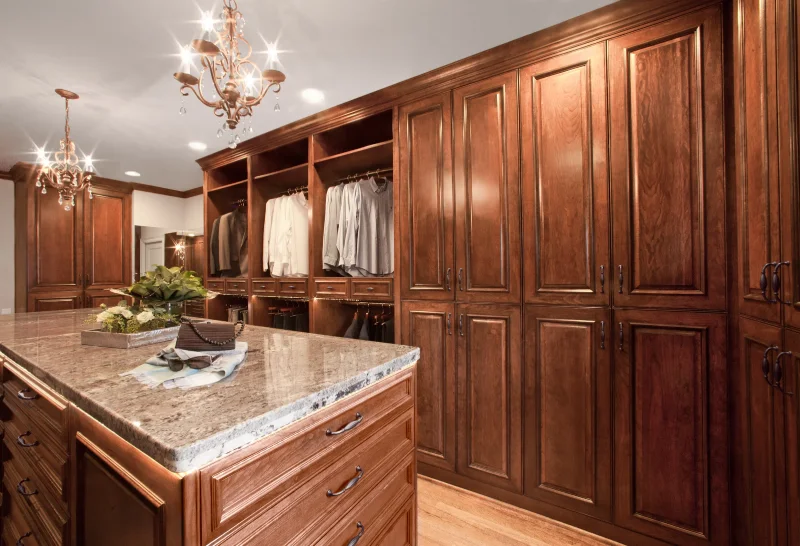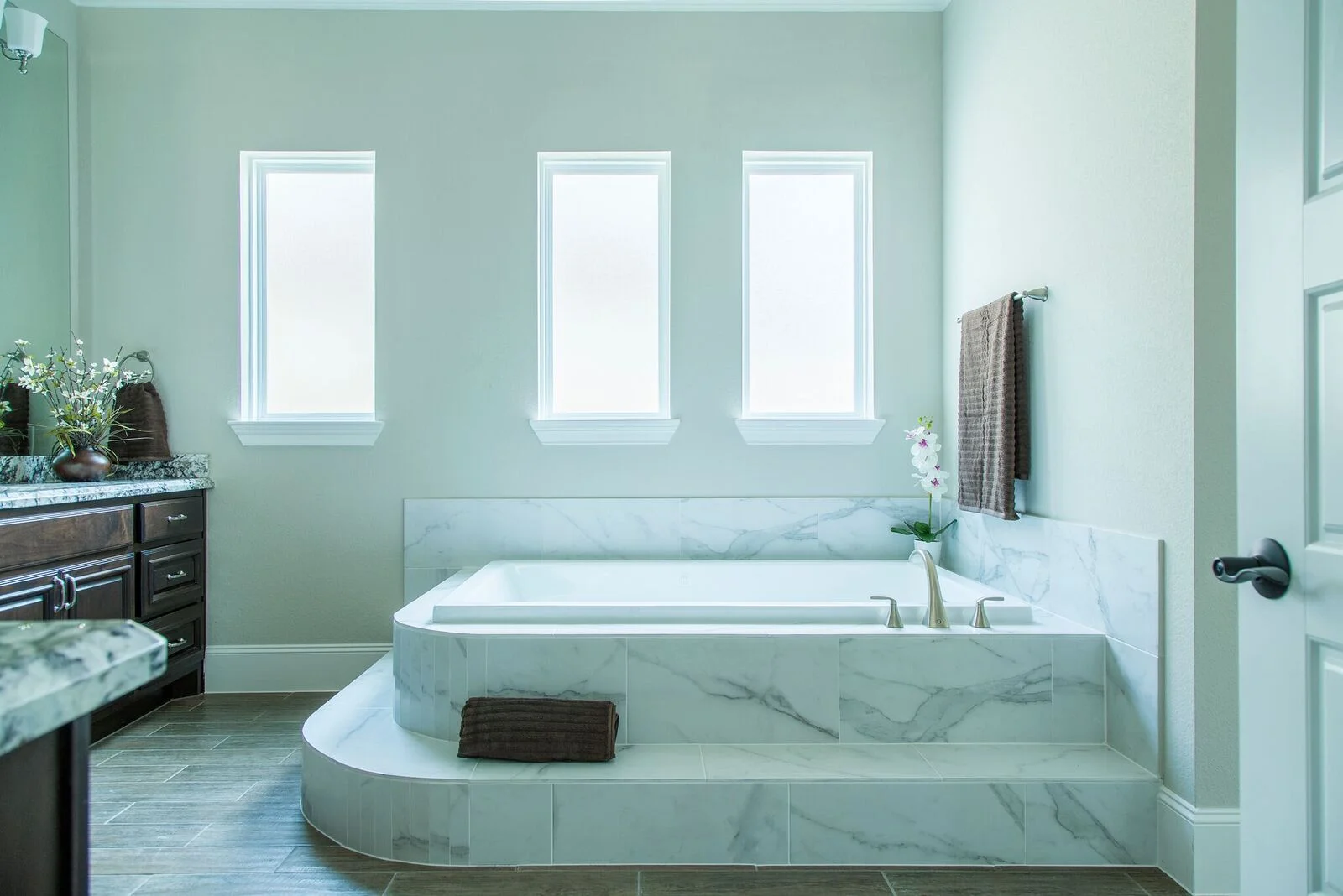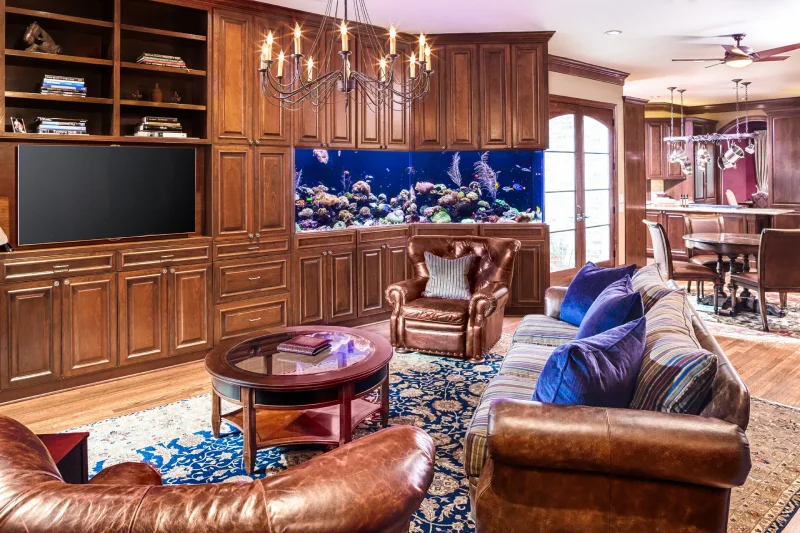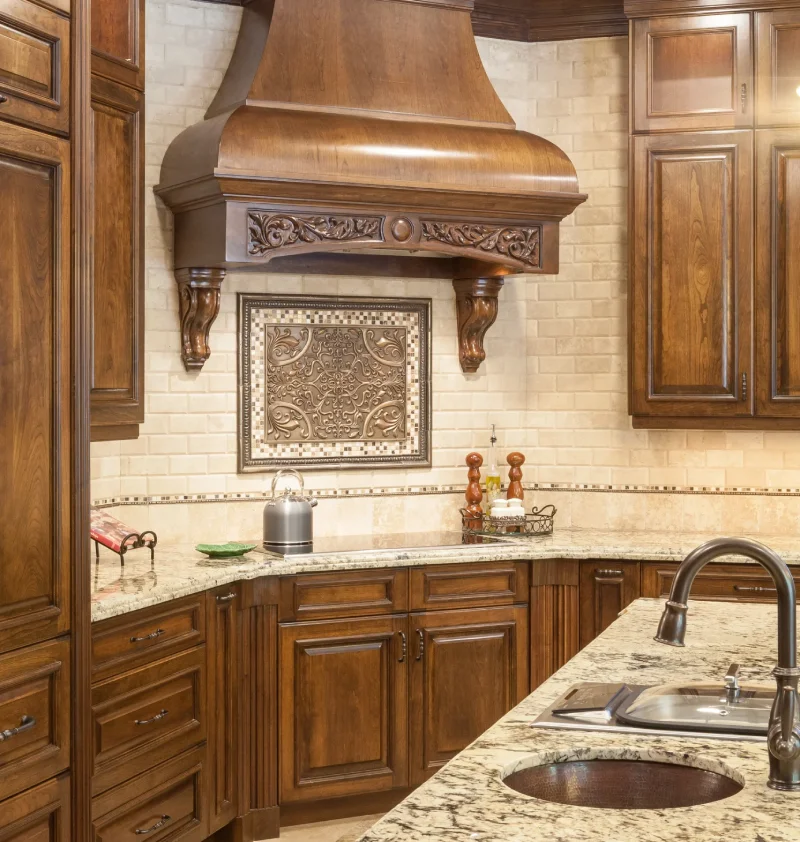
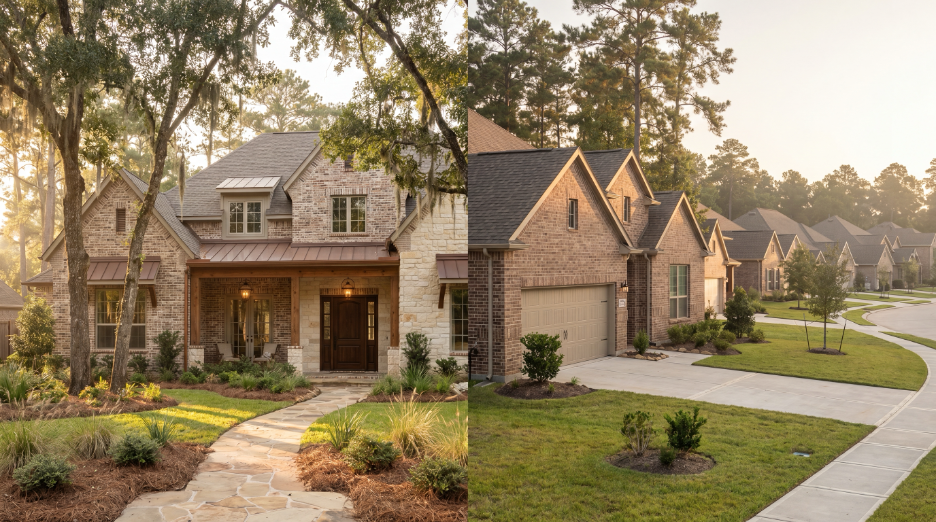
A custom home in The Woodlands is built one-of-a-kind for a single homeowner on their selected lot, with architectural plans drawn from scratch to match lifestyle, site, and Development Standards Committee requirements. A production home is one of many near-identical residences a developer constructs from a pre-designed floor plan library across a single tract. The decision hinges on personalization, timeline, site control, and long-term value rather than price alone.
Key Takeaways
- Definition matters first. A custom home is engineered specifically for one buyer and one site; a production home is one repeated execution of a developer's existing plan inventory across many lots.
- The Woodlands' DSC changes the math. The Development Standards Committee enforces architectural review on every new build, which custom home builders navigate routinely but production builders accommodate through master entitlement pre-clearance.
- Cost framing is not cost reality. Production homes appear lower at sticker price, but custom homes capture greater long-term resale value and avoid the change-order premiums that arise when production plans are heavily modified.
- Timeline differences are real but predictable. A custom home in The Woodlands typically runs 12 to 18 months from contract to keys; a production home runs 6 to 10 months from breaking ground.
- Site and soil drive the decision more than buyers expect. Montgomery County's expansive clay soils and waterway setbacks reward site-specific engineering — a structural discipline custom home builders embed into every plan.
- The buyer profile determines the right answer. Production homes serve buyers needing a known timeline with limited customization; custom homes serve buyers who treat their residence as a 20-year design investment.
What Is the Difference Between a Custom Home and a Production Home in The Woodlands?
A custom home is a residence designed and constructed for one specific homeowner on a specific lot, with architectural plans originated from a blank page rather than adapted from a library. Every elevation, floor plan, and finish flows from the homeowner's brief and the site's constraints. The home does not exist before the homeowner commissions it.
A production home is one of many homes built from a developer's pre-designed floor plan inventory. The developer purchases large tracts of land, secures master entitlements, and constructs the same plans repeatedly across many lots with limited buyer modification. Production communities trade design uniqueness for economies of scale on framing, finishes, and labor.
In The Woodlands, this distinction carries unusual weight. The community was master-planned by George P. Mitchell beginning in 1974 under what is now Howard Hughes Corporation stewardship, with architectural character preserved through the Development Standards Committee (DSC). Production builders built thousands of homes across early villages such as Grogan's Mill and Cochran's Crossing, but the remaining buildable inventory in The Woodlands increasingly favors custom or semi-custom delivery on individually-owned lots, particularly in Carlton Woods, Creekside Park, and Sterling Ridge.
For The Woodlands homeowners, the question is less "which type of home is better in the abstract" and more "which delivery model fits my lot, my family, and my horizon for living in this residence?"
How Does a Custom Home Builder Differ From a Production Builder?
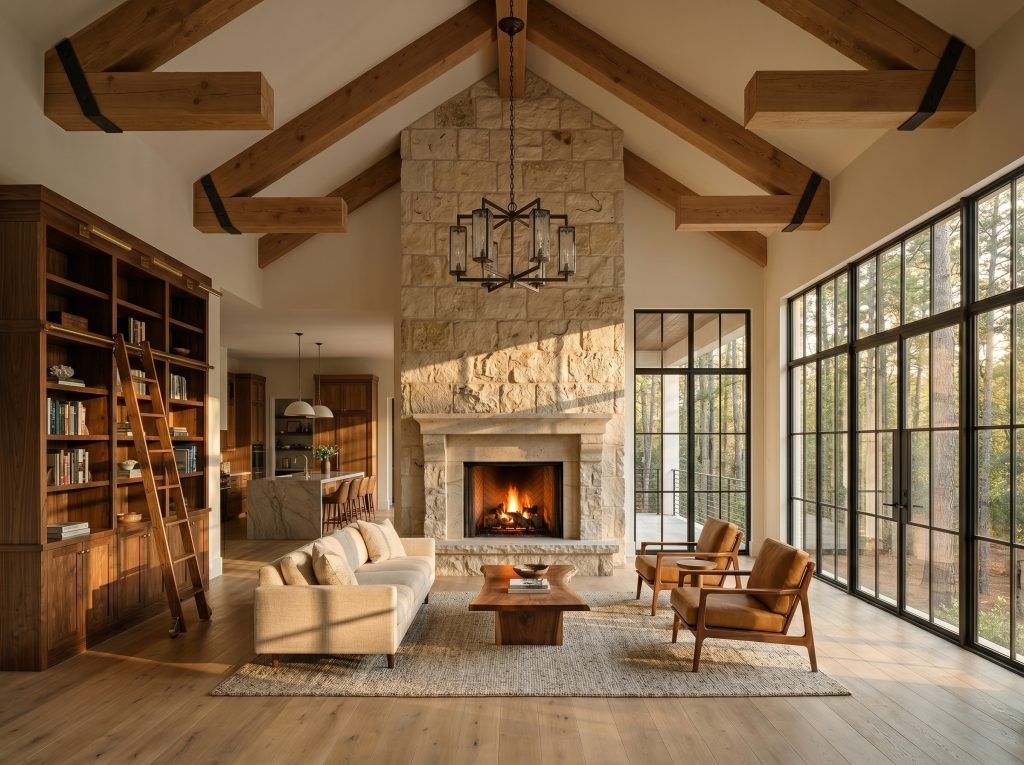
A custom home builder originates each project from the homeowner's brief, manages design through construction under a single contract, and tailors every specification to the buyer and the lot. A production builder operates a repeatable plan library, sells pre-engineered homes from model centers, and limits modifications to pre-priced option packages.
The differences extend through five operational dimensions:
- Design origination. Custom home builders commission architectural plans drawn for one homeowner. Production builders use plans designed once and replicated many times.
- Site engagement. Custom home builders evaluate the lot's soil, drainage, setbacks, and DSC restrictions before design begins. Production builders deliver identical plans across lots.
- Material specification. Custom home builders write finish schedules from a wide universe of materials — Texas limestone, hand-laid brick, custom millwork, specified plumbing brands. Production builders offer structured option tiers from supplier programs designed for volume buyers.
- Contract structure. Custom home builders typically sign a fixed-price or cost-plus contract with weekly owner meetings and a single point of accountability. Production builders use standardized purchase contracts with selection deadlines and a sales counselor.
- Post-construction relationship. Custom home builders commonly provide multi-year warranty service as the buyer's direct contact. Production builders usually transfer warranty service to a regional department after closing.
How Much Does a Custom Home Cost in The Woodlands Compared to a Production Home?
A custom home in The Woodlands typically runs $300 to $600 per square foot, with luxury executions in Carlton Woods and Creekside Park reaching $700 to $900 per square foot once high-end millwork, smart-home systems, and custom architectural detail are specified. A production home in the remaining production pockets of The Woodlands prices closer to $180 to $260 per square foot at base, with upgrades pushing finished pricing to $250 to $320 per square foot.
Sticker comparison favors production. Long-term value calculation often does not. Three cost dynamics shape the actual ownership picture for The Woodlands homeowners:
- Change-order pressure on production homes. Production builders price aggressively at base, then capture margin through structured design-studio upgrades. Buyers who arrive expecting to "lightly customize" a production home routinely add $80,000 to $250,000 in selections — and the upgrades cannot reach genuinely custom architectural detail because the underlying plan is fixed.
- Lot cost separation. A custom home assumes the buyer owns or will purchase a lot independently. Carlton Woods estate lots transact between $400,000 and $1.2 million, Creekside Park lots between $180,000 and $450,000, and Sterling Ridge re-developable lots between $250,000 and $500,000. Production homes typically bundle lot and home into one price.
- Long-term resale dynamics. Custom homes in The Woodlands' established villages have historically appreciated at a premium to comparable production homes, reflecting individualized architectural character and the scarcity of new construction in DSC-controlled inventory.
How Long Does a Custom Home Take to Build vs. a Production Home?
A custom home in The Woodlands typically takes 12 to 18 months from signed construction contract to certificate of occupancy. A production home, when available, runs 6 to 10 months from foundation pour to keys.
The custom home timeline includes phases that production builds compress or skip entirely:
- Pre-design discovery (4-8 weeks). Site analysis, soil borings, programming interviews, and lifestyle workshops define the brief.
- Schematic and design development (6-10 weeks). Floor plans evolve through three to five iteration cycles with the homeowner.
- Construction documentation (4-6 weeks). Permit-ready drawings and finish schedules complete the design package.
- DSC submission and approval (4-12 weeks). The Development Standards Committee reviews exterior elevations, materials, color palette, landscape plan, and site fit.
- Montgomery County permitting (2-4 weeks). Structural, mechanical, electrical, and plumbing permits issue in parallel with the DSC track.
- Construction (8-12 months). From foundation through final walkthrough.
A production home compresses this sequence because design is already complete and DSC has pre-approved the developer's plan library at master entitlement. For families with school-year timing or relocation deadlines, production homes offer earlier timeline certainty; for families who treat the home as a 20-year residence, the additional months invested in custom design return decades of fit-to-life livability.
What Does the Design-Build Methodology Mean for Custom Homes in The Woodlands?
Design-build is a project delivery method in which one entity holds responsibility for both architectural design and construction execution under a single contract with the homeowner. The alternative — hiring an architect first and then bidding the completed plans to a builder — creates three predictable failure modes for The Woodlands homeowners: an accountability gap when issues surface, coordination cost across two parallel contracts, and estimate volatility when plans bid 20 to 40 percent above expectation.
Design-build resolves all three by placing decision authority and financial accountability in one firm. Keechi Creek Builders operates as a design-build firm with in-house AutoCAD and 3D rendering capability, allowing The Woodlands homeowners to walk through a virtual model before construction begins and confirm every elevation against DSC standards during design rather than discovering conflicts after submission.
What DSC Requirements Affect Custom and Production Homes Differently?
The Development Standards Committee (DSC) enforces architectural and environmental standards across every village in The Woodlands, reviewing exterior elevations, materials, color, landscaping, lighting, and site fit before construction permits issue. DSC requirements apply to custom and production homes alike, but operate differently in practice.
For production homes, the developer negotiates master entitlement with DSC at the community level, securing pre-approval for an entire floor plan library and elevation set. Individual home buyers inherit the DSC clearance the developer secured.
For custom homes, every project receives individual DSC review. Architectural plans, material samples, color palette, exterior lighting, driveway and walkway material, and landscape plan all submit as a complete package. Custom home builders with established DSC experience submit complete packages on the first attempt; builders without that institutional knowledge frequently endure two or three revision cycles, each adding 4 to 8 weeks to the project timeline.
How Do Custom and Production Homes Compare on Lot Selection and Site Fit?
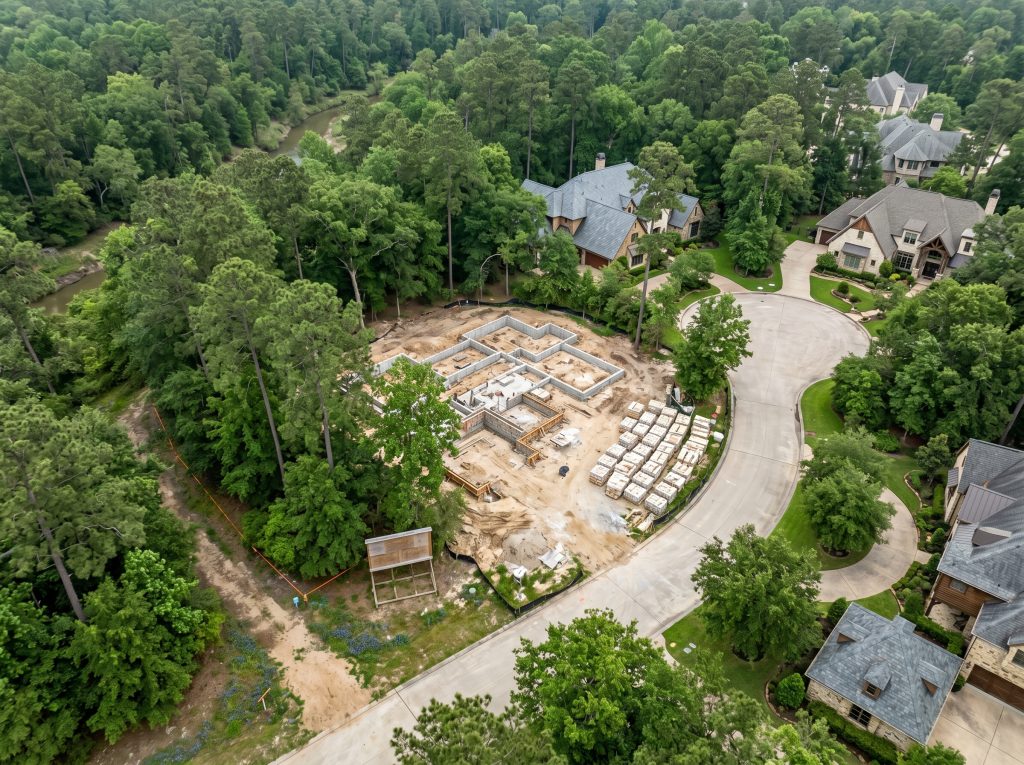
A custom home is designed around a specific lot's soil, slope, drainage, tree canopy, and exposure. A production home delivers a standard plan to a developer-prepared pad, with the lot graded to accept the plan rather than the plan engineered to fit the lot.
The Woodlands' geography rewards site-specific design. The community sits across a mix of upland pine forest, hardwood bottomland, and Spring Creek floodplain. Soil composition varies meaningfully between villages — and even between adjacent lots. Custom home builders address these conditions through geotechnical analysis before design begins: foundation engineering follows the soil report, site grading preserves protected trees per The Woodlands' canopy mandate, drainage routes around wetland setbacks, and driveway alignments respect mature root systems.
For lots in Creekside Park near Spring Creek, in Sterling Ridge with significant grade variation, or in Carlton Woods with extensive specimen trees, site-specific custom design materially outperforms standard production execution.
What Buyer Profile Is Right for Custom vs. Production in The Woodlands?
The right answer depends on time horizon, design specificity, site complexity, and warranty expectation. Custom home is the right answer when the buyer plans to occupy for 10+ years, has specific architectural requirements not represented in production plan libraries, the lot warrants site-specific engineering, or the buyer values weekly owner-builder collaboration. Production home is the right answer when the buyer needs to occupy by a known date with limited tolerance for variability, preferences align well with available plan libraries, lot conditions are standard, and the buyer values speed-to-occupancy over individualized identity.
A third path — semi-custom — exists in the gray zone: semi-custom builders begin from a plan library but accept meaningful modifications to floor plan, elevation, and finish. For The Woodlands homeowners, custom home builder Keechi Creek Builders navigates these distinctions during the discovery consultation.
How Does Quality of Construction Differ Between Custom and Production Homes?
Custom home construction typically specifies higher-grade structural materials, finer millwork, and more durable mechanical systems than production-grade equivalents:
- Framing. Custom homes commonly use engineered lumber and larger headers than code minimum; production homes meet code with standard dimensional lumber.
- Foundation. Custom homes receive site-specific engineering (drilled piers, post-tensioned slabs, hybrid systems) calibrated to soil conditions.
- HVAC. Custom homes commonly install zoned multi-stage systems with right-sized ductwork; production homes install single-zone systems from generalized loads.
- Plumbing. Custom homes specify mid-tier or premium brands (Kohler, Brizo, House of Rohl); production homes specify builder-grade tiers.
- Millwork. Custom homes feature site-built or shop-fabricated millwork in solid hardwood; production homes feature prefabricated cabinetry in MDF.
- Roofing. Custom homes commonly specify 50-year architectural shingles or standing-seam metal; production homes use 25-year three-tab.
These differentials translate to longer service life and stronger resale positioning over a 20-year horizon. For The Woodlands homeowners weighing a kitchen remodeling project on an existing residence, similar credential, contract, and warranty questions apply.
Custom Home vs. Production Home Comparison Table
| Dimension | Custom Home | Production Home |
| Design origination | From homeowner brief | From plan library |
| Lot engagement | Site-specific engineering | Standard pad delivery |
| DSC submission | Individual review | Master entitlement umbrella |
| Timeline (contract to keys) | 12-18 months | 6-10 months |
| Per-sqft price range (Woodlands) | $300-$900 | $180-$320 |
| Customization scope | Unlimited within site/DSC | Pre-priced option tiers |
| Contract type | Fixed-price or cost-plus | Standardized purchase agreement |
| Warranty provider | Builder, multi-year | Regional warranty department |
| Resale positioning | Architectural uniqueness | Comparable to neighbors |
| Best-fit horizon | 10+ year ownership | 5-10 year ownership |
Frequently Asked Questions
Is a custom home always more expensive than a production home in The Woodlands?
Sticker price favors production homes, but total cost of ownership over a 10 to 20 year horizon often favors custom homes when lot quality, finish durability, and resale positioning are included. A custom home in The Woodlands averages $300 to $600 per square foot; production homes average $180 to $260 per square foot at base. The premium compresses meaningfully once production buyers add typical upgrades.
Can a production home in The Woodlands be customized to feel custom?
Production builders allow structured upgrades — flooring tier, cabinet finish, brick palette, kitchen island layout from a small menu — but cannot alter the underlying floor plan, structural system, or core elevation. Buyers who attempt deep modification of a production plan commonly spend custom-home money for production-grade results because the underlying plan limits how far the finishes can elevate the home.
How does the Development Standards Committee affect my timeline for a custom home?
DSC review on a custom home in The Woodlands typically runs 4 to 12 weeks from submission to approval. Builders with established DSC track records, including Keechi Creek Builders, submit complete packages on the first cycle; builders without that institutional knowledge often endure two to three revision cycles, each adding 4 to 8 weeks. DSC approval runs in parallel with construction documentation, so well-managed projects experience minimal net timeline impact.
Do custom homes hold their value better than production homes in The Woodlands?
Custom homes in The Woodlands' established villages have historically resold at a premium per square foot relative to comparable production homes, reflecting individualized architectural character, higher-grade finishes, and the scarcity of new construction inventory in DSC-controlled villages. The premium is most pronounced in Carlton Woods, Creekside Park, and Sterling Ridge.
What is a semi-custom home, and is it the right middle ground?
A semi-custom home begins from a builder's plan library but accepts meaningful modifications to floor plan, elevation, and finish that production builders do not permit. Semi-custom delivery suits buyers who want more design influence than production allows but less complexity than full custom requires. Semi-custom timelines run 9 to 14 months — between production and custom — and pricing per square foot typically lands at $250 to $400.
How long has Keechi Creek Builders built custom homes in The Woodlands?
Keechi Creek Builders was founded in 2007 by Brandon Lynch, a Texas A&M Construction Science graduate holding the Graduate Master Builder (GMB), Certified Green Professional (CGP), and Certified Aging-in-Place Specialist (CAPS) credentials. The firm has earned 32 industry awards including GHBA Custom Builder of the Year and maintains a BBB A+ rating since 2011. Having navigated Montgomery County permitting and The Woodlands DSC for 17+ years, the firm operates as a fully integrated design-build practice.
Should I buy a production home if I already own a lot in The Woodlands?
Owning a lot fundamentally shifts the calculus toward custom delivery. Production builders generally require buyers to purchase a lot within their own community inventory rather than building on a buyer-owned lot. Custom home builders, by contrast, design specifically to the lot the homeowner owns — engineering the foundation, siting the home for tree preservation and DSC conformance, and aligning the floor plan with the lot's exposure and grade.
Working With Keechi Creek Builders on Your Custom Home
For The Woodlands homeowners weighing custom against production, the path forward starts with a discovery consultation that evaluates lot, lifestyle, timeline, and budget against both delivery models. Keechi Creek Builders, a design-build custom home firm operating across The Woodlands since 2007, brings 17+ years of DSC navigation, a multi-discipline in-house team, and a 32-award track record to that conversation. The firm holds membership in the National Association of Home Builders (NAHB), Texas Association of Builders, Greater Houston Builders Association, and National Kitchen and Bath Association. Brandon Lynch holds the Graduate Master Builder credential — a distinction fewer than 500 active builders nationwide maintain.
From DSC approval through final walkthrough, the firm integrates design, engineering, and construction under a single contract. The Woodlands residents in Carlton Woods, Creekside Park, Sterling Ridge, Grogan's Mill, and across all 9 villages can schedule a discovery consultation to begin the custom home vs. production home conversation grounded in their specific site and lifestyle goals.