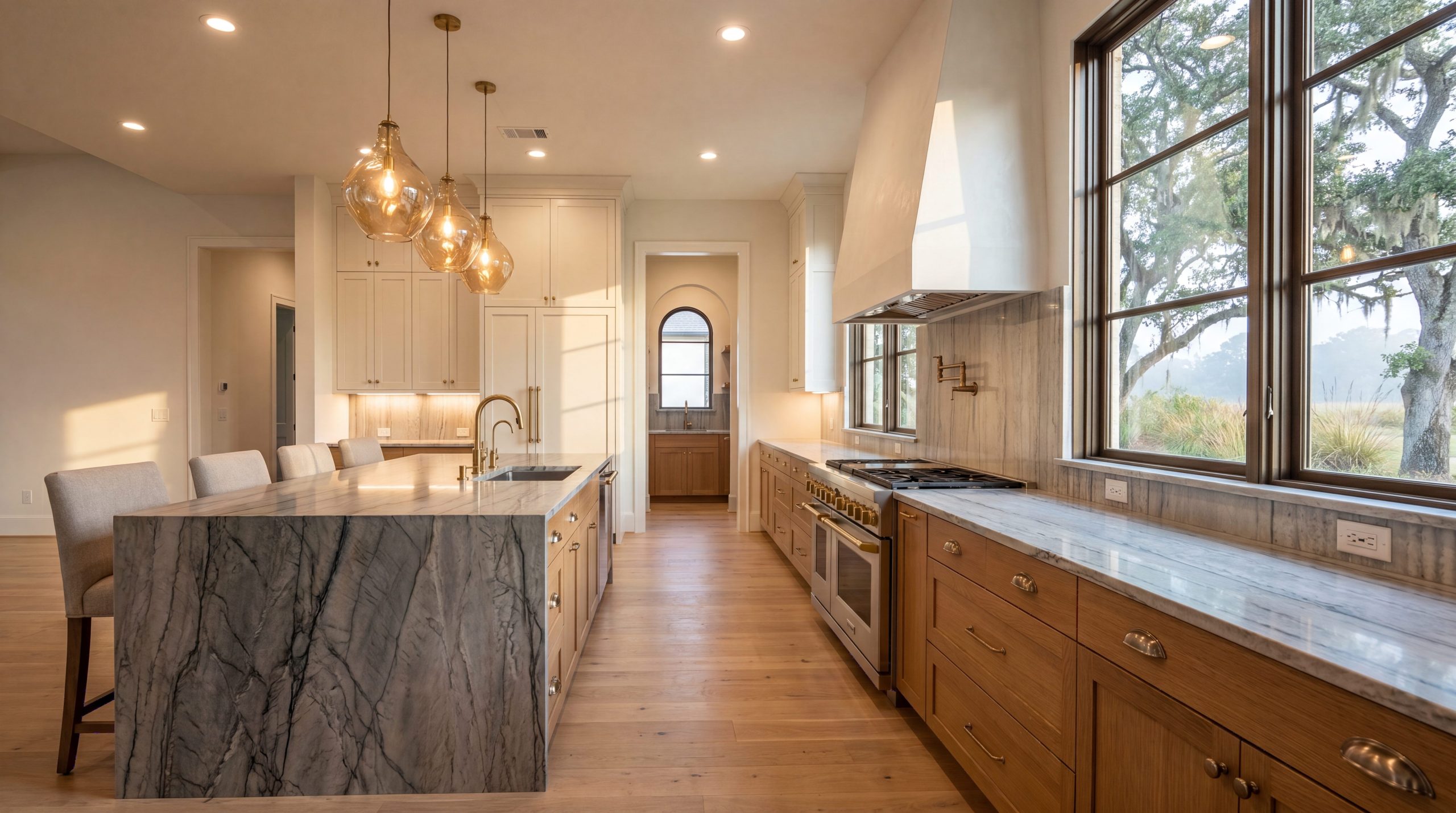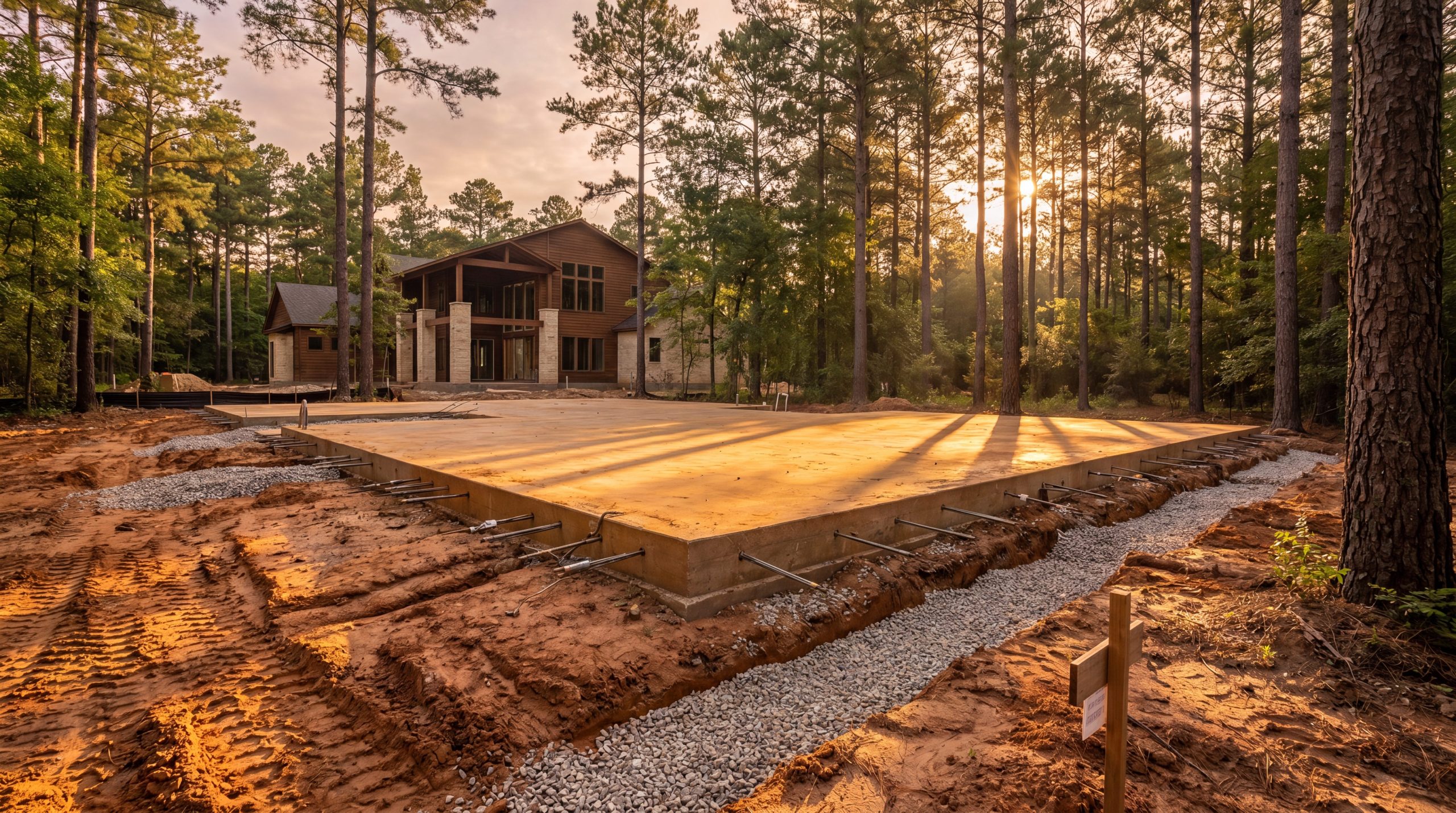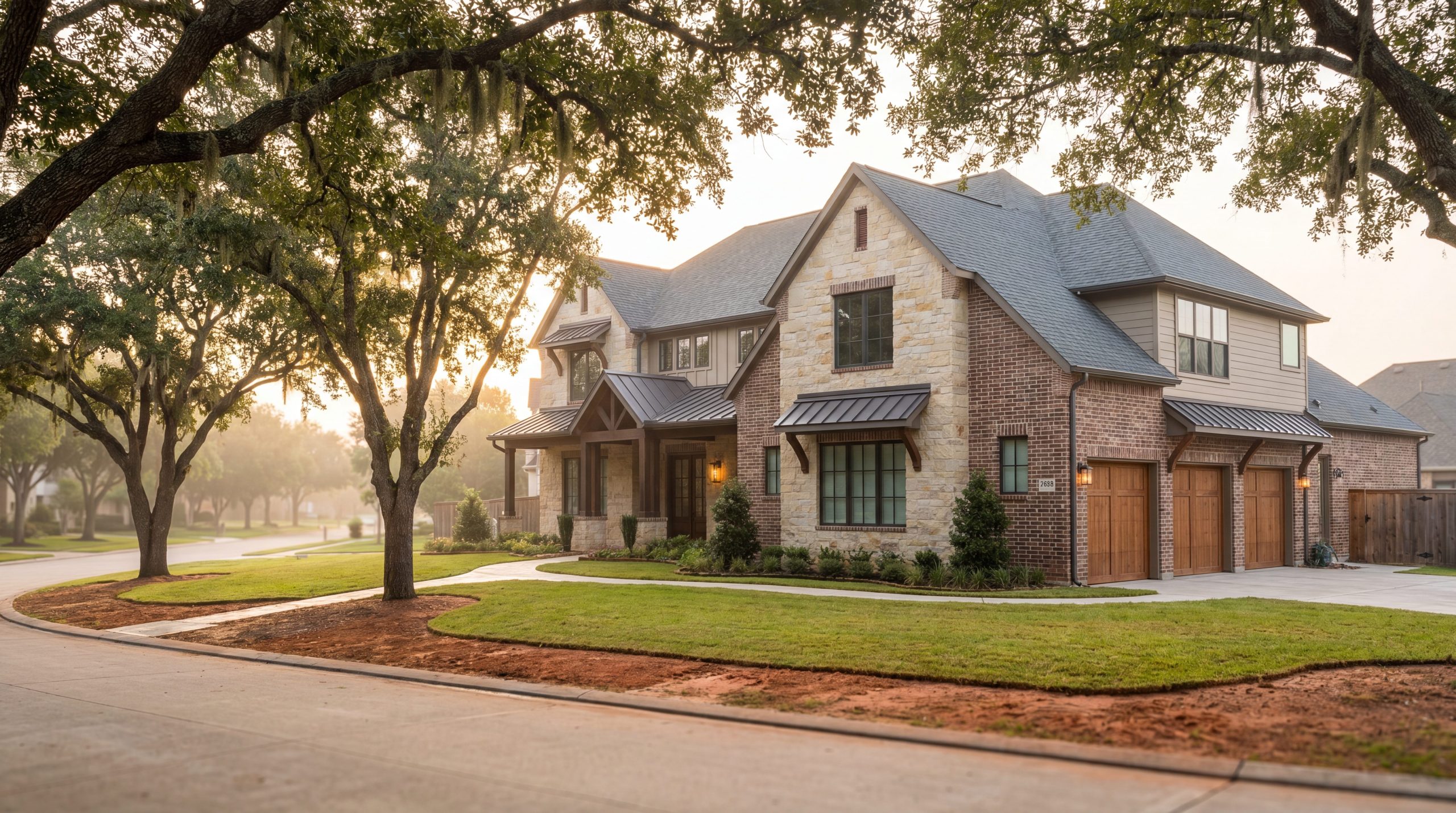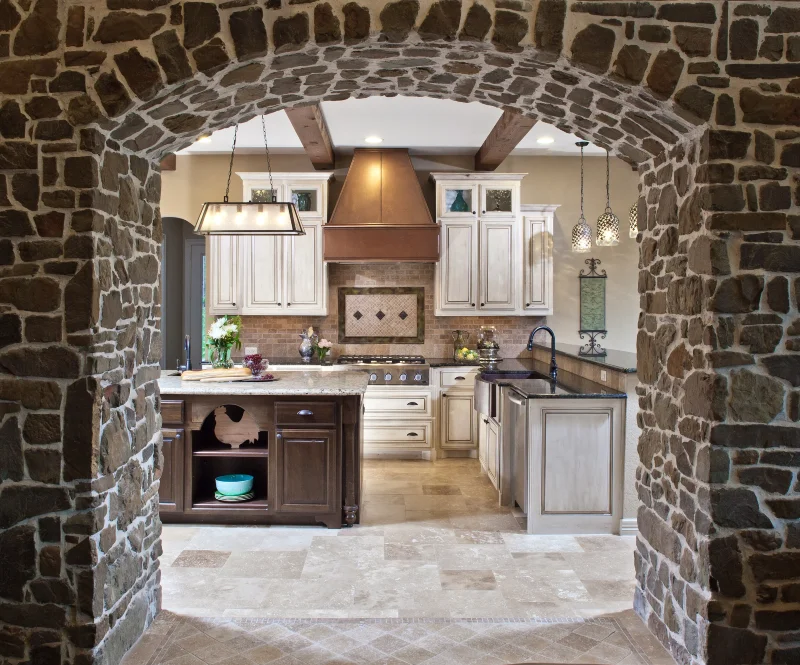
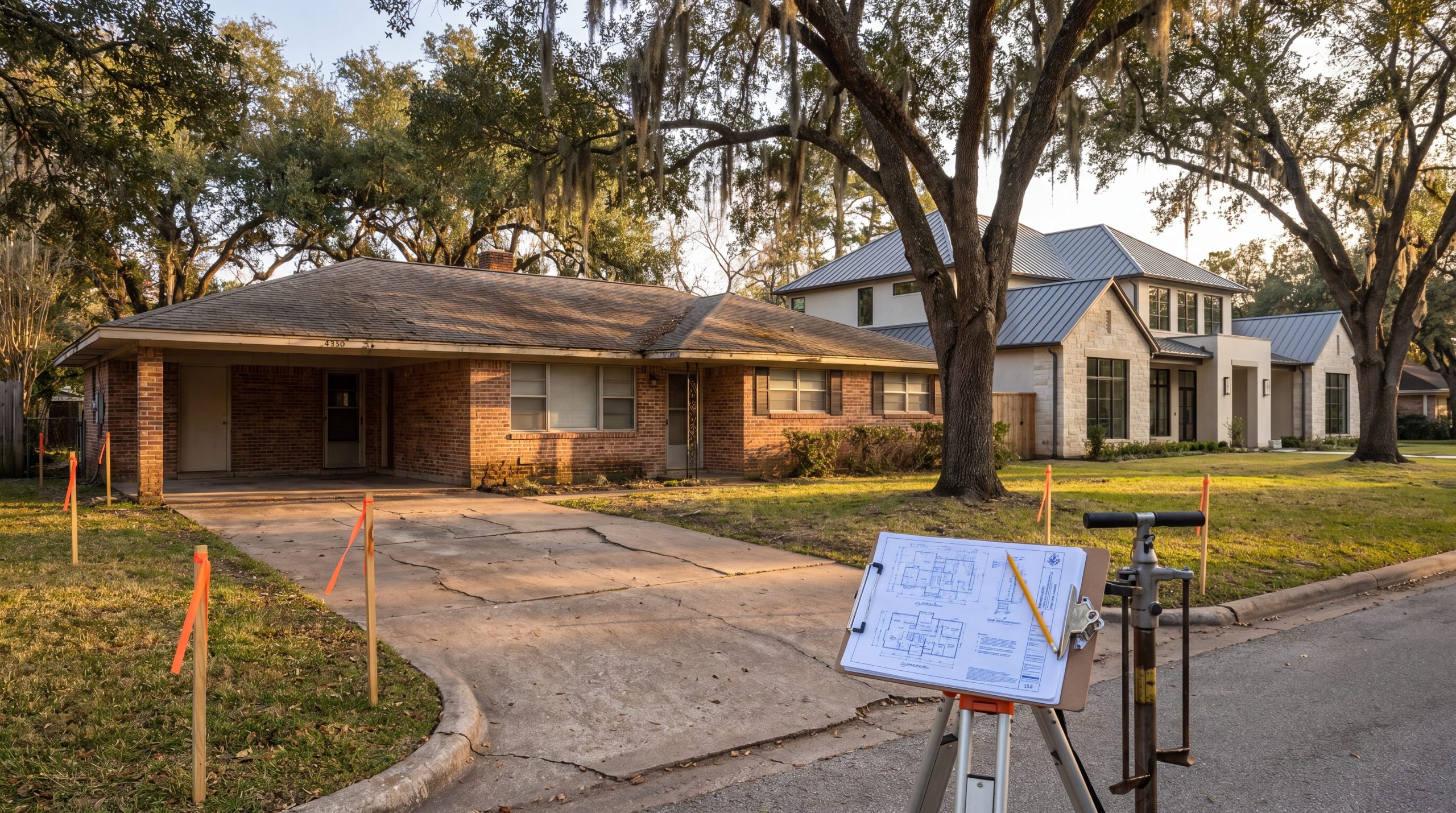
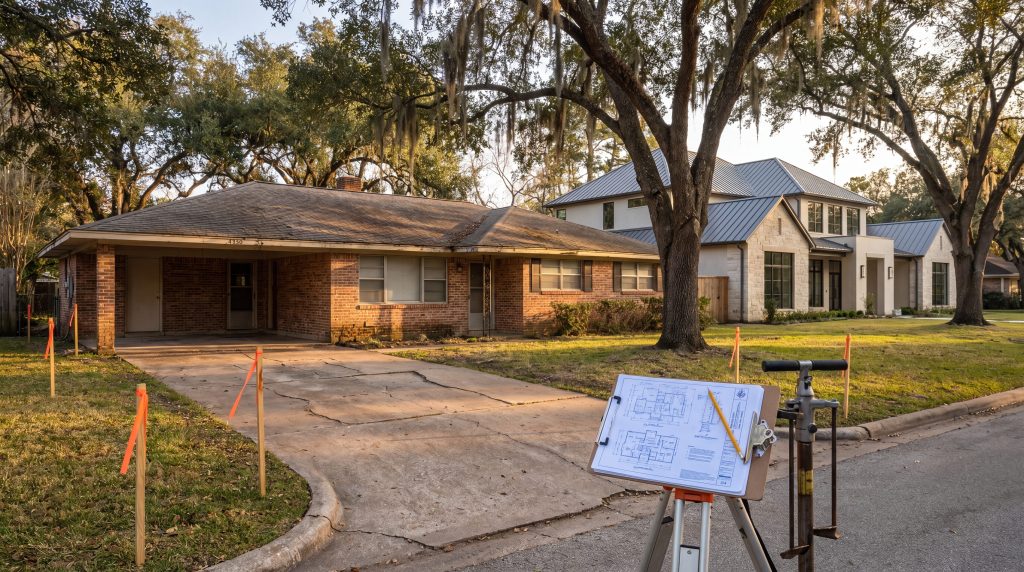
The teardown-vs-renovate decision in Memorial Houston comes down to four numbers — current lot value, current improvement value, true scope of needed repairs, and target finished-home value — measured against the structural condition of your 1950s or 1960s ranch. When the lot is worth more than the existing improvements and the home needs structural, mechanical, and envelope work simultaneously, a teardown rebuild usually produces better long-term value. When the structure is sound and you love the floor plan bones, a major renovation can win on cost and on speed to occupy. Keechi Creek Builders runs a paid engineering assessment first so the decision is grounded in data, not guesswork.
Key Takeaways
- Lot value drives the math: In Hunters Creek Village, Bunker Hill Village, and Piney Point Village, lot values commonly run $1.2M–$2.5M+ on a quarter to half acre — when the lot is worth more than the improvement, the teardown calculus shifts.
- Structural condition is the tiebreaker: Foundation movement, original electrical service, galvanized supply, ductwork accessibility, and roof framing each get a pass-or-fail grade before renovation is viable.
- 1950s–1960s ranch is the housing stock: Most Memorial Villages homes were built between 1955 and 1975, which sets the baseline for the systems an honest assessment has to evaluate.
- Each village has its own ARB: Demolition and new construction permits flow through the city-of-village Architectural Review Board plus Harris County — process and timeline differ by village.
- A paid engineering assessment is the right first step: A $3K–$8K Texas-licensed structural and mechanical assessment turns a guess into a documented decision.
- Cost frames are honest: A KCB-tier Memorial custom home runs $2.2M–$3.8M+ all-in; a major Memorial renovation that touches structural, MEP, and envelope work usually lands $400K–$1.5M.
- HCAD is the source of truth: The Harris County Appraisal District separates land value from improvement value on every parcel — that one document anchors the decision.
How Should a Memorial Homeowner Frame the Teardown-vs-Renovate Decision?
The decision is not emotional. It is a four-variable equation: current lot value, current improvement value, true cost of needed repairs, and finished home value at completion. Brandon Lynch, Keechi Creek Builders' founder and a Texas A&M structural engineering alumnus, has framed this conversation for Memorial homeowners for 17+ years — every honest answer starts with a Harris County Appraisal District record and ends with a paid structural assessment.
For Memorial Villages homeowners, the lot is rarely the variable in question. Lots in Hunters Creek Village, Bunker Hill Village, and Piney Point Village commonly run $1.2M–$2.5M+ on a quarter to half acre because the school zoning, mature live oaks, deep setbacks, and proximity to Memorial Park are non-reproducible. What changes between properties is the improvement value and the condition of what is actually on the lot. A 1962 ranch that has been continuously maintained and lightly updated is a different decision from a 1958 ranch that has been deferred for three decades.
The four-variable frame avoids the two most common errors. The first is over-loving the existing floor plan and committing to a renovation that ends up costing 80% of new construction without the structural and energy-efficiency benefits. The second is over-romanticizing a teardown when the existing structure is genuinely sound and the lot economics do not justify rebuild, leaving the homeowner with an 18-month construction process when 9 months of focused renovation would have served them.
What Is the 30% Rule and Does It Apply to Memorial Villages?
The 30% rule says you should not invest more than 30% of your finished home value in a single renovation project. It is a useful guard rail for tract-housing markets — but for Memorial Villages, the rule needs translation. The finished value of a renovated Memorial home is bounded by neighborhood comps and by the structural realities of a 60-year-old envelope; the finished value of a new-construction Memorial home is bounded by what custom homebuilders can deliver on the lot.
For a Memorial Villages homeowner whose finished home value (lot plus structure) projects to $3.0M–$4.5M after the work is done, 30% lands at $900K–$1.35M of renovation budget. That is a real major-renovation envelope — it covers a primary suite addition, a full kitchen and primary bath rebuild, MEP modernization, envelope insulation upgrade, and selective structural reinforcement. Below that envelope, renovation is usually the right answer. Above it, the math starts to favor teardown — because the same dollars applied to new construction on the same lot produce a longer-lived home with current code, current energy performance, and full design flexibility.
What Structural Assessment Criteria Do Memorial Builders Actually Evaluate?
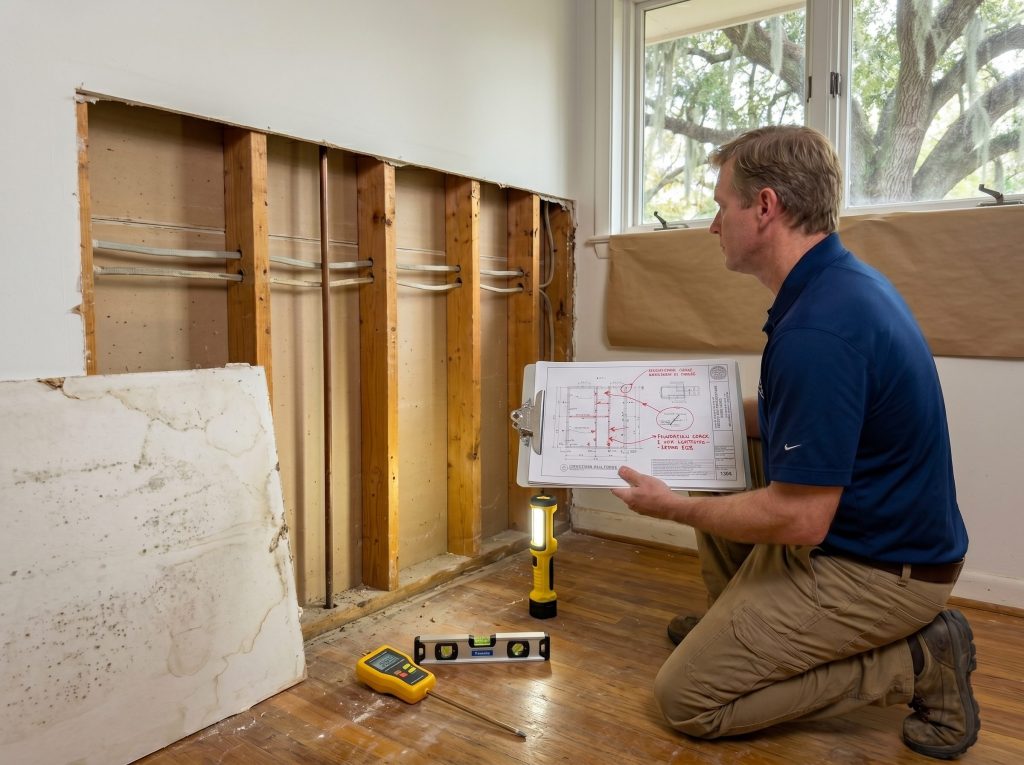
Brandon Lynch's engineering background drives a specific assessment checklist. Every Memorial 1950s–1960s ranch gets evaluated against the same eight criteria before any teardown-vs-renovate decision moves forward:
- Foundation movement: Differential settlement readings, perimeter elevation survey, and crack mapping. Beaumont Clay moves several inches between wet and dry seasons; the original slab usually was not engineered for the loads.
- Framing and load path: Roof framing condition, header sizing at original openings, sagging at midspan, and any prior remodel that altered the load path without engineering.
- Roof structure and envelope: Decking condition, evidence of multiple roof overlays, ventilation, and insulation continuity.
- Electrical service capacity: Original 100A or 150A service is rarely enough for current loads; original Federal Pacific or Zinsco panels are immediate replacements; aluminum branch wiring or original cloth-sheathed runs need full rewire.
- Plumbing supply and waste: Galvanized supply lines are usually mineral-occluded after 60 years; cast-iron drains under the slab may be partially failed; original copper at fixture stubs is the canary.
- HVAC ductwork accessibility: Original gravity ductwork in a slab home is not retrievable; rerouting drives substantial ceiling and soffit work.
- Hazardous materials flags: Asbestos in original duct insulation, vermiculite in attic insulation, lead-based paint on original trim. Memorial's 1950s–1960s housing stock predates the bans.
- Lot grading and drainage: Foundation perimeter slope, French drain presence, downspout tie-ins, and any history of slab moisture exposure.
Each criterion gets a Pass / Watch / Replace grade, and the cumulative grade tells the truth. Three or more "Replace" grades almost always favor teardown — because each one is a major-budget line item, and they compound.
|
Decision Variable |
Renovation Favors |
Teardown Favors |
|
Lot value vs improvement value |
Improvement value > 35% of total |
Improvement value < 25% of total |
|
Foundation condition |
Stable, no differential movement |
Settlement, perimeter movement, multiple cracks |
|
Electrical service |
200A+ panel, copper branch |
Original panel, aluminum or cloth-sheath branch |
|
Plumbing supply |
Recently replaced or accessible |
Original galvanized, slab-buried |
|
HVAC and ductwork |
Accessible attic ducts |
Original gravity, slab-encased |
|
Floor plan fit |
Lives well with reconfiguration |
Cannot achieve target program |
|
Energy performance |
Acceptable after envelope work |
Requires full envelope rebuild |
|
Time to occupy |
6–12 months acceptable |
14–20 months acceptable |
|
Brandon's Builder Insight In 17 years building in Memorial Villages, I have learned that the homeowners who regret renovation are the ones who skipped the structural assessment to save the $5K. The homeowners who regret teardown are the ones who never ran the four-variable equation with their HCAD record open on the table. A few weeks of disciplined engineering work — borings, panel evaluation, drain camera, perimeter survey — turns the biggest residential investment of your life into a decision you can actually defend to yourself five years later. |
How Does Memorial Lot Value Affect the Math?
The Harris County Appraisal District separates every Memorial parcel into Land Value and Improvement Value. That single record is the starting point for the decision. When the HCAD land value is two or three times the improvement value, the lot is the asset and the structure is incidental — which is exactly the condition under which a teardown rebuild produces the largest finished-value lift.
Memorial Villages lots earn the values they do because of irreplaceable inputs: SBISD school zoning, mature live oak canopies that took 80 years to grow, deep setbacks, low through-traffic, and proximity to Memorial Park and Buffalo Bayou. None of those inputs are replicable elsewhere in west Houston at the same price point. That is why the lot rarely depreciates and why builders compete to find redevelopable lots in Hunters Creek Village and Bunker Hill Village.
For a homeowner, the practical question is: if I tear down today, what would a new custom home on this lot appraise for at completion? When the answer is materially above the sum of (current lot value) plus (KCB-tier new construction cost), the teardown is economically rational. When it is not, renovation usually wins.
Do Memorial Villages Allow Teardowns, and How Does Permitting Work?
Memorial Villages operates as six incorporated cities, each with its own Architectural Review Board. Hunters Creek Village ARB, Bunker Hill Village ARB, and Piney Point Village ARB each set their own setback rules, height envelopes, lot coverage maximums, and architectural compatibility standards. Hedwig Village, Hilshire Village, and Spring Valley Village add their own variations. A demolition pathway exists in every village, but the rules and timelines are not identical.
The standard sequence is: HCAD record review, then survey, then geotechnical, then ARB demolition application, then Harris County demolition permit, then utility disconnects, then the demolition itself, then a fresh foundation engineering package, then the new construction permit cycle. From the day Brandon Lynch's team is engaged to the day demolition begins, three to six months is typical depending on the village and the season.
|
Village |
ARB Process Note |
Typical New-Build Envelope |
|
Hunters Creek Village |
Architectural review required for new construction and exterior modifications |
Two-story custom homes common, deep setbacks |
|
Bunker Hill Village |
Strict lot coverage and tree protection rules |
Transitional contemporary common, mature canopy preserved |
|
Piney Point Village |
Detailed architectural compatibility review |
Large estate lots, often 0.5+ acre |
|
Hedwig Village |
Architectural review with focus on lot character |
More variation in lot size, transitional styles common |
|
Hilshire Village |
Smaller-lot review process |
Closer setbacks, careful tree protection |
|
Spring Valley Village |
Compatibility-focused review |
Mixed mid-century and new construction |
What Does the Engineering-First KCB Approach Look Like?
Keechi Creek Builders' engineering-first sequence is the wedge for Memorial decisions. The standard package: a Texas-licensed structural engineer's site visit with the eight-criterion checklist; a geotechnical boring at the lot if a teardown is on the table; a drain camera scope of the existing waste system; an electrical service evaluation; and a thermal envelope assessment with a blower-door test for renovation candidates. Total cost: $3K–$8K depending on scope.
That deliverable becomes the document the homeowner can actually decide against. It says, in writing, what each system would cost to bring to current standards, what the foundation realistically needs, what the lot would carry as new construction, and what HCAD says about the four-variable equation. Brandon Lynch personally reviews the full package before any schematic design begins. Memorial homeowners weighing a parallel kitchen project alongside the teardown decision often pair this assessment with a Memorial kitchen remodeling walkthrough so the design strategy is integrated from day one.
|
Actionable Tip Pull your HCAD record this week at hcad.org and write down two numbers — Land Value and Improvement Value. If the land value is more than twice the improvement value, you are looking at a teardown candidate before you have any other conversation. Bring that record, plus a copy of your original house plans if you have them, to your engineering assessment meeting. |
What Should a Memorial Homeowner Expect for Cost and Timeline?
KCB-tier Memorial custom home construction runs $2.2M–$3.8M+ all-in for a finished, fully engineered home on an existing lot. That envelope reflects current foundation engineering on Beaumont Clay, current envelope and energy code, current MEP systems, and the finish level Memorial Villages buyers and homeowners expect. Timeline from groundbreaking to certificate of occupancy: 13–18 months on a typical Memorial Villages lot.
A major Memorial renovation that touches structural, MEP, and envelope work usually lands $400K–$1.5M depending on scope and house size. Below $400K, the project is closer to a finish-and-mechanical refresh than a true major renovation. Above $1.5M, the math usually says teardown was the rational answer. Renovation timelines: 6–12 months from permits to move-in for a major renovation, 3–6 months for a finish-and-mechanical refresh.
The decision framework holds. Get the HCAD record. Run the engineering assessment. Apply the four-variable equation. Make the decision you can defend five years later — and then build, the right way, with a Memorial Houston custom home builder who has the engineering depth to back the decision.
Frequently Asked Questions
Is it cheaper to renovate or tear down in Memorial?
For most Memorial Villages homes, a finish-and-mechanical renovation is cheaper than teardown rebuild, but a true major renovation that touches structural, MEP, and envelope work usually approaches 60–75% of new construction cost without delivering current-code energy performance or full design flexibility. The cost answer changes depending on the structural condition, the floor plan fit, and the lot value. The right question is not "cheaper today" but "best long-term value for this specific lot and structure."
What does demolition cost in Memorial Villages?
Residential demolition in the Memorial Villages typically runs $25K–$60K for a single-story ranch, depending on size, asbestos remediation needs, and disposal fees. That number includes utility disconnects, the demolition itself, foundation removal, debris haul-off, and site grading. Demolition permits are coordinated through the specific village and Harris County. A geotechnical boring after demolition usually adds $3K–$6K to the line.
Do Memorial Villages allow teardowns?
Yes. Every Memorial Village — Hunters Creek Village, Bunker Hill Village, Piney Point Village, Hedwig Village, Hilshire Village, and Spring Valley Village — allows residential demolition under its own permitting process. The Architectural Review Board in each village reviews the new construction that follows; demolition itself is permitted through the village in coordination with Harris County. The process is well-established because teardown-and-rebuild has been a Memorial reality for two decades.
How long does a Memorial teardown-and-rebuild take?
From the day a builder is engaged to the day the new home receives its certificate of occupancy, 18–24 months is typical for a Memorial Villages teardown-and-rebuild. That breaks down to roughly three to six months for engineering, design, ARB approval, demolition permits, and demolition itself, followed by 13–18 months of construction. Specific timelines vary by village ARB process, lot conditions, and design complexity.
What if a previous owner remodeled — does that change my decision?
It can change the assessment substantially, but rarely in the direction homeowners expect. Previous remodels that were not engineered — wall removals without stamped drawings, panel upgrades without permits, plumbing reroutes without inspection — often introduce hidden problems that surface only when systems are opened up. A previous remodel does not eliminate the need for the eight-criterion structural assessment; in many cases it makes the assessment more important.
How does Memorial lot value affect the math?
Memorial Villages lot values commonly run $1.2M–$2.5M+ on a quarter to half acre because of SBISD zoning, mature live oak canopies, deep setbacks, and proximity to Memorial Park. When the Harris County Appraisal District land value is two or three times the improvement value, the lot is the dominant asset and a teardown rebuild typically produces the largest finished-value lift. When land and improvement are closer to even, renovation often wins.
What is the role of a paid engineering assessment?
A $3K–$8K Texas-licensed engineering assessment evaluates foundation movement, framing and load path, electrical service, plumbing supply and waste, HVAC, hazardous material flags, lot grading, and envelope condition. The deliverable is a written grade for each criterion plus a per-system replacement cost estimate. That document turns the teardown-vs-renovate decision into a numbers-driven conversation rather than a guess. Brandon Lynch personally reviews every Memorial package.
Decide With Engineering, Not Emotion — Talk to a Memorial Builder With the Depth to Back the Decision
The teardown-vs-renovate question is the single biggest financial decision most Memorial homeowners will ever make. Get it right by grounding it in the four-variable equation, the HCAD record, and a paid structural assessment with a Texas-licensed engineer's signature on the deliverable. From village ARB approval through final walkthrough, the engineering-first sequence is what separates a confident decision from a regretted one.
Call (281) 914-4951 to schedule the Memorial engineering assessment conversation with Brandon Lynch directly, or send us a message through the Keechi Creek Builders contact page at https://www.keechicreekbuilderstx.com/contact-us/ — KCB replies within 24 hours and starts every Memorial relationship the same way: with data, not a guess.