By Brandon Lynch, GMB, CAPS, CGP · Published June 15, 2026 · Keechi Creek Builders
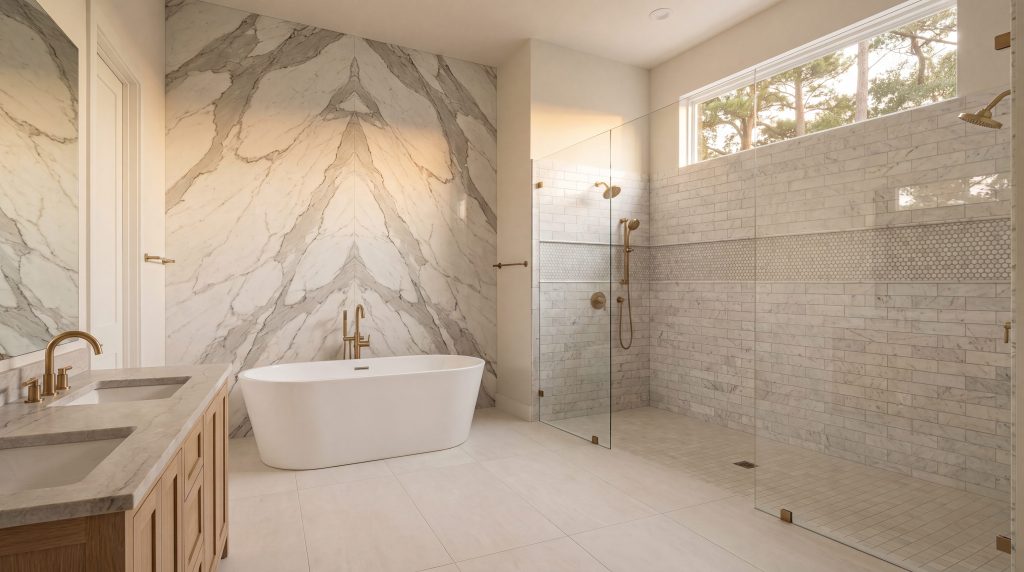
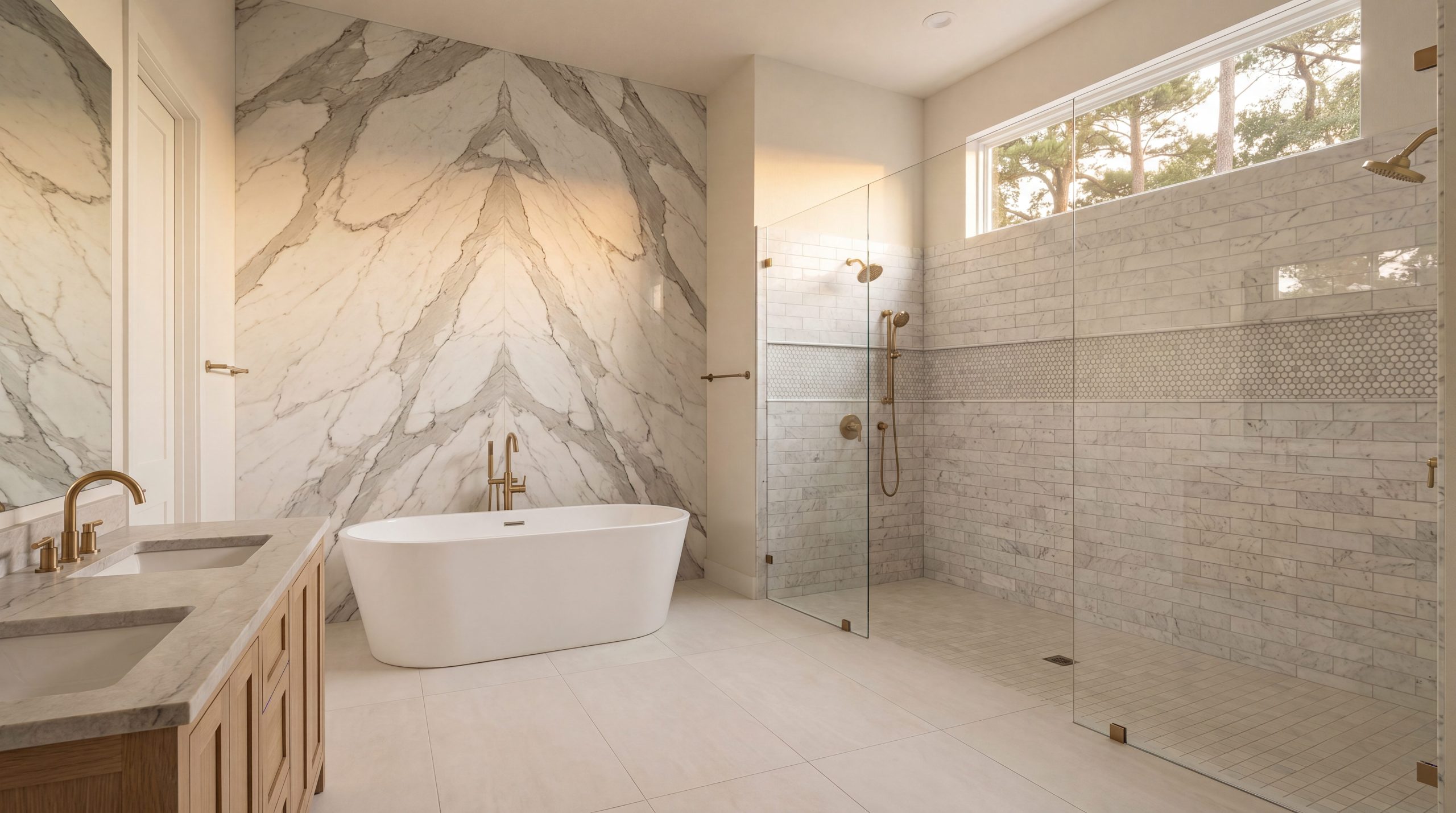
Bathroom tile ideas in a Tomball home are not finish selections — they are engineering decisions dressed in design language. Calacatta marble, large-format porcelain, hand-laid Carrara mosaic, glazed ceramic subway: each material carries a different coefficient of friction, a different absorption rate, and a different relationship with Houston humidity. This guide walks Tomball homeowners through the framework Brandon Lynch, GMB, CAPS, CGP, applies on every Keechi Creek Builders master bathroom renovation in Augusta Pines, Gleannloch Farms, and the surrounding Harris County master-planned communities.
Key Takeaways
- Porcelain tile rated at or below 0.5% water absorption is the default specification for Houston bathroom floors and shower walls — the climate demands it
- Natural stone (Calacatta, Carrara, honed marble, travertine) belongs on accent walls and primary vanity backsplashes where its veining justifies the higher maintenance schedule
- ANSI A137.1 coefficient-of-friction ratings — not aesthetic alone — determine which tile is safe for a curbless walk-in shower floor
- Large-format 24x48 porcelain tile reduces visible grout lines and reads as continuous stone, which is the dominant 2026 luxury tile direction
- The right tile decision is sequenced floor → wall → shower → accent — never the reverse
- Brandon Lynch and Tommy Strong hold dual CAPS certification — relevant when tile selection must accommodate aging-in-place curbless showers and slip-resistant flooring
- Keechi Creek Builders specifies named brands — Daltile (Texas-based), Florida Tile, Stone Source NY, Waterworks — not generic 'premium tile'
Why Bathroom Tile Ideas Become Engineering Decisions in Tomball
Bathroom tile fails in Houston for predictable reasons. The grout absorbs moisture from the post-shower air, mildew colonizes the porous joint, and within eight years the bathroom that earned compliments at handoff looks tired. The tile itself can also fail — natural stone that was beautiful on the showroom slab develops etching from a hard-water stain, polished marble loses its shine in the high-traffic floor zone, and ceramic tile with the wrong absorption rating cracks during a Houston freeze-thaw transition.
These failures are not random. They map directly to four specifications most homeowners never see during the showroom visit: water absorption rating, coefficient of friction, abrasion resistance, and breaking strength. Daltile, Florida Tile, and the other major manufacturers publish these numbers on every product spec sheet. The job of a credentialed remodeler is to translate them into decisions a homeowner can make confidently.
In 19 years of Houston residential construction, Keechi Creek Builders has watched the same five tile mistakes repeat across Tomball homes built between 2005 and 2018. Most originate not in the homeowner's taste but in the contractor's silence on technical performance. This guide is the conversation that should happen before tile is ordered — not after the warranty call.
How Houston Humidity Shapes Tile Performance
Tomball sits at roughly 75% average relative humidity. That is not a number you feel on a March morning. It is a number tile materials feel every day for thirty years. Three climate realities drive the specification:
|
Brandon's Builder Insight In 19 years building across Greater Houston, the tile failures I get called to inspect almost never start at the tile. They start under it. My Texas A&M engineering training taught me to treat the substrate as the real product, so in a humid Tomball bathroom I specify a continuous waterproof membrane and the right movement joints before anyone opens a box of porcelain. Get the assembly right and the tile you chose for its looks will still look that way in twenty years. |
Water absorption rating. The ANSI A137.1 standard divides tile into four categories: non-vitreous (>7% absorption), semi-vitreous (3-7%), vitreous (0.5-3%), and impervious (≤0.5%). For Tomball master bathroom floors and shower walls, impervious porcelain is the default. Glazed ceramic at 3-7% absorption is acceptable on dry-zone walls — a powder room backsplash, the vanity wall — but compromises in the wet zone reach the homeowner as recurring grout staining within a decade.
Thermal cycling. Houston transitions from 35°F overnight to 75°F afternoons during winter cold fronts. Tile installed over a slab without uncoupling membrane absorbs that thermal stress through the grout joint and the tile body. Porcelain absorbs less; natural stone absorbs more; ceramic with poor breaking strength cracks first. A Schluter DITRA or comparable uncoupling underlayment is non-negotiable on Tomball post-tension slab bathroom installations.
Mildew load. Houston's airborne mold spore count is among the highest in the United States. Grout joints provide colonization substrate. Specifying epoxy grout in the shower and a sealed urethane grout on the floor reduces colonization by an order of magnitude relative to standard cement grout. This is a specification decision, not a maintenance decision.
The named brands worth specifying for Houston conditions — Daltile, Florida Tile, Stone Source NY, Waterworks — publish climate-appropriate sub-collections specifically because the southeast US installation environment is different from the desert southwest.
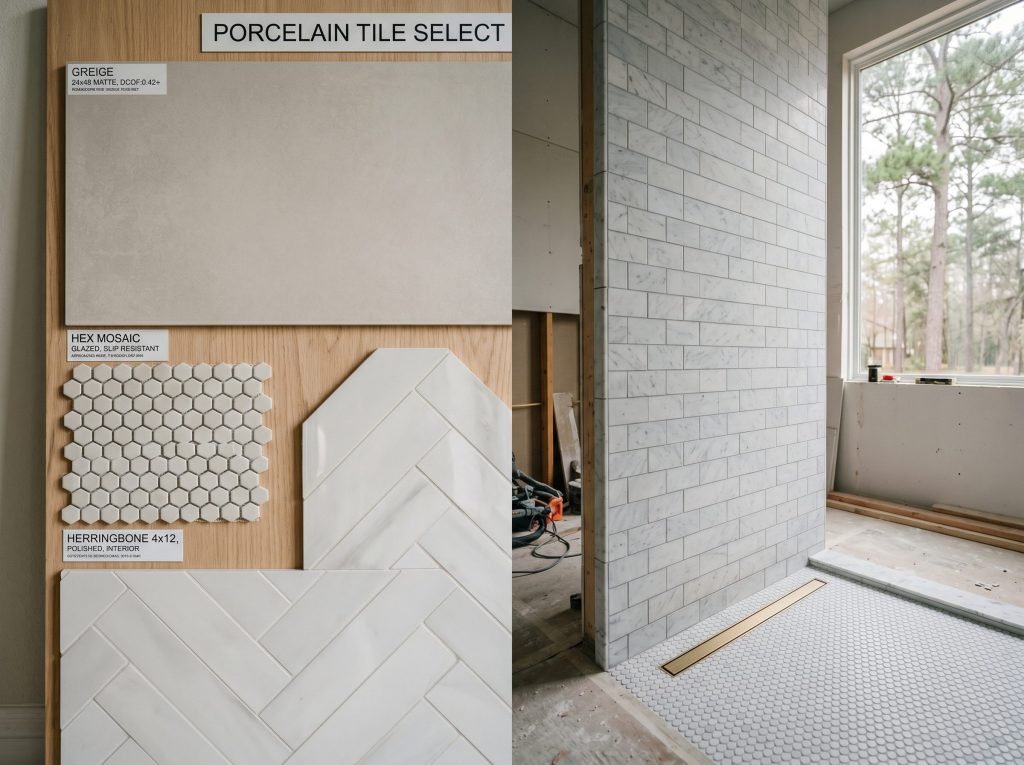
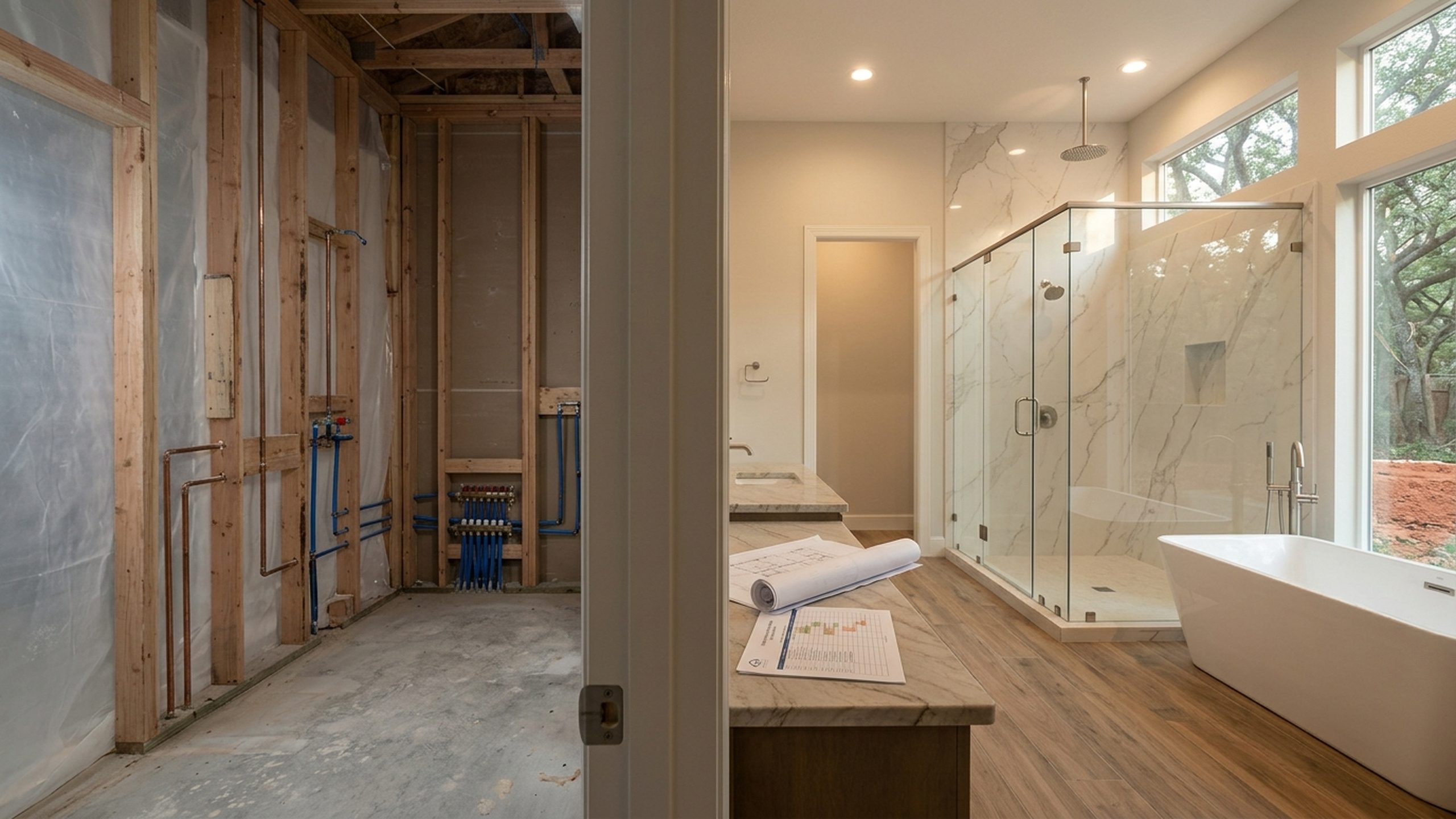
Porcelain tile samples (hexagon, herringbone, large-format) shown alongside installed Carrara mosaic shower floor in a Tomball master bathroom — the decision hierarchy of floor, wall, shower, accent in one frame.
The Four Tile Materials Worth Specifying in a Tomball Master Bathroom
Porcelain Tile — The Default Specification
|
Actionable Tip When you compare bathroom tile samples, ask for each tile's PEI wear rating and its DCOF slip rating, not just the price per square foot. Bring the samples home and wet them, then stand on them with bare feet. The floor that still feels secure when wet is the one that belongs in a Tomball master bathroom. |
Porcelain is the dominant material in modern Houston bathroom renovation, and the reason is structural rather than aesthetic. Porcelain tile is fired at temperatures above 2,200°F, which produces a body with water absorption at or below 0.5%. That single specification eliminates the moisture-driven failure mode that defines most builder-grade Tomball bathroom tile.
Large-format porcelain — 24x24, 24x48, and increasingly 48x48 — has become the architectural backbone of luxury master bathrooms in Augusta Pines and Gleannloch Farms renovations. Continuous grout lines disappear visually, the floor reads as a single slab, and the maintenance burden drops because grout square-footage drops. Daltile's porcelain slab collections and Florida Tile's HDP series are the workhorse specifications for Tomball floor-and-wall continuous installations.
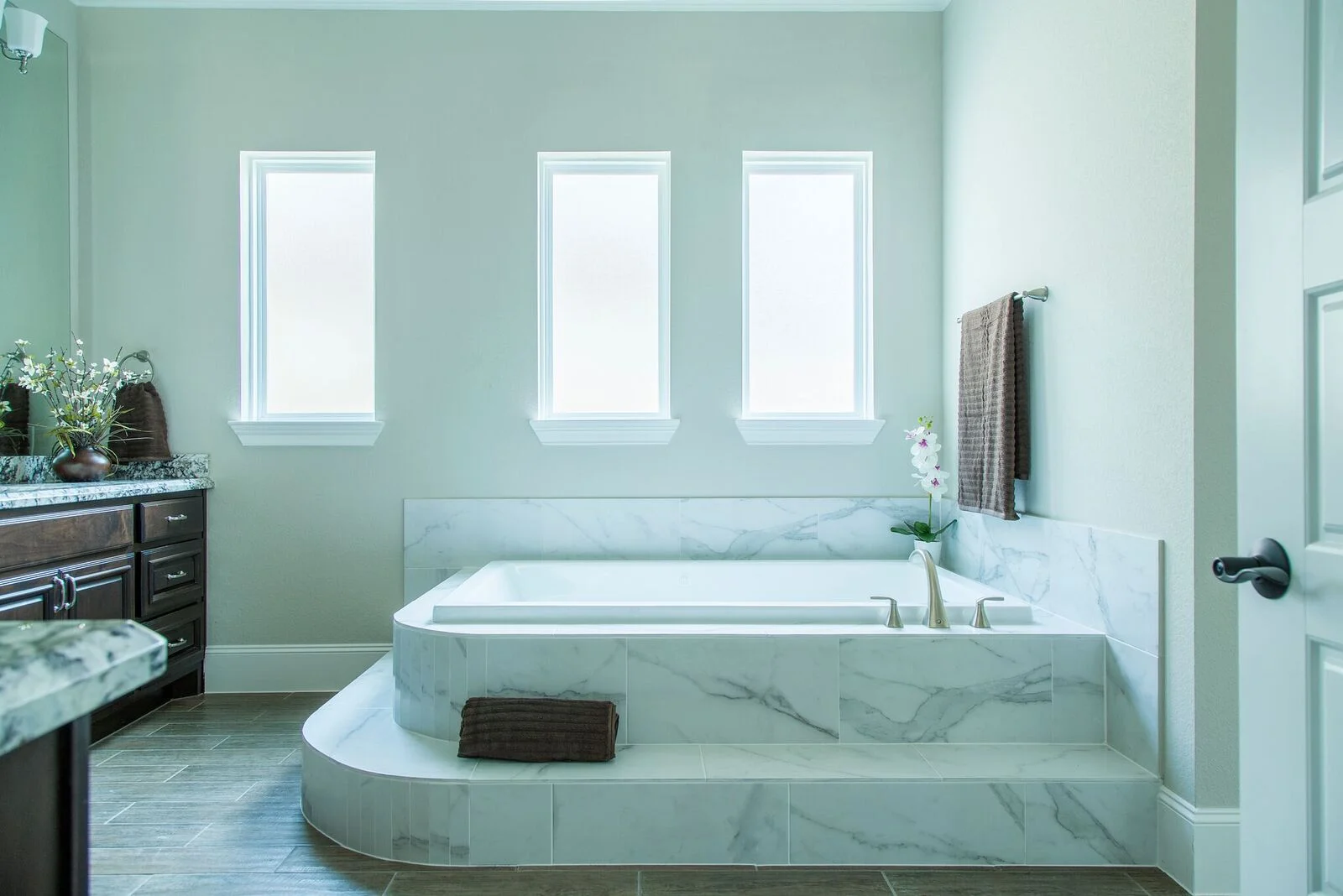
Porcelain also takes on convincing marble-look visual character. A 24x48 polished porcelain tile with a Calacatta print can carry an accent wall at a fraction of the maintenance burden of natural stone — and with a stain-resistance the slab cannot match. For the homeowner who loves Calacatta but renovates with two teenagers in the home, this is often the right answer.
Natural Stone — Calacatta, Carrara, Travertine, Honed Marble
Natural stone is what taste-driven Tomball homeowners reach for first. Carrara marble and Calacatta marble carry visual character no engineered material fully replicates. Stone Source NY and Waterworks specify the stone collections that anchor most luxury Houston master bathrooms in the $80,000-$130,000+ investment tier.
Where natural stone belongs: accent walls behind freestanding tubs, primary vanity backsplashes, shower benches, and statement niches. Where natural stone is overspecified: shower floors, primary bathroom floors in high-traffic homes, and any zone exposed to hard-water staining without a strict sealing schedule.
The maintenance reality must be communicated honestly. Honed marble must be re-sealed every 9-18 months in Houston conditions. Polished marble on a floor will dull in the high-traffic zone within two years. Travertine — beautiful in a powder-room floor — etches under a single dropped perfume bottle in a master bath. The right answer is selective deployment: stone where the eye stops, porcelain where the foot traffic moves.
Ceramic Tile — The Dry-Zone Workhorse
Glazed ceramic at 3-7% water absorption remains the right specification for dry-zone walls — vanity backsplashes, powder-room accent walls, and laundry bathroom feature walls. Hand-laid 3x6 subway tile in white or warm white reads as a timeless choice across both modern farmhouse and transitional Tomball architectural vocabularies, and the cost-per-square-foot is meaningfully lower than porcelain or stone.
The mistake is using glazed ceramic in the shower wet zone. The body absorbs moisture, the glaze can craze under thermal cycling, and the assembly looks tired within a decade. If subway tile is the aesthetic goal, the right specification is porcelain subway with a hand-glazed visual character — Daltile and Florida Tile both produce these collections specifically for the wet-zone application.
Mosaic Tile — Penny Round, Hexagon, and Statement Accents
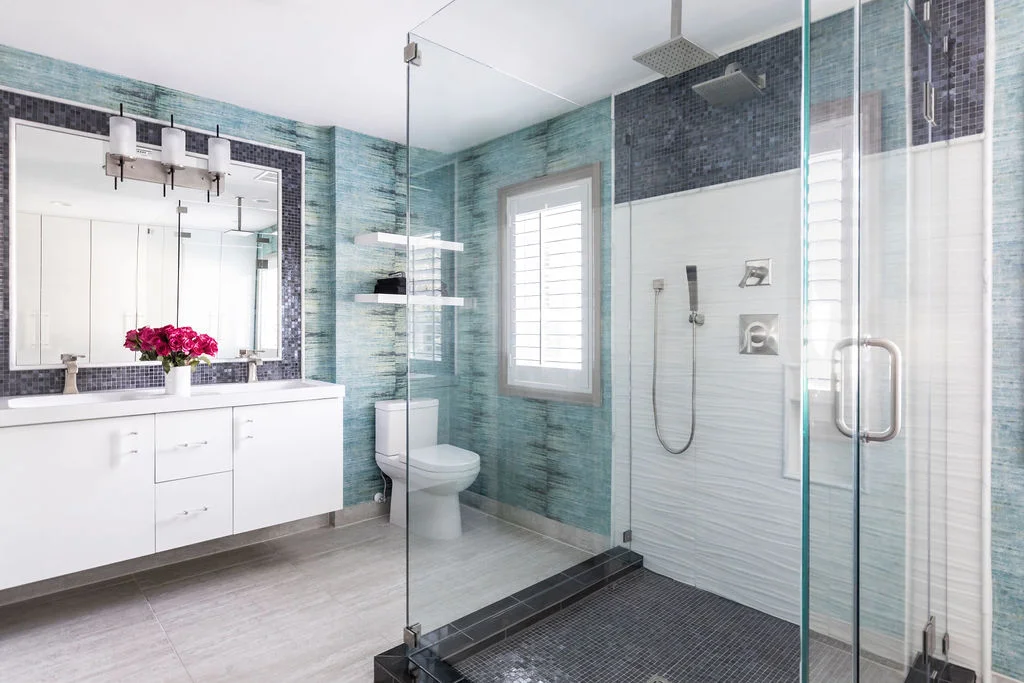
Mosaic tile carries two structural advantages over field tile: the dense grout matrix increases the coefficient of friction, and the small individual pieces conform to curbed and curbless shower-floor slopes that field tile cannot accommodate. For ANSI A137.1-compliant curbless walk-in showers — the universal-design feature that Brandon Lynch's and Tommy Strong's CAPS certifications make routine in Keechi Creek Builders Tomball renovations — penny-round Carrara mosaic on the shower floor is the canonical specification.
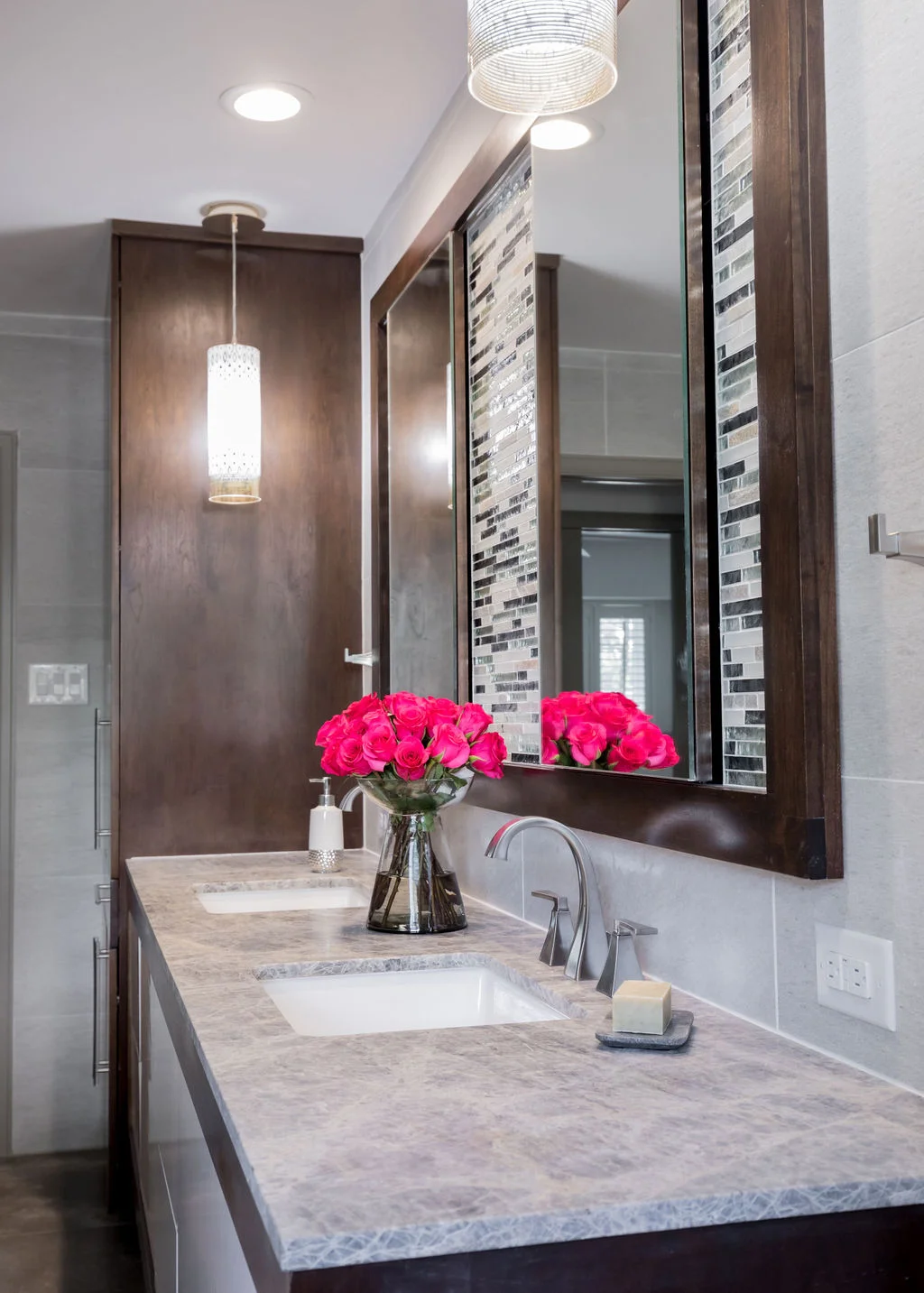
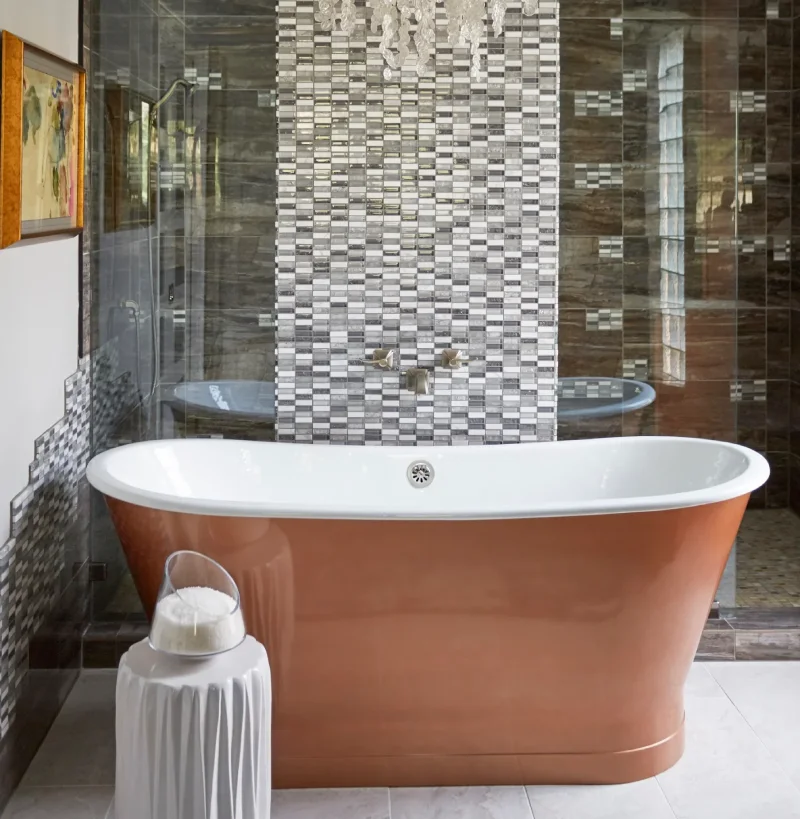
Mosaic also belongs in vertical accent strips: a single ribbon of hand-set Carrara penny-round running floor-to-ceiling in a shower niche, a horizontal band of glass mosaic at eye level above the vanity, a herringbone-set Calacatta mosaic behind a freestanding tub. Deployed with restraint, mosaic is the detail that lifts a master bathroom from 'renovated' to 'designed.'
The Tile Decision Sequence — Floor First, Then Wall, Then Shower, Then Accent
The reason most Tomball bathroom tile selections feel disjointed is sequence. Homeowners arrive at the showroom with a Pinterest board organized by inspiration image rather than by material role. The professional sequence reverses that:
1. Floor first. The floor is the largest tile field and the foundation of the visual palette. It must meet ANSI A137.1 dynamic coefficient of friction of 0.42 or higher for the wet-zone area. Large-format porcelain in a warm neutral is the default; veined porcelain or honed limestone-look porcelain are the upmarket alternatives.
2. Primary wall material. The non-shower wall surfaces — vanity wall, behind the tub, opposite the shower entry — establish the color and texture conversation. A 12x24 polished porcelain stacked vertically reads as architectural; a 4x12 hand-glazed ceramic subway reads as transitional; a slab of book-matched Calacatta reads as the Ruler archetype Tomball homeowners often select.
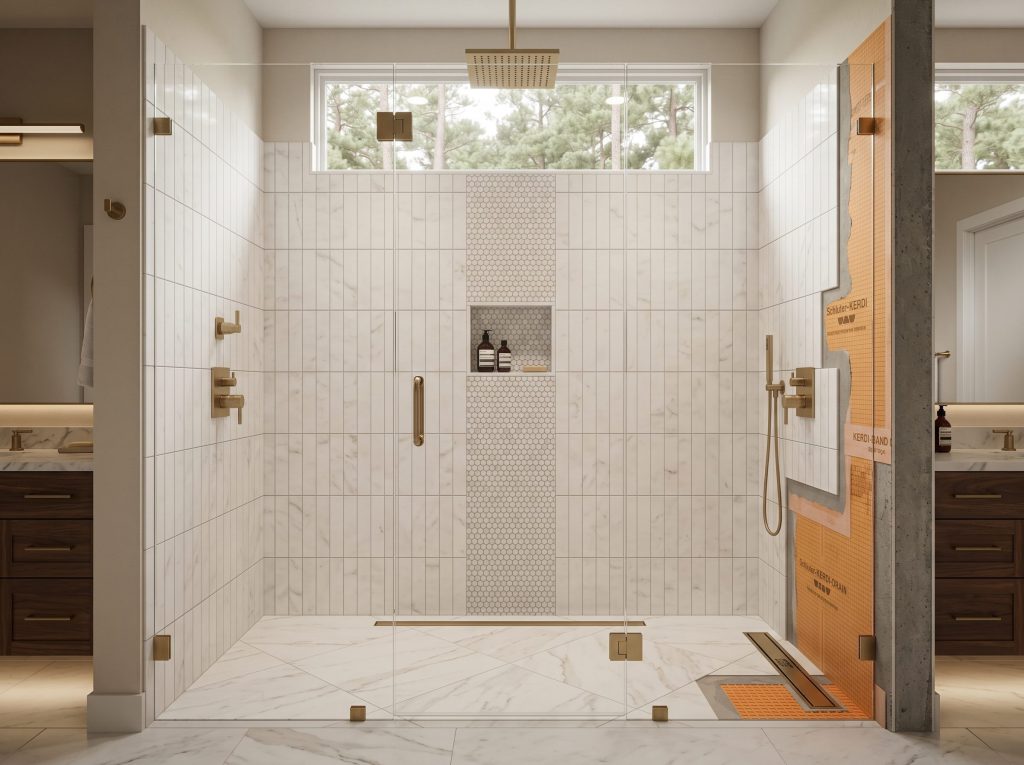
3. Shower interior. Shower walls coordinate with the primary wall material — sometimes as a continuation, sometimes as a deliberate contrast. The shower floor takes a mosaic or small-format tile rated for wet-zone coefficient of friction. The curbless detail requires a 1/4-inch-per-foot slope to a linear drain.
4. Accent and statement. The last decision is the smallest tile square-footage with the highest design weight. A book-matched Calacatta slab behind the tub. A penny-round Carrara mosaic ribbon in the shower niche. A herringbone hexagon at the vanity backsplash. This is where taste expresses itself — after the structural decisions are settled.
When the sequence is honored, the master bathroom reads as designed rather than assembled. When the sequence is inverted — the accent tile is selected first and the floor is chosen to 'match' — the bathroom feels visually noisy and the technical specifications often compromise.
Tomball-Specific Considerations — Augusta Pines, Gleannloch Farms, Northpointe
Tomball master bathrooms built between 2005 and 2018 share a common construction profile that shapes tile decisions in ways most generic guides ignore.
Post-tension slab foundations. The slab is the substrate, and post-tension cables run through it at engineered intervals. Schluter DITRA or comparable uncoupling underlayment must be installed before tile to absorb the differential movement between cable-restrained zones and the open field. Skipping this step is the single most common cause of cracked floor tile in 10-15 year-old Tomball homes — a failure mode that has nothing to do with the tile itself.
HOA architectural review. Augusta Pines' Architectural Review Board does not typically govern interior bathroom finishes, but exterior modifications connected to the bathroom — a transom window addition, a clerestory above the shower — do require ARB approval. Plan tile orders around the review timeline; ordering imported Calacatta with a 14-week lead time before the ARB decision is finalized is a budget mistake.
Houston water chemistry. Tomball water carries 8-12 grains-per-gallon of hardness depending on the community. Marble responds to this chemistry by etching at fixture-contact points within months unless sealed properly. Honed (matte) finishes mask this damage better than polished finishes — relevant when specifying Calacatta or Carrara for any horizontal surface.
The 2,200-4,500 sq ft envelope. Tomball master bathrooms generally range from 120 to 280 sq ft. Below 180 sq ft, large-format 24x48 tile begins to look out of scale; above 220 sq ft, anything smaller than 12x24 produces a visually busy floor. The community context — Augusta Pines is generally larger envelopes than Northpointe — informs the format decision more than most homeowners realize.
These specifics are the reason Keechi Creek Builders' approach to bathroom tile is community-specific rather than generic. From Augusta Pines ARB submittal through final walkthrough, the tile specification is informed by the home's foundation type, water chemistry, and architectural vocabulary — not by Pinterest alone.
Investment Ranges — What Bathroom Tile Actually Costs in a Tomball Master Renovation
Tile material costs vary by an order of magnitude. A glazed ceramic 3x6 subway runs $3-$6 per sq ft installed; a Calacatta marble slab installation can exceed $80 per sq ft. The honest cost ranges for a Tomball master bathroom in the 180-260 sq ft envelope:
|
Tile Tier |
Material + Installation |
Tomball Application |
|---|---|---|
|
Builder upgrade |
$8–$14 / sq ft |
Large-format porcelain, standard installation, sealed cement grout |
|
Mid-luxury |
$15–$28 / sq ft |
Mixed porcelain field + accent mosaic, epoxy grout in wet zones |
|
Luxury |
$30–$55 / sq ft |
Honed marble or Calacatta accent wall, premium porcelain field, full Schluter system |
|
TAB Star tier |
$55–$110+ / sq ft |
Book-matched stone slab, hand-laid mosaic, Waterworks-coordinated detail |
For a 200 sq ft Tomball master bathroom, tile alone typically represents 18-26% of the total renovation budget. Understanding this distribution prevents the common mistake of overspecifying tile at the expense of plumbing, lighting, or cabinetry — each of which influences the finished space more than most homeowners initially expect.
Frequently Asked Questions
What is the best tile for a Tomball bathroom floor?
Large-format porcelain rated at or below 0.5% water absorption with a dynamic coefficient of friction of 0.42 or higher is the default specification for Tomball bathroom floors. A 24x24 or 24x48 matte porcelain in a warm neutral handles Houston humidity, post-tension slab thermal cycling, and Tomball water chemistry better than ceramic, natural stone, or vinyl plank alternatives. Daltile and Florida Tile both produce porcelain collections engineered for this application.
Is marble a practical bathroom tile choice in Houston's climate?
Marble is practical when deployed selectively. Calacatta and Carrara marble belong on accent walls, vanity backsplashes, and shower benches — surfaces that read visually but absorb minimal water and traffic. Marble on a master bathroom floor will dull in the high-traffic zone within two years; on a shower floor it requires a sealing schedule most homeowners will not maintain. Use stone where the eye stops; use porcelain where the foot moves.
What is the difference between porcelain and ceramic tile in a bathroom?
The technical difference is water absorption. Porcelain is fired at higher temperatures and produces a body with absorption at or below 0.5% — classified as impervious under ANSI A137.1. Glazed ceramic typically absorbs 3-7%. In a Houston bathroom, porcelain is the appropriate specification for floors, shower walls, and any wet-zone surface. Ceramic is acceptable on dry-zone walls — vanity backsplashes, powder room feature walls — where its lower cost and warmer hand-glazed character are visible.
Do I need a permit to remodel a bathroom in Tomball?
Most cosmetic bathroom remodels — tile, fixtures, cabinetry — do not require a City of Tomball or Harris County permit when no plumbing or electrical relocation is involved. Once the renovation includes drain relocation, electrical circuit additions, or structural modification, a permit is required. Keechi Creek Builders manages the permit process on every renovation that requires it; the homeowner is not navigating the City of Tomball Building Department or Harris County permitting on their own.
What is the 3-4-5 rule in tile?
The 3-4-5 rule is a geometry technique installers use to establish a perfect square reference point before laying field tile. Measuring 3 feet in one direction, 4 feet perpendicular, and confirming a 5-foot diagonal produces a right angle by the Pythagorean theorem. It is the foundational layout step on every well-installed Tomball bathroom tile project — without it, the floor pattern slowly drifts out of square as it crosses the room.
How long does bathroom tile last in a Houston home?
Properly specified and installed porcelain bathroom tile carries a functional lifespan of 30-50 years. Natural stone — honed marble, Calacatta, travertine — lasts equally long but requires a sealing schedule every 9-18 months in Houston conditions. The component most likely to fail before the tile itself is the grout. Specifying epoxy grout in the wet zones and sealed urethane grout on the floor extends the visual life of the installation by a decade or more relative to standard cement grout.
Can aging-in-place features be integrated into a luxury Tomball master bathroom tile design?
Yes — and this is one of the design intersections Keechi Creek Builders specializes in. Curbless walk-in showers with ANSI A137.1-compliant penny-round mosaic floors, integrated grab bars colored to match the tile body, and comfort-height vanity tile setbacks all integrate into a luxury aesthetic without the institutional look that homeowners fear. Brandon Lynch and Tommy Strong both hold CAPS certification from the National Association of Home Builders — universal design is the default design vocabulary, not an add-on.
Working with Keechi Creek Builders on a Tomball Bathroom Tile Selection
The right master bathroom tile ideas are the ones a Tomball homeowner can live with for two decades — through the slab's thermal cycling, the high-traffic morning routine, the visiting grandparents who need a curbless shower entry, and the resale conversation that may come in 2040. Keechi Creek Builders' design-build process puts tile selection where it belongs: after the structural assessment, after the 3D visualization, after the material samples are physically in the home under Houston light.
From the initial design consultation through final walkthrough, every named brand specification — Daltile, Florida Tile, Stone Source NY, Waterworks — is justified by performance data, cost transparency, and the homeowner's daily use case. The TAB Star Award for Best Bathroom Renovation in the $105,000-$130,000 investment tier was not won by guessing on tile. It was won by sequencing the decision correctly.
For Tomball homeowners in Augusta Pines, Gleannloch Farms, Northpointe, or any of the Harris County master-planned communities Keechi Creek Builders has served since 2007, the conversation begins with a design consultation. To discuss your master bathroom tile project, contact Brandon Lynch at (281) 914-4951 or [email protected]. Browse the broader bathroom remodeling portfolio or explore the firm's kitchen remodeling work in the same Tomball communities — and start at the Keechi Creek Builders homepage for the full design-build process.
Further reading: industry standards from the Tile Council of North America and the ANSI tile specification framework define the technical performance ratings every Tomball bathroom tile decision should reference.
Brandon Lynch, GMB, CAPS, CGP, is the founder of Keechi Creek Builders, a 32-award-winning Houston-area design-build firm serving Tomball and the surrounding master-planned communities since 2007.
To plan your Tomball master bathroom tile selection with performance data behind every choice, call (281) 914-4951 first and our team will walk through your materials and your timeline. Prefer to write? Send us a message through our contact page at https://www.keechicreekbuilderstx.com/contact-us/, and Keechi Creek Builders will get back to you within 24 hours to start the conversation.