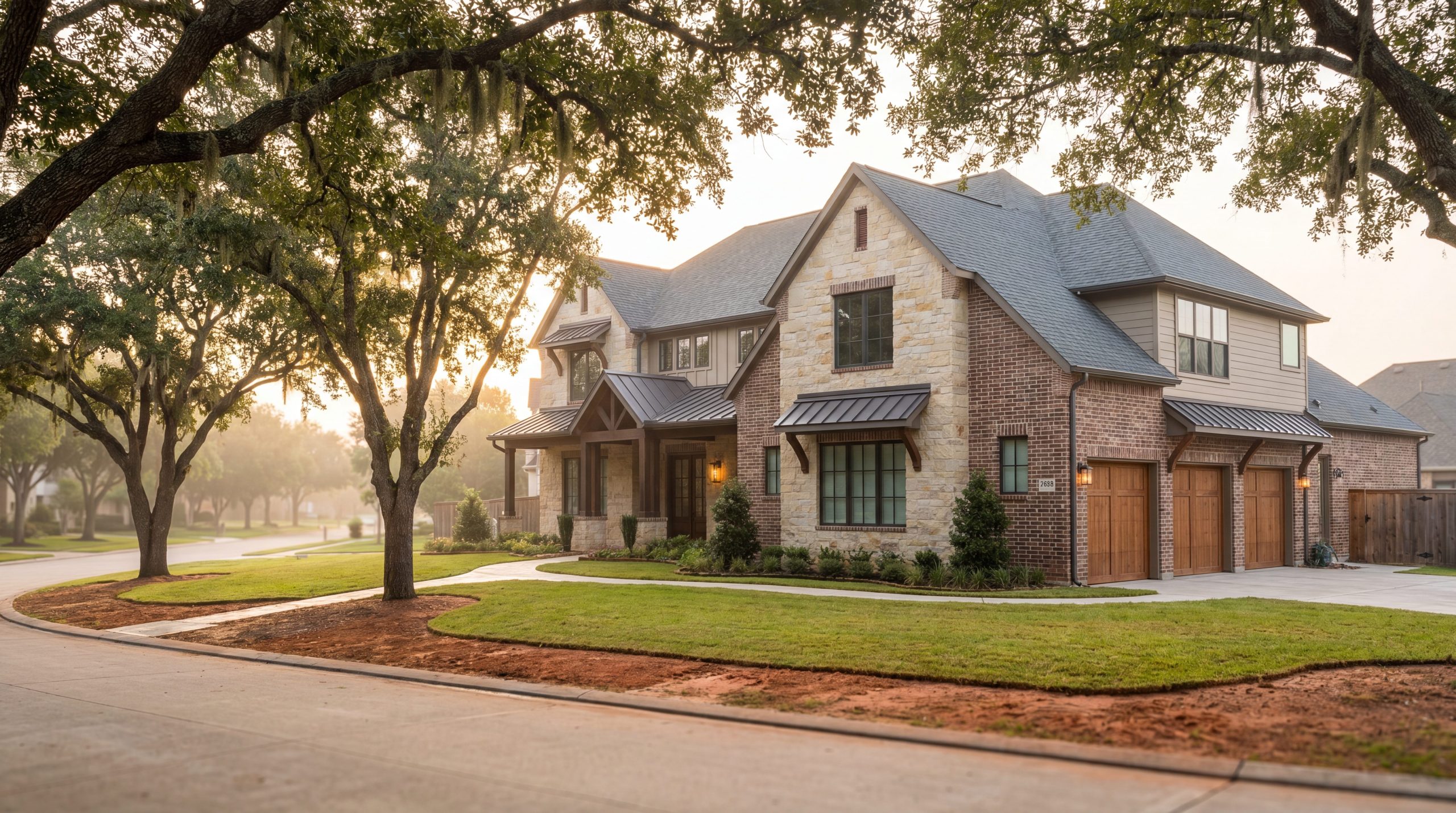
Clay soil foundation engineering in The Woodlands TX requires an engineered solution — typically a post-tension slab, drilled-pier and grade-beam system, or true pier and beam — because the area's expansive clay can swell 6–8% by volume in wet seasons and shrink during drought, generating uplift and settlement forces that destroy under-engineered concrete. Texas soil conditions in the Woodlands area produce repeated soil movement that drives most foundation problems and foundation damage seen across Greater Houston, North Texas, and Houston — but for homeowners working with a credentialed custom home builder, these soil conditions are managed with engineering, not reacted to with foundation repair.
Key Takeaways
- Expansive Clay Reality: The Woodlands sits on the same Beaumont and Lissie Formation clay soils that drive most foundation problems and foundation damage across Greater Houston — soil moisture swings between drought and rainfall can lift or drop a slab an inch or more between seasons.
- Engineering, Not Guesswork: A real custom foundation begins with a site-specific geotechnical report and a free foundation inspection of the lot identifying active zone depth, plasticity index, bearing capacity, and consistent soil moisture targets — not a generic Houston-area slab spec.
- Three Workable Systems: Custom builders in The Woodlands rely on post-tension slabs, drilled-pier and grade-beam foundations, or pier and beam foundations — the right foundation depends on soil type, soil conditions, soil composition, home weight, and lot drainage.
- Site Prep Is Half the Battle: Pre-pour moisture conditioning, compacted select fill, French drains, and roof-leader management decide whether a sound design actually performs against seasonal soil movement and soil shrinkage for 30+ years.
- Montgomery County Matters: Foundation plans pass through Montgomery County structural review and the Development Standards Committee (DSC), which checks grading and drainage alongside the soils engineer's seal — protecting foundation stability from day one.
- Brandon Lynch, GMB, CGP, CAPS: Keechi Creek Builders has engineered clay-soil foundations from Sterling Ridge to Carlton Woods to Indian Springs since 2007 — every plan ships with a Texas-licensed engineer's stamp and a documented foundation inspection record.
- Warranty That Means Something: A custom Woodlands foundation should carry a 10-year structural warranty backed by builder reputation — not a disclaimer-laden production-home boilerplate that pushes early warning signs back onto the homeowner.
How Does Clay Soil Affect Foundations in The Woodlands?
The Woodlands sits on the expansive clay belt that runs across Greater Houston, with Beaumont Formation clays dominant in the southern villages (Grogan's Mill, Panther Creek) and sandier Lissie Formation soils to the north (Carlton Woods, Creekside Park). These clays absorb water and swell up to 6–8% by volume, then shrink and pull away from concrete during drought — that expand-contract cycle is what destroys foundations that were not engineered for it.
For The Woodlands homeowners, the practical consequence is differential movement: one corner of the slab lifts while another stays put, cracking tile, jamming doors, and splitting sheetrock. The active zone — the soil depth that swells and shrinks with seasonal moisture — typically extends 8 to 12 feet below grade across Montgomery County. Any foundation that relies on surface clay without addressing what happens below the active zone is making a bet against drought cycles, irrigation runoff, and the slow root pressure of mature loblolly pines. Early signs of soil-related foundation movement — diagonal sheetrock cracks, doors that won't latch in the dry season, hairline cracks along the slab edge — should be addressed at the first warning signs, not after the foundation shifts have widened. Texas clay soil damages your foundation over time precisely because the cycle is gradual; the difference between a foundation that needs minor monitoring and one that needs full foundation repair often comes down to whether early warning signs were noticed and the soil around your foundation was watered through drought.
What Foundation Type Works Best on Montgomery County Clay Soil?
There is no single "best" foundation for clay soil in The Woodlands — only the right system for the lot, the home's weight, and 30+ years of moisture cycles. Keechi Creek Builders and other credentialed custom builders here rely on three engineered systems proven on expansive clay.
- Post-Tension Slab: Steel cables run through the slab in a 4-foot grid and are tensioned after cure, putting the entire slab into compression that resists tensile cracking from soil movement. Post-tension slabs perform well on moderate-active-zone sites and are what Keechi Creek Builders specifies most often in Sterling Ridge and Indian Springs.
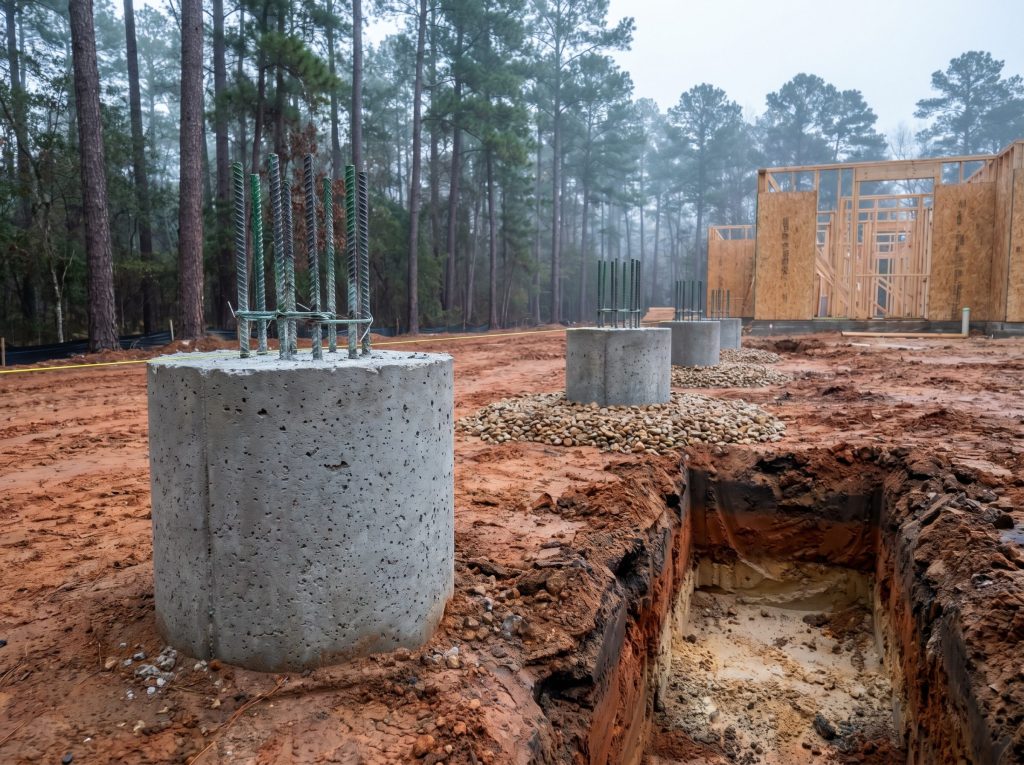
- Drilled-Pier and Grade-Beam Foundation: Concrete piers are drilled 14 to 22 feet down past the active zone and bell at the base to anchor in stable bearing strata. A reinforced grade beam ties the piers together. The home's weight transfers below the active zone, so seasonal swell at the surface no longer drives structural movement — common in Carlton Woods and on lots transitioning between Beaumont and Lissie clays.
- True Pier and Beam Foundations: Concrete piers supporting wood beams over a crawlspace — less common in modern Woodlands customs but valid for lots with high water tables or architecture requiring an elevated floor plane. Pier and beam foundations are also frequently used in older homes across Texas because the crawlspace gives plumbing and HVAC a serviceable cavity.
The wrong answer — one Keechi Creek Builders has audited on too many production-built homes — is a conventional shallow slab with no post-tensioning and marginal site preparation. That foundation may pass inspection, but the bill comes due 8 to 15 years in.
How Do Custom Home Builders Engineer for Expansive Soils?
Engineering a custom foundation for expansive clay starts well before any concrete is poured. The first step is a site-specific geotechnical report from a Texas-licensed soils engineer, who drills test borings to identify soil profile, plasticity index, active zone depth, and bearing pressures. From DSC approval through final walkthrough, that report is the technical foundation every other decision rests on.
Keechi Creek Builders pairs every custom home with a Texas-licensed structural engineer who reviews the geotechnical data and produces a sealed foundation plan — post-tension cable layout, reinforcing steel locations, slab thickness, or pier diameter, depth, and grade-beam reinforcement. The engineer's seal carries real legal weight: it makes the engineer professionally responsible for the design, the kind of accountability production builders rarely sign up to. Having navigated Montgomery County permitting for 17+ years, Keechi Creek Builders also runs a documented preparation sequence on every project, with each phase logged with photos and field-density tickets attached to the homeowner's project record.
|
Brandon's Builder Insight In 17 years building custom homes in The Woodlands, the single biggest difference I've seen between foundations that perform for 30 years and foundations that fail by year 12 is what happens to the soil before the concrete arrives. We pre-condition the clay with controlled moisture for 7–10 days, compact select fill in 6-inch lifts to 95% Standard Proctor, and verify it with field density tests. A perfectly designed slab poured on inadequate subgrade is still going to move — subgrade discipline is where engineering pays off. |
What Site Preparation Is Required Before the Foundation Pour?
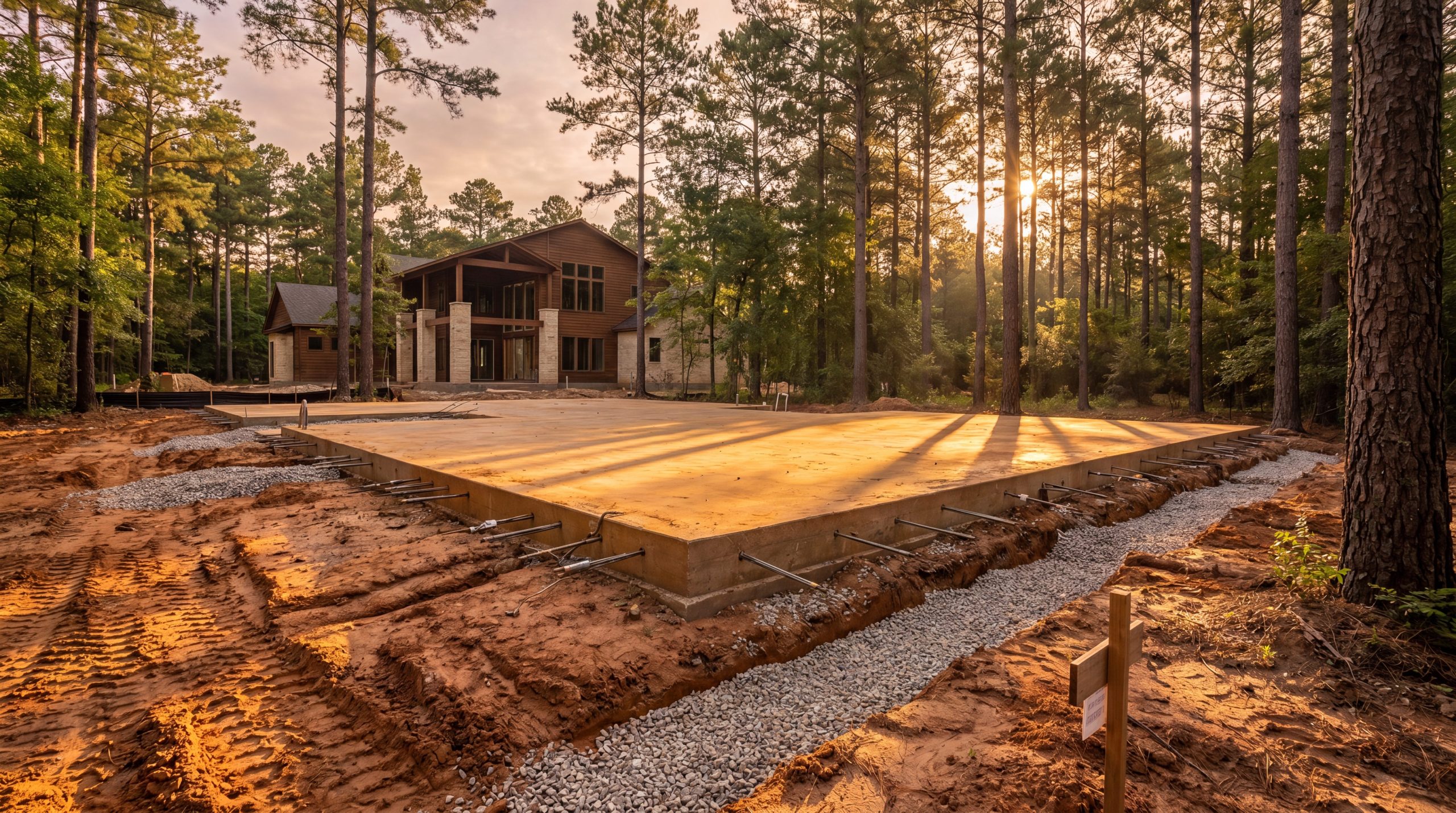
Site preparation is the load-bearing half of clay-soil foundation engineering and the phase production builders most often shortcut. The engineered sequence for The Woodlands homeowners looks like this:
- Step 1, Geotechnical Investigation: Test borings to 20 feet with lab analysis of plasticity index, moisture content, and Atterberg limits.
- Step 2, Tree and Root Management: Existing roots in the building pad are removed to depth to prevent future moisture loss to vegetation, while preserved trees are protected per DSC mandate.
- Step 3, Strip and Cut to Grade: Organic topsoil — usually 8 to 18 inches on wooded Woodlands lots — is stripped and the pad cut to the engineer's subgrade elevation.
- Step 4, Select Fill Placement: Engineered fill is placed in 6-inch lifts and compacted to 95% Standard Proctor density, with each lift field-tested before the next goes down.
- Step 5, Moisture Conditioning: Subgrade is pre-wetted to within 2% of optimum moisture content for 7 to 10 days — the single most cost-effective insurance policy against future differential movement.
- Step 6, Drainage Installation: Perimeter French drains, underslab capillary breaks, and roof-leader tie-ins are installed before vapor barrier.
- Step 7, Vapor Barrier and Steel Placement: A 10-mil polyethylene barrier, then post-tension cables and reinforcing steel placed per the structural engineer's plan and chair-supported off the barrier.
- Step 8, Pre-Pour Inspection: Both Montgomery County structural inspection and Keechi Creek Builders' in-house QA sign off before any concrete is ordered.
How Does The Woodlands Geology Differ from Houston Proper?
For The Woodlands homeowners, Montgomery County clays differ from the Harris County black-gumbo clays inside Loop 610 and from the highly expansive Texas clay seen in North Texas. Southern villages sit on Beaumont Formation soils with high-plasticity clays and active zones in the 9 to 12 foot range. Northern and western villages — Carlton Woods, Sterling Ridge, Creekside Park — transition toward older Lissie Formation deposits, still expansive but with sandier interbeds that reduce swell potential.Montgomery County
Two custom homes on otherwise identical lots — one in Panther Creek, one in Creekside Park — may justify different foundation systems. A post-tension slab with a 12-inch select-fill cap may suit Creekside Park; the same home in Panther Creek may justify a drilled-pier system anchored 16 feet down. Montgomery County permitting also differs from City of Houston: plans pass through County structural review and then through the DSC for setback, grading, and drainage compliance — a quality-control layer that does not exist in unincorporated Harris County.
What Drainage and Maintenance Protect a Clay-Soil Foundation?
Engineered foundations on expansive clay still depend on homeowner drainage and moisture habits to protect your home from soil shrinkage and seasonal soil movement. Three protections move the odds heavily in the homeowner's favor.
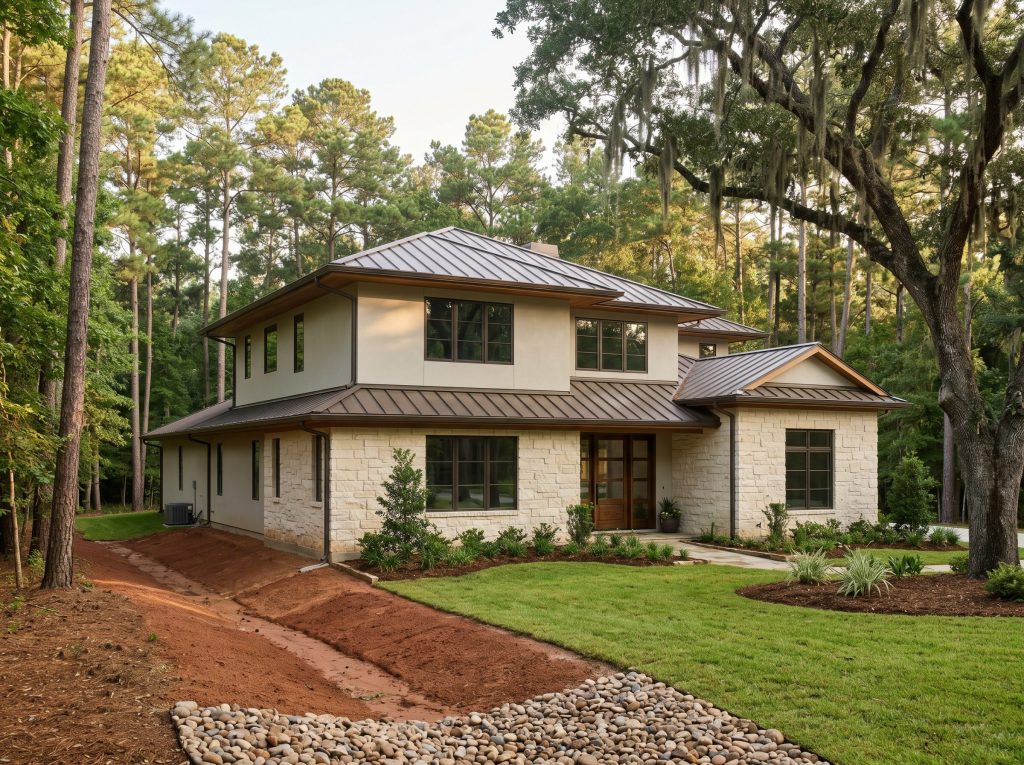
Positive lot drainage. Surface water must move away from the foundation in every direction; the DSC requires it, and the engineered plan delivers it through a perimeter swale, French drains where the lot will not gravity-drain, and roof-leader extensions discharging at least 6 feet from the slab. Poor drainage and standing water within 18 inches of the foundation during a Gulf Coast spring will undo a carefully engineered design within a single season.
Drought-season foundation watering. Soaker hoses installed 18 inches off the slab perimeter — watered the soil around the home for 20 to 30 minutes every other day during dry spells — hold consistent soil moisture steady, preventing the soil shrinkage cracks that let next spring's rain rush back in too aggressively.
Vegetation discipline. Mature loblolly pines and live oaks within 15 feet of the slab draw substantial moisture from the soil during drought. The DSC will not allow blanket tree removal — the canopy is part of what makes The Woodlands what it is — but root barriers installed at construction and modest crown management keep the trees and the foundation compatible. Keechi Creek Builders installs root barriers as a standard inclusion on lots with mature trees within the active zone.
|
Actionable Tip Walk the perimeter of your home after the next heavy rain and look for any place water pools within 6 feet of the slab. Mark each spot with a flag, then have your builder or a drainage contractor regrade the area or add a French drain before the next dry season starts. One hour of attention extends foundation life more than any other homeowner maintenance task. |
What Foundation Warranty Should I Expect on a Woodlands Custom Home?
A custom-built home in The Woodlands should carry, at minimum, a 10-year structural foundation warranty backed by both the builder's reputation and a recognized third-party warranty company. Keechi Creek Builders — a National Association of Home Builders (NAHB) Graduate Master Builder firm with 32 industry awards and a BBB A+ rating — stands behind every custom foundation as a long-term relationship, not a one-time transaction. The warranty should specify covered structural elements (slab, piers, grade beams, load-bearing walls), exclusions, and a defined dispute resolution process. Production builders frequently bury foundation issues under cosmetic exclusions; that pattern does not survive in a credentialed custom builder's contract.
Foundation engineering also shapes the practical scope of every other space in the home — once the slab is sound, the same site-prep and drainage discipline carries forward into the home's kitchen remodeling and full-home renovation work years down the road. And every Woodlands custom build starts on the custom home builder service page, where the full design-build process is documented.
Frequently Asked Questions
Why is clay soil such a problem for foundations in The Woodlands?
Clay soil in The Woodlands belongs to the expansive clay family — it swells when wet and shrinks when dry, producing volume changes of 6 to 8 percent across a single wet-dry seasonal cycle. That movement generates uplift and settlement forces strong enough to crack an unengineered slab. Custom home builders in The Woodlands engineer specifically for it, using post-tension slabs, drilled-pier and grade-beam systems, or true pier and beam construction paired with controlled site preparation and drainage discipline.
What is a post-tension slab and is it the right choice for my lot?
A post-tension slab is a reinforced concrete foundation with high-strength steel cables tensioned after the concrete cures, putting the entire slab into compression and resisting the tensile cracking that expansive clay soil movement causes. It performs well on most Woodlands lots with moderate active-zone depth and reliable drainage. The right choice for any specific lot, however, is determined by the geotechnical report — Keechi Creek Builders pairs every custom home with a Texas-licensed structural engineer who reviews the soils data before specifying the system.
How deep does the active clay layer go in The Woodlands?
The active zone — the depth of soil that swells and shrinks with seasonal moisture — typically extends 8 to 12 feet below grade across The Woodlands, deeper in southern Beaumont Formation soils and shallower in the sandier Lissie Formation soils to the north. A site-specific geotechnical report is the only reliable way to confirm active zone depth on a particular lot, and that depth drives whether a post-tension slab or a drilled-pier foundation is the better engineering match.
Are drilled piers worth the extra cost on a Woodlands custom home?
On lots with deep active zones, variable soil profiles, or mature trees within the active zone, drilled piers paired with a grade beam transfer the home's weight below the seasonal expansion zone, substantially reducing differential movement risk over 30+ years. The upfront cost runs 15 to 25 percent higher than a comparable post-tension slab, but the long-term performance justifies the investment where geotechnical data supports it. Keechi Creek Builders recommends piers when the soils report specifies them — not as a default upsell.
Does Montgomery County require a geotechnical report for a new foundation?
Montgomery County's structural plan review does not universally mandate a geotechnical report for every single-family permit, but a Texas-licensed structural engineer cannot responsibly seal a foundation plan for an expansive clay site without one — and any reputable custom home builder in The Woodlands commissions the report regardless. The DSC and the structural inspector both expect the design to reflect site-specific soils data, and lender appraisals and homeowner insurance policies increasingly require it.
Build on a Foundation Engineered for The Woodlands, Not Against It
Clay soil is the geology you build with in The Woodlands — fighting it with a generic spec is how foundations fail by year 12. Engineering with it, through site-specific soils data, a sealed structural plan, disciplined subgrade preparation, and durable drainage, is how a custom home serves a family for three decades and holds its value the whole time. Keechi Creek Builders has applied that engineering discipline across every Woodlands village since 2007, from Sterling Ridge starter customs to Carlton Woods luxury estates.
Call (281) 914-4951 to start the conversation with Brandon Lynch directly, or send us a message through our contact page at keechicreekbuilderstx.com/contact-us — Keechi Creek Builders will get back to you within 24 hours with a plan to evaluate your lot, your soils, and the engineered foundation system that fits both.