Foundation engineering determines the structural longevity, resale value, and living comfort of every custom home built in The Woodlands. Montgomery County's expansive clay soils demand site-specific geotechnical analysis, precision-engineered slab or pier-and-beam systems, and builder-level accountability that production homes rarely deliver. Keechi Creek Builders integrates licensed structural engineering into every custom home project from day one.
Key Takeaways
- Soil Analysis Is Non-Negotiable: The Woodlands sits on Beaumont Formation clay that can swell 4-6 inches seasonally, making geotechnical soil testing the single most critical step before foundation design begins.
- Engineered Foundations Outperform Generic Designs: Site-specific foundation engineering accounts for your lot's exact soil composition, drainage patterns, and structural load requirements rather than applying a one-size-fits-all template.
- Builder-Engineer Integration Reduces Costly Errors: When the builder and structural engineer work under one contract, design conflicts surface during planning instead of manifesting as expensive change orders during construction.
- Pier-and-Beam vs. Slab Depends on Your Lot: Each foundation type carries distinct advantages in Montgomery County; the correct choice depends on soil borings, flood zone classification, and architectural load calculations specific to each building site.
- Credentials Signal Accountability: Certifications like Graduate Master Builder (GMB) and membership in the National Association of Home Builders confirm that a builder meets verified standards of construction science knowledge and professional ethics.
- Foundation Failures Cost More Than Prevention: Remediation of foundation defects in Texas averages $8,000 to $30,000 for residential properties, while proper engineering during initial construction adds a fraction of that cost to the overall project budget.
What Does Foundation Engineering Mean for a Custom Home in The Woodlands?
Foundation engineering is the discipline of designing structural support systems calibrated to a specific building site's soil conditions, load requirements, and environmental exposure. For custom homes in The Woodlands, this means accounting for Montgomery County's Beaumont Formation clay, seasonal moisture fluctuations, and the structural demands of homes that often exceed 4,000 square feet.
Unlike production homes that replicate a single foundation template across dozens of lots, a custom home builder in The Woodlands commissions site-specific geotechnical reports before any concrete is poured. These reports reveal soil plasticity indices, bearing capacity, and water table depth at your exact build location.
The American Society of Civil Engineers (ASCE) defines foundation engineering as one of the oldest branches of civil engineering, with standards that have evolved over centuries to address regional soil challenges. In Southeast Texas, those challenges are substantial and require builders with deep local knowledge.
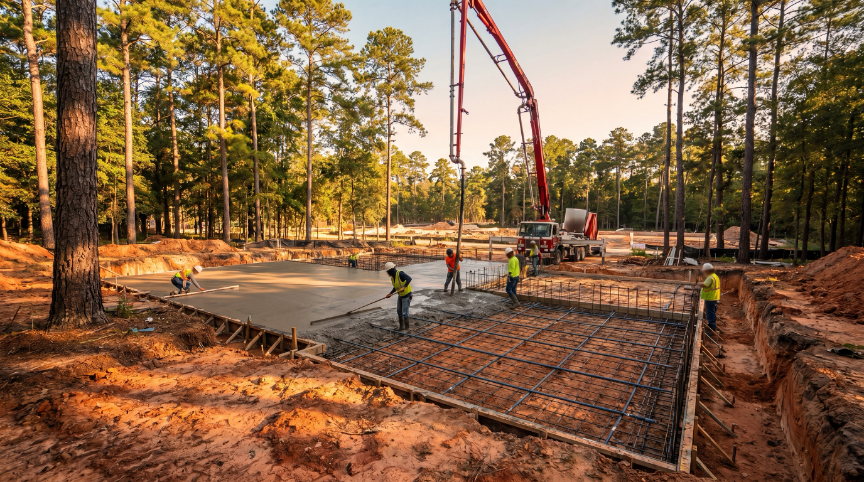
Foundation engineering for custom home construction in The Woodlands encompasses geotechnical investigation, structural analysis, material specification, and construction oversight. Each phase requires technical expertise that goes well beyond selecting a standard slab thickness from a catalog.
Why Do The Woodlands' Clay Soils Demand Specialized Foundation Design?
The Woodlands was developed on land characterized by Beaumont Formation clay, a soil type classified as highly expansive by the United States Department of Agriculture. This clay absorbs moisture during rain events and contracts during drought, creating a cyclical movement pattern that can shift foundations several inches over a single season.
Homes built without engineering calibrated to these conditions face predictable consequences: interior wall cracking, door and window frames falling out of square, and differential settlement that compromises structural load paths. These are not cosmetic issues. They signal active structural degradation that worsens over time without intervention.
| Did You Know? Montgomery County's expansive clay soils rank among the most challenging foundation environments in the United States. The Beaumont Formation extends across much of Southeast Texas and has caused foundation-related insurance claims exceeding $1 billion in the Greater Houston area over the past two decades. Proper geotechnical analysis before construction is the most reliable way to prevent these outcomes. |
Geotechnical soil testing for a custom home site in The Woodlands typically involves drilling multiple borings to depths of 15-30 feet, extracting soil samples, and analyzing them for Atterberg limits, moisture content, and unconfined compressive strength. The resulting data drives every decision in the foundation design process.
Soil conditions vary meaningfully even between adjacent lots in the same village. A property near Spring Creek in Creekside Park presents different subsurface conditions than a lot on higher ground in Sterling Ridge. This variability is precisely why engineered foundations outperform standardized templates in The Woodlands.
How Does a Structural Engineer Design a Foundation for Custom Home Construction?
A licensed structural engineer translates geotechnical data into a buildable foundation plan. The process follows a defined sequence: soil report review, structural load calculation, foundation type selection, reinforcement detailing, and drainage integration. Each step builds on the previous one, and shortcuts at any stage compromise the entire system.
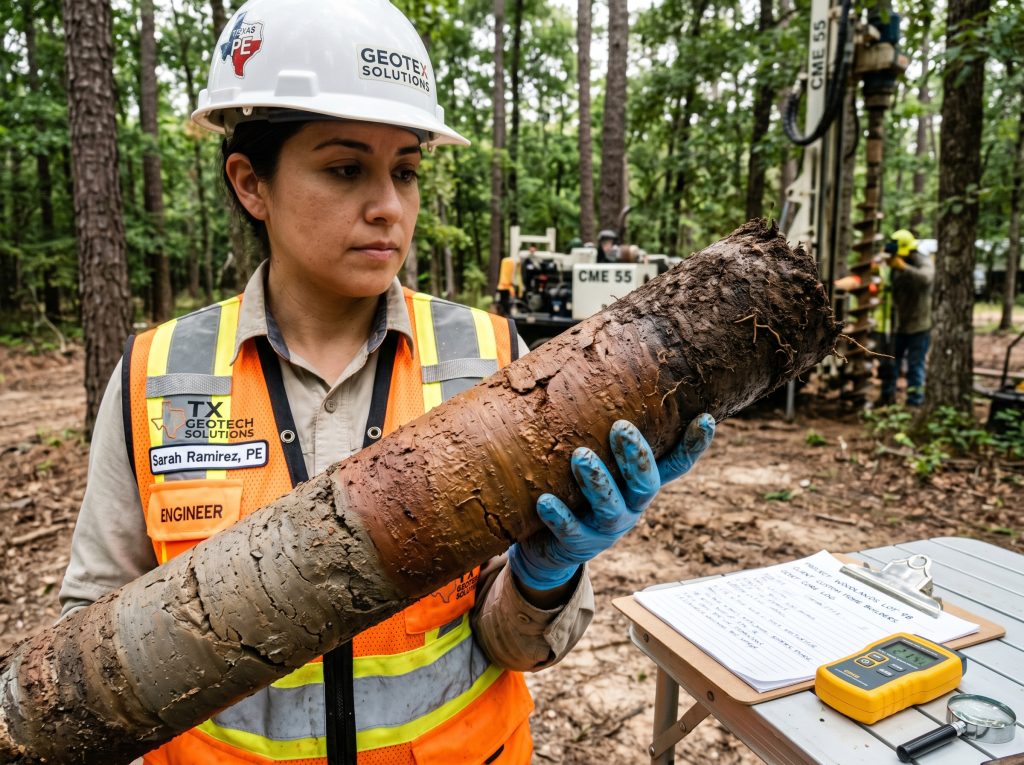
For custom homes in The Woodlands, structural engineers typically evaluate two primary foundation types: post-tensioned concrete slabs and pier-and-beam systems. Post-tensioned slabs use high-strength steel tendons embedded in concrete to resist soil movement. Pier-and-beam foundations elevate the structure on concrete piers driven to stable bearing strata, creating a crawlspace that allows future access for plumbing and electrical modifications.
| Factor | Post-Tensioned Slab | Pier-and-Beam |
| Soil Movement Resistance | High (steel tendons resist lateral forces) | High (piers bypass unstable surface soil) |
| Future Access | Limited (utilities encased in slab) | Excellent (crawlspace allows modifications) |
| Cost Range (2,500 SF) | $18,000 - $28,000 | $25,000 - $40,000 |
| Typical Application | Single-story or moderate load homes | Multi-story, elevated lots, or flood zones |
| Drainage Integration | Surface grading critical | Elevated structure reduces flood risk |
| Maintenance Requirements | Consistent soil moisture management | Periodic pier inspection and ventilation checks |
The structural engineer also specifies concrete mix designs, rebar sizing and spacing, and post-tensioning schedules calibrated to the expected soil movement range. For The Woodlands, this often means designing for a potential vertical movement of 3-6 inches over the foundation's lifespan.
What Credentials Should Your Custom Home Builder Hold for Foundation Work?
The distinction between a builder who understands foundation engineering and one who subcontracts it without oversight is measurable in outcomes. Builders with formal construction science education and industry certifications bring a layer of technical accountability that protects homeowners from the communication gaps between separate architect, engineer, and contractor teams.
The National Association of Home Builders (NAHB) administers several professional designations that signal verified competency in residential construction. The Graduate Master Builder (GMB) designation represents the highest level of NAHB education, requiring completion of courses in construction management, business practices, and building science.
Brandon Lynch, founder of Keechi Creek Builders, holds GMB, CGP, and CAPS certifications from NAHB, backed by a construction science degree from Texas A&M University. Tommy Strong, KCB's Senior Project Manager, is a third-generation carpenter who holds CLC, CGR, and CAPS certifications with over 30 years of field experience. This combination of academic engineering knowledge and hands-on craft expertise means foundation decisions at KCB are informed by both structural theory and practical field conditions.
| Brandon's Builder Insight Most foundation problems we see in The Woodlands trace back to a single root cause: the builder treated the foundation as a commodity instead of an engineered system. A foundation designed for a lot in Creekside Park should not use the same specifications as one in Indian Springs. The soil profiles are different, the drainage patterns are different, and the structural loads vary based on the home's architectural plan. That is why we commission independent geotechnical reports for every lot we build on. |
How Does the Design-Build Model Improve Foundation Engineering Outcomes?
Traditional custom home construction separates the architect, structural engineer, and builder into independent contracts. Each party optimizes for their own scope, and design conflicts frequently surface during construction when resolution is most expensive. The design-build model consolidates these disciplines under one team and one contract, which changes the dynamics of foundation engineering significantly.
At Keechi Creek Builders, the structural engineer, architect, and construction team collaborate from the initial design meeting. Foundation design decisions inform architectural choices, and architectural ambitions are validated against structural reality before any commitment is made. This integration typically saves 15-20% on change orders compared to the traditional sequential approach.
For homeowners in The Woodlands, this means the foundation is not an afterthought adapted to fit a pre-designed floor plan. The floor plan and foundation are co-developed, ensuring that load paths, bearing walls, and point loads are accounted for from the outset. The result is a structurally coherent home where every element works together rather than being force-fit during construction.
The design-build approach also accelerates the permitting timeline. Because engineering, architectural, and construction documents are coordinated internally, The Woodlands' Development Standards Committee receives a cohesive submission rather than piecemeal plans that trigger revision requests.
What Foundation Inspection and Maintenance Should Homeowners Expect?
Foundation engineering does not end when the concrete cures. The Woodlands' seasonal moisture cycles create ongoing demands on residential foundations that require consistent attention over the life of the home. Homeowners who invest in engineered foundations should also invest in a maintenance protocol that protects that engineering over decades.
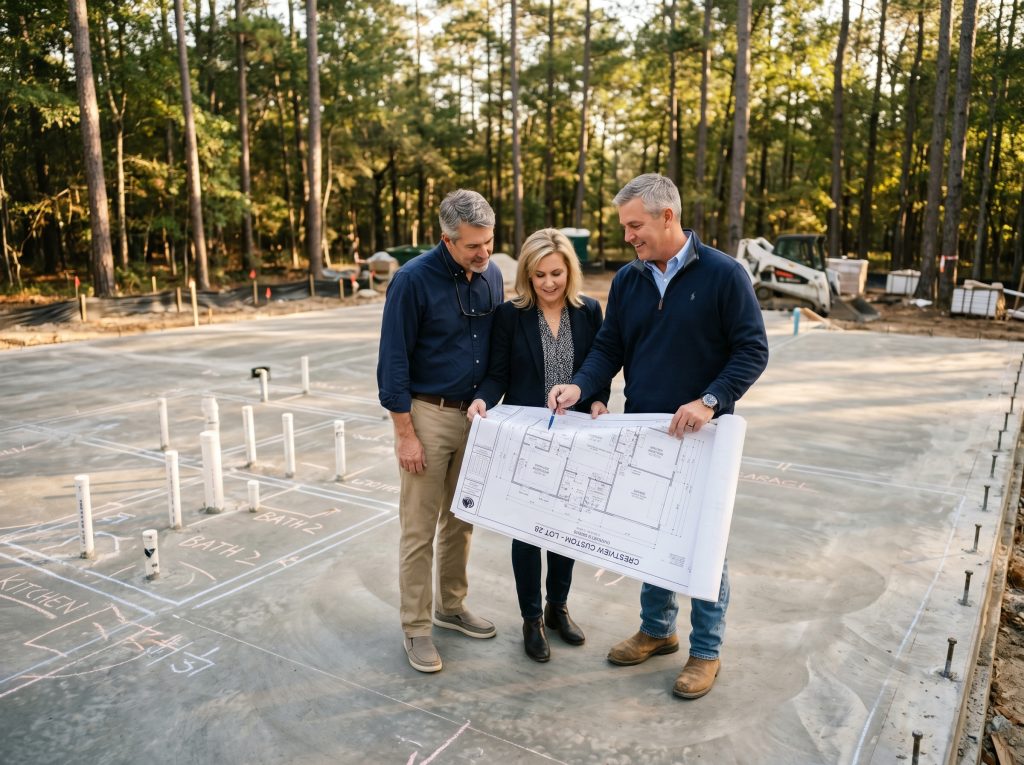
A comprehensive foundation maintenance program for custom homes in Montgomery County includes several critical components:
- Consistent perimeter watering during drought months to maintain stable soil moisture around the foundation
- Gutter and downspout systems directing water at least 5 feet away from the foundation perimeter
- Annual visual inspection of exterior grade lines to confirm positive drainage slope away from the structure
- Interior monitoring for early warning signs: sticky doors, hairline drywall cracks, or gaps between walls and ceiling
- Professional structural evaluation every 5-7 years, or immediately if warning signs appear
Keechi Creek Builders provides a post-construction concierge program that includes scheduled foundation and structural check-ins during the critical first years after construction. This ongoing relationship between builder and homeowner ensures that the engineering investment made during construction continues to deliver returns over the life of the home.
How Does Foundation Engineering Protect Your Investment in The Woodlands?
The Woodlands consistently ranks among the highest-value residential communities in Greater Houston. Villages like Carlton Woods, Sterling Ridge, and Creekside Park command premium lot prices precisely because the community maintains rigorous architectural and construction standards through its Development Standards Committee.
A home built on a properly engineered foundation retains structural integrity through decades of soil movement, weather events, and natural aging. Conversely, foundation deficiencies become increasingly expensive to remediate over time. The Foundation Performance Association, a Texas-based professional organization, documents that residential foundation repair costs in the Greater Houston area typically range from $8,000 to $30,000, with complex cases exceeding $50,000.
The Woodlands' villages each present distinct lot characteristics that affect both new construction and future renovation projects. Properties that may eventually require kitchen remodeling in The Woodlands or structural modifications must account for the original foundation's engineering parameters. Understanding those parameters from the start ensures that future modifications remain structurally viable.
| Actionable Tip Before purchasing a lot for custom home construction in The Woodlands, request a preliminary geotechnical assessment. A $2,000-$4,000 investment in soil testing before closing can reveal conditions that significantly impact foundation design costs and overall construction budgets. Ask your builder to attend the soil boring process so they can observe subsurface conditions firsthand. |
What Questions Should You Ask a Builder About Foundation Engineering?
Homeowners evaluating custom home builders in The Woodlands should probe foundation engineering practices directly. The quality of a builder's answers reveals whether they treat the foundation as a critical engineered system or a commodity checkbox.
Seven questions that separate engineering-driven builders from the rest:
- Do you commission independent geotechnical soil reports for every lot, or use standardized foundation templates?
- Which licensed structural engineering firm designs your foundations, and can the homeowner review their qualifications?
- How do you determine whether a post-tensioned slab or pier-and-beam system is appropriate for a specific lot?
- What is your process for integrating structural engineering findings into the architectural design?
- How do you handle drainage engineering around the foundation perimeter?
- What warranty or structural guarantee do you provide on foundation work?
- What post-construction foundation monitoring do you offer or recommend?
A builder who answers these questions with specifics rather than generalities demonstrates the engineering-first mindset that protects your investment. Vague responses such as "we use the standard foundation" or "our engineer handles that" should raise concerns about the level of oversight and integration.
Frequently Asked Questions
How much does it cost to have a structural engineer look at a foundation?
A structural engineer's foundation evaluation in The Woodlands typically costs $400 to $800 for an existing home inspection, while full geotechnical soil testing and foundation design for new construction ranges from $2,000 to $6,000. Keechi Creek Builders includes structural engineering as part of the integrated design-build contract, eliminating the need for homeowners to source and manage a separate engineering firm.
What is the difference between a structural engineer and a foundation engineer?
A structural engineer holds a Professional Engineer (PE) license and designs load-bearing systems across an entire building, including foundations, framing, and roof structures. A foundation engineer is a structural engineer who specializes specifically in below-grade support systems. Both analyze soil conditions, calculate loads, and produce stamped engineering plans. For custom homes in The Woodlands, the structural engineer typically handles the complete structural design including the foundation.
Do you need a structural engineer for foundations?
Texas does not legally require a licensed structural engineer for single-family residential foundations, but reputable custom home builders in The Woodlands engage one for every project. Engineered foundations designed for your lot's specific soil conditions outperform generic templates and reduce the risk of costly settlement, cracking, and structural movement over the home's lifespan.
What does a foundation engineer do during custom home construction?
A foundation engineer reviews geotechnical soil reports, designs the foundation system (slab or pier-and-beam), specifies concrete strength and reinforcement schedules, details drainage integration, and provides construction-phase inspection to confirm the foundation is built according to engineered plans. At Keechi Creek Builders, the structural engineer participates in pre-construction planning meetings alongside the architect and builder to ensure complete design integration.
How long does it take to build a custom home foundation in The Woodlands?
Foundation construction for a custom home in The Woodlands typically takes 4-8 weeks from site preparation through final concrete curing. Post-tensioned slab foundations require tensioning the steel tendons after the concrete reaches specified strength, which adds 7-14 days. Pier-and-beam foundations may take longer if piers must be driven to significant depth to reach stable bearing soil below the Beaumont clay layer.
What foundation problems are most common in The Woodlands?
The most prevalent foundation issues in The Woodlands stem from Montgomery County's expansive clay soils: differential settlement where one area of the foundation sinks more than another, upheaval during wet seasons, and perimeter cracking from drought-induced soil shrinkage. Poor drainage design and inadequate soil moisture management accelerate all three failure modes. Proper foundation engineering and ongoing maintenance significantly reduce these risks.
How does The Woodlands' Development Standards Committee affect foundation engineering?
The Woodlands' Development Standards Committee reviews architectural submissions for compliance with community standards, but foundation engineering decisions are driven by geotechnical data and structural load requirements. The committee evaluates exterior aesthetics, setbacks, and height restrictions. Builders experienced in The Woodlands, like Keechi Creek Builders, coordinate both committee requirements and engineering specifications simultaneously to prevent conflicts that delay construction timelines.
Building on Solid Ground in The Woodlands
Foundation engineering is the single decision in custom home construction that cannot be corrected later without extraordinary cost. The expansive clay soils underlying The Woodlands' villages demand a builder who treats the foundation as an engineered system designed for your specific lot, not a standardized template applied without analysis.
The KCB team brings construction science education, NAHB-verified certifications, and 32 industry awards to every foundation decision. When the builder, structural engineer, and architect work under one roof from day one, the result is a home engineered to perform across decades of Montgomery County's demanding soil conditions. That is the standard Keechi Creek Builders holds on every custom home project in The Woodlands.