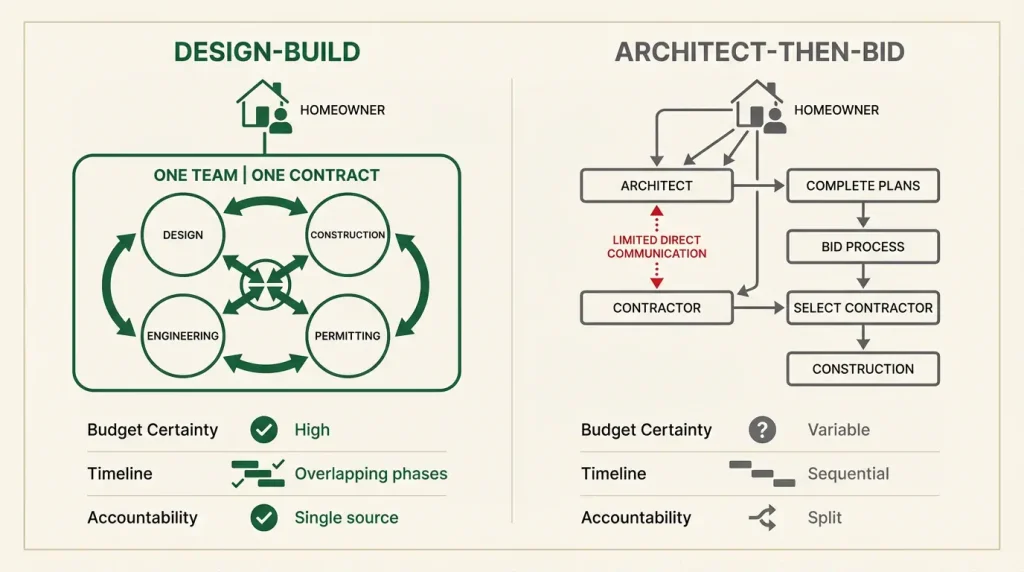
The design-build model combines architectural design and construction under a single contract with one team and one point of accountability, while the traditional architect-then-bid approach separates design and construction into two independent relationships that the homeowner must coordinate. For custom homes in Magnolia, TX, where Montgomery County's dual-jurisdiction permitting, expansive clay soils, and acreage lot requirements add complexity that generic projects don't face, the integrated design-build approach eliminates the coordination failures that most commonly cause budget overruns and timeline delays.
Key Takeaways
- Design-build means one contract, one team: The architect and builder work for the same firm from day one. You have a single point of contact throughout the entire custom home project, from initial concept through final walkthrough.
- Architect-then-bid separates design from execution: You hire an architect independently to create plans, then solicit bids from separate contractors to build them. You become the coordinator between two teams with potentially different priorities.
- Budget accuracy differs significantly: Design-build firms provide real-time cost feedback during design because their construction team is involved from the start. The traditional model often reveals budget problems only after complete plans go out to bid.
- Communication gaps cause the most expensive problems: In the traditional model, the homeowner relays questions between architect and contractor. In design-build, the design team and construction team collaborate directly, catching issues before they become change orders.
- Timeline compression favors design-build: Design and construction phases can overlap in design-build, with foundation work beginning while interior details are finalized. The traditional model is strictly linear: design must be complete before bidding even starts.
- Magnolia's complexity amplifies the advantage: Montgomery County's dual-jurisdiction building codes, expansive clay soil requiring engineered foundations, and acreage lot site preparation create technical challenges where architect-builder coordination isn't optional.
How Does the Traditional Architect-Then-Bid Model Work?
In the traditional model (sometimes called design-bid-build), you hire an architect first. The architect creates a complete set of construction drawings, specifications, and details based on your vision. Once those plans are finished, you take them to general contractors and solicit competitive bids for construction.
The architect's role typically ends (or shifts to periodic oversight) once construction begins. The contractor takes over, and you're left managing the relationship between two professionals who may have never worked together on your specific project.
Here's the fundamental tension: the architect designs without full visibility into current construction costs and builder capabilities. The contractor bids on plans they had no input in creating. When the bids come back higher than expected (and they often do), you cycle back to the architect for redesign. That back-and-forth adds weeks and frustration.
For a straightforward project in a simple regulatory environment, this model can work. For a custom home on 5 acres in unincorporated Montgomery County where you need geotechnical soil testing, an engineered post-tensioned foundation, septic system design, and dual-jurisdiction permitting? The traditional model introduces risk at every handoff point.
What Makes Design-Build Different for Custom Homes?
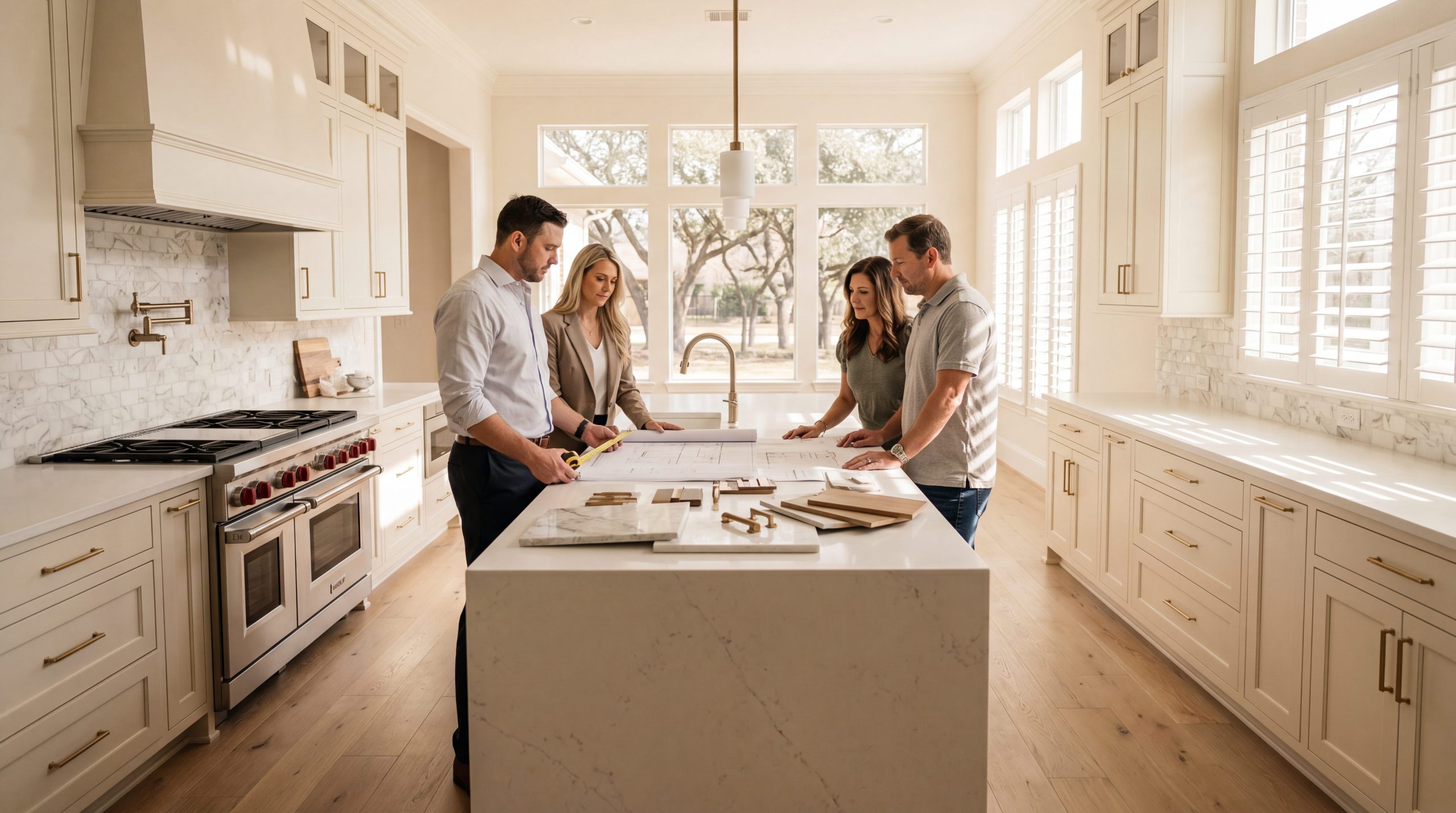
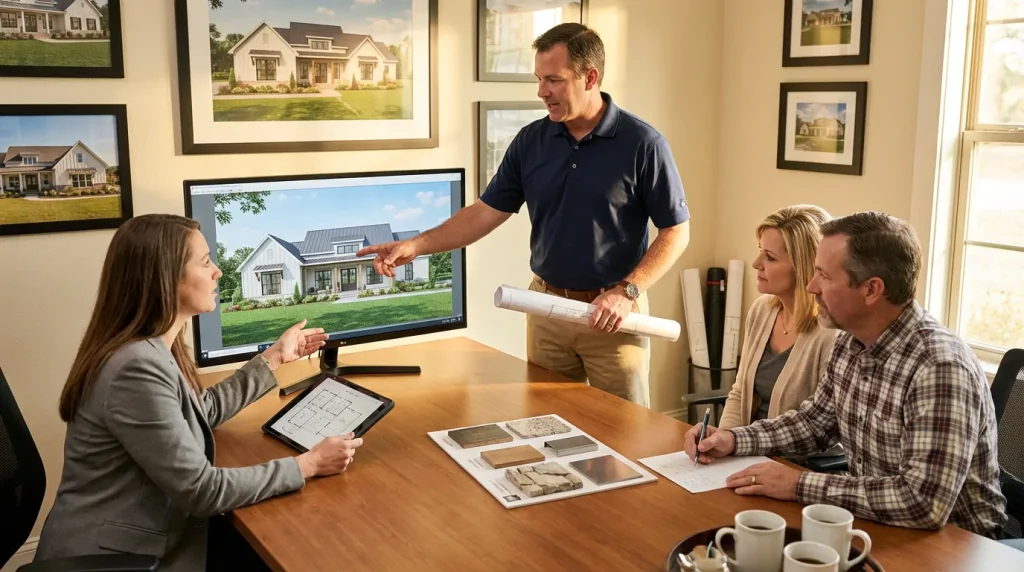
The design-build model eliminates the gap between design and construction by putting both under one roof. Your architect and builder aren't separate entities with separate contracts. They're colleagues on the same team, collaborating from the first sketch to the final inspection.
What does that look like in practice? During the design phase, the construction team provides real-time cost feedback. When the architect proposes a feature, the builder can immediately assess its construction cost, timeline impact, and feasibility for your specific lot conditions. No waiting for bids. No surprise pricing. No going back to the architect for costly redesigns.
The Design-Build Institute of America reports that integrated project delivery consistently outperforms the traditional method on budget adherence, schedule performance, and owner satisfaction. That's not marketing. That's documented performance data across thousands of residential and commercial projects.
For Magnolia homeowners, design-build provides a specific advantage that generic comparisons miss: your builder's knowledge of local conditions informs the design from day one. Foundation engineering requirements for Houston's clay soil don't get discovered during bidding. Montgomery County's permitting process doesn't surprise anyone mid-project. HOA architectural review requirements in High Meadow Ranch or Thousand Oaks are built into the design timeline, not discovered after plans are finalized.
How Do Communication and Accountability Compare?
This is where the two models diverge most dramatically, and where the real cost differences hide.
In the traditional model, you are the communication hub. The architect has questions about site conditions? They ask you, and you relay to the contractor. The contractor identifies a conflict between the structural plans and the mechanical system? They report to you, and you contact the architect for a resolution. Every message passes through you.
That relay system creates three problems. Messages get lost or delayed. Technical nuance gets simplified in translation. And when something goes wrong, the architect points to the contractor's execution and the contractor points to the architect's plans. You're stuck in the middle trying to figure out who's responsible.
Design-build removes you from that relay position entirely. The architect and builder communicate directly because they're on the same team. Questions get resolved in real time. Accountability is unified. If something goes wrong, there's one firm responsible for fixing it. No finger-pointing. No blame-shifting between separate companies.
We've seen this dynamic play out dozens of times over 19 years of building in Montgomery County. The homeowners who come to us after failed experiences with the traditional model almost always describe the same frustration: they felt like a project manager rather than a homeowner bringing a vision to life.
| Factor | Design-Build | Traditional Architect-Then-Bid |
|---|---|---|
| Point of contact | One team, one contact | Two separate firms, you coordinate |
| Budget visibility | Real-time cost feedback during design | Cost revealed only at bidding phase |
| Timeline structure | Design and construction phases overlap | Strictly linear: design → bid → build |
| Change management | Team resolves internally, one approval | Architect revises plans, contractor re-bids |
| Accountability | Single-source responsibility | Split between architect and contractor |
| Local knowledge in design | Builder's site expertise informs design | Architect may lack local construction data |
| Typical timeline savings | 15-25% faster project completion | Longer due to sequential phases |
Why Does Magnolia's Market Make This Decision More Important?
Generic design-build vs. architect content treats this as a universal decision. It's not. The stakes change based on local complexity, and Magnolia adds layers that most markets don't.
Montgomery County's expansive clay soils require foundation systems (post-tensioned slabs or pier-and-beam) that must be engineered for specific lot conditions. That engineering happens during design. If your architect doesn't know what the soil report says (because they've never worked with a local geotechnical engineer), the foundation design may need to be completely reworked when a builder finally reviews it.
The dual-jurisdiction permitting system (City of Magnolia vs. unincorporated Montgomery County) means permit applications, code versions, and inspection requirements change based on which side of a jurisdictional line your lot falls on. A design-build team that has navigated both jurisdictions hundreds of times builds that knowledge into the design timeline automatically.
Acreage lots along FM 1488 and FM 2978 require septic system design, well drilling assessment, tree clearing plans, and drainage engineering. These aren't afterthoughts. They're integral to the site plan, and a design-build team addresses them during design rather than discovering them during construction.
Brandon Lynch's Texas A&M engineering background gives Keechi Creek Builders a specific advantage here. We don't just manage the design-build process. We bring engineering analysis to the design phase. Foundation specifications, structural load calculations, and constructability reviews happen before plans are finalized, not after they go out to bid. That's what an engineer-founded design-build firm delivers that the traditional model structurally cannot.
When Does the Traditional Model Still Make Sense?
Fair question, and we'll give you an honest answer. The architect-then-bid model has advantages in specific situations:
- Highly experimental or avant-garde architectural design where you want an architect with complete creative freedom unconstrained by construction cost awareness during the conceptual phase.
- Projects where you already have a deep relationship with both an architect and a contractor who have worked together before and have established communication patterns.
- Simple projects in straightforward regulatory environments where site complexity is minimal and the design-to-construction handoff carries limited risk.
For a custom home on Magnolia acreage with expansive clay soil, dual-jurisdiction permitting, and a project budget exceeding $500,000? The traditional model introduces unnecessary risk at every coordination point.
What Questions Should You Ask When Evaluating Delivery Models?
Whether you're leaning toward design-build or the traditional approach, these questions will reveal how well-equipped a firm is to handle your project:
- "Who designs the foundation, and when?" In design-build, foundation engineering is part of the design phase. In the traditional model, it may not happen until the contractor reviews plans.
- "What happens when construction costs exceed the design budget?" Design-build firms catch this during design. Traditional models catch it at bidding.
- "How do you handle Montgomery County's permitting requirements?" A local design-build firm should describe the specific jurisdictional verification process. An out-of-area architect may not know to ask.
- "Who is my single point of contact during construction?" Design-build provides one. The traditional model provides two (or more).
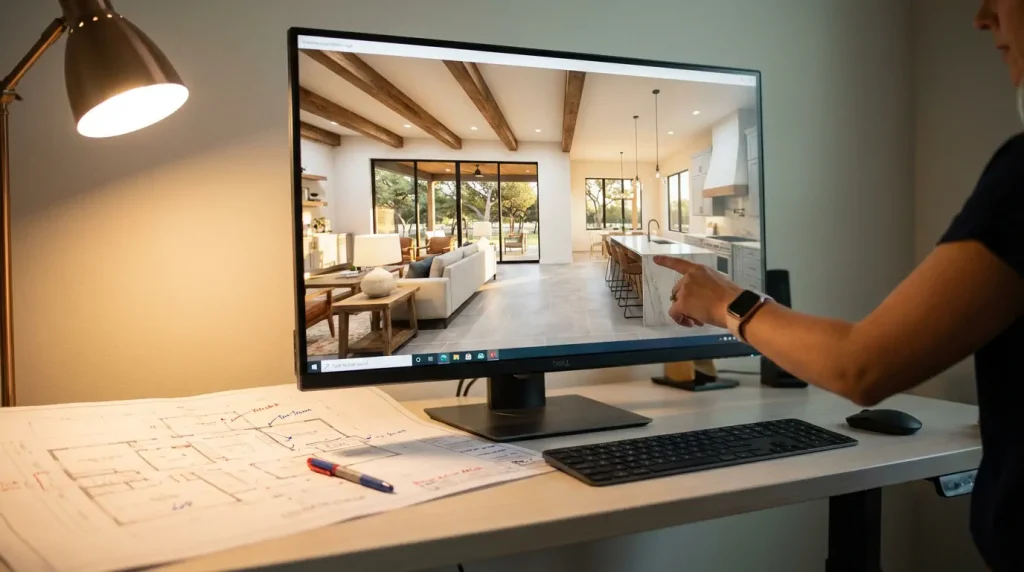
- "Can I see your 3D walkthroughs before construction begins?" Firms like Keechi Creek Builders use AutoCAD and 3D rendering technology to let homeowners experience their custom home virtually before a single footing is poured.
These questions don't just help you choose a delivery model. They help you evaluate whether any builder — regardless of model — has the local expertise and process transparency your Magnolia project demands.
Frequently Asked Questions
What is the difference between design-build and hiring an architect and contractor separately?
Design-build combines architectural design and construction under a single contract with one firm responsible for both. The traditional model separates these functions: you hire an architect to create plans, then solicit bids from separate contractors. The key difference is accountability and communication. Design-build provides a single point of contact and unified project responsibility, while the traditional model requires the homeowner to coordinate between two independent teams.
Is design-build more expensive than hiring an architect and contractor separately?
Design-build is typically more cost-predictable, not more expensive. Because the construction team provides real-time cost feedback during the design phase, projects are designed to budget from day one. The traditional model often produces beautiful plans that exceed the construction budget, requiring costly redesigns. The American Institute of Architects acknowledges that design-bid-build carries inherent pricing uncertainty until bids are received.
Can I still get a fully custom home design with a design-build firm?
Yes. Design-build doesn't mean template-based design. At Keechi Creek Builders, every home starts with a blank architectural canvas. The difference is that our architect and construction team collaborate throughout the design process, ensuring every creative decision is buildable, affordable, and optimized for your specific lot conditions in Magnolia. You get the same level of architectural customization with the added benefit of construction expertise informing every design decision.
How much faster is design-build compared to the traditional model?
Design-build projects typically complete 15-25% faster than traditional architect-then-bid projects because design and construction phases overlap. Foundation and site work can begin while interior finish selections are being finalized. The traditional model is strictly sequential: design must be complete, bids solicited, contractor selected, and then construction begins, adding months to the overall timeline.
What are the disadvantages of the design-build model?
The primary limitation is that you're working with one firm rather than two independent entities providing checks and balances. Some homeowners prefer the separation of an architect advocating for their design vision while a contractor focuses on execution. However, for projects requiring significant local expertise (like Magnolia custom homes with Montgomery County's complex regulatory environment), the integrated approach's advantages typically outweigh this concern.
How does design-build handle change orders differently?
In design-build, change requests are evaluated by the design and construction team together, providing immediate feedback on cost and timeline impact. The traditional model requires the homeowner to request a design revision from the architect, wait for updated plans, then submit those to the contractor for re-pricing. This back-and-forth can add weeks per change and create friction between the architect and contractor over scope interpretation.
Should I choose design-build for a Magnolia custom home?
For most Magnolia custom home projects, design-build provides significant advantages due to the area's unique complexity. Montgomery County's dual-jurisdiction building codes, expansive clay soil requiring engineered foundations, acreage lot site preparation needs, and HOA architectural review processes all benefit from choosing a custom home builder with integrated design-build capabilities and deep local expertise.
Conclusion
The design-build vs. architect-then-bid decision shapes every aspect of your custom home experience: your budget predictability, timeline, communication quality, and the likelihood that your finished home matches your vision. For Magnolia homeowners building on Montgomery County acreage with engineered foundations, dual-jurisdiction permits, and the complexity that comes with a truly custom project, the design-build model provides integrated accountability that the traditional model structurally cannot match. One contract. One team. One point of accountability from first sketch to final walkthrough.