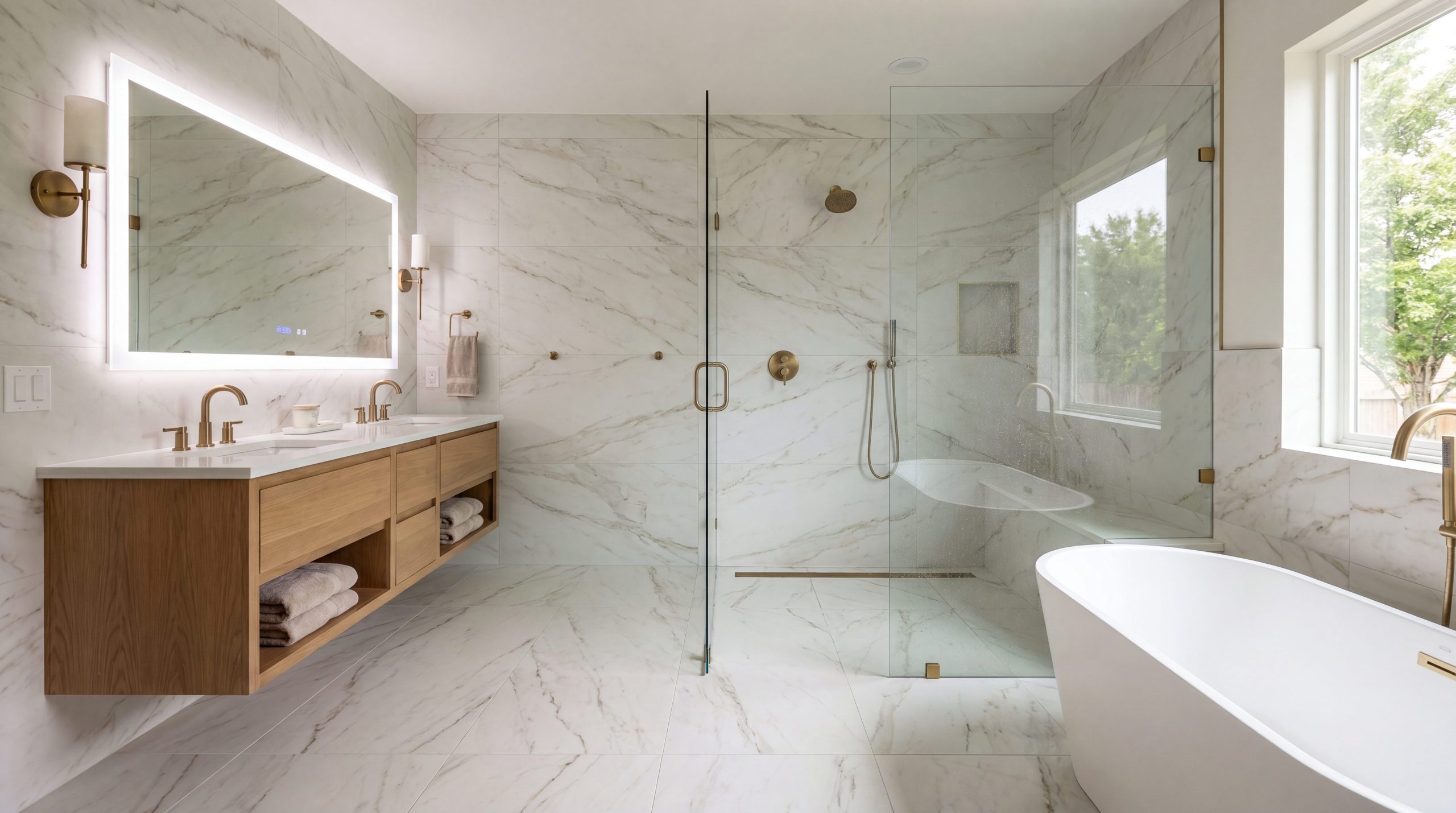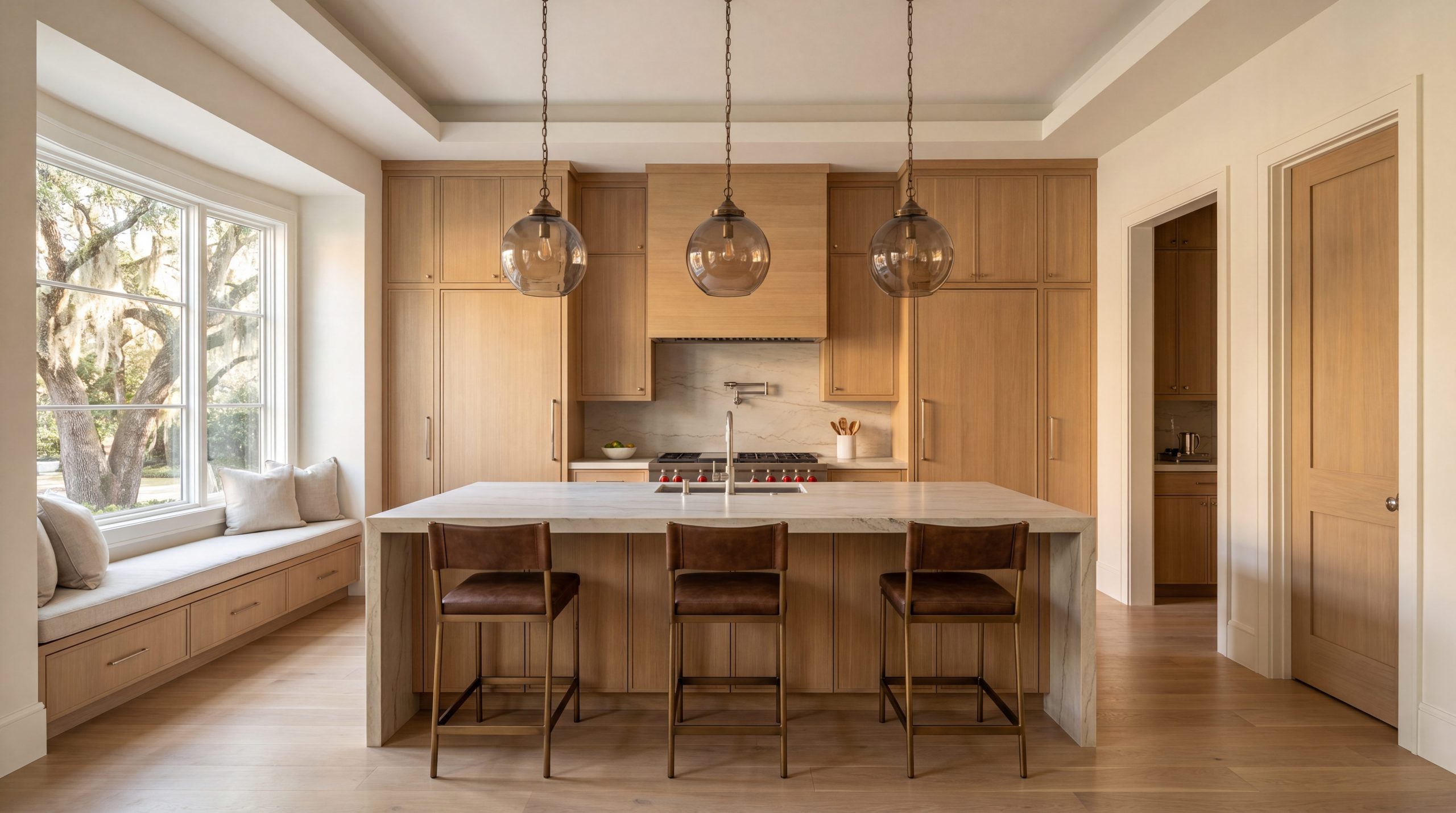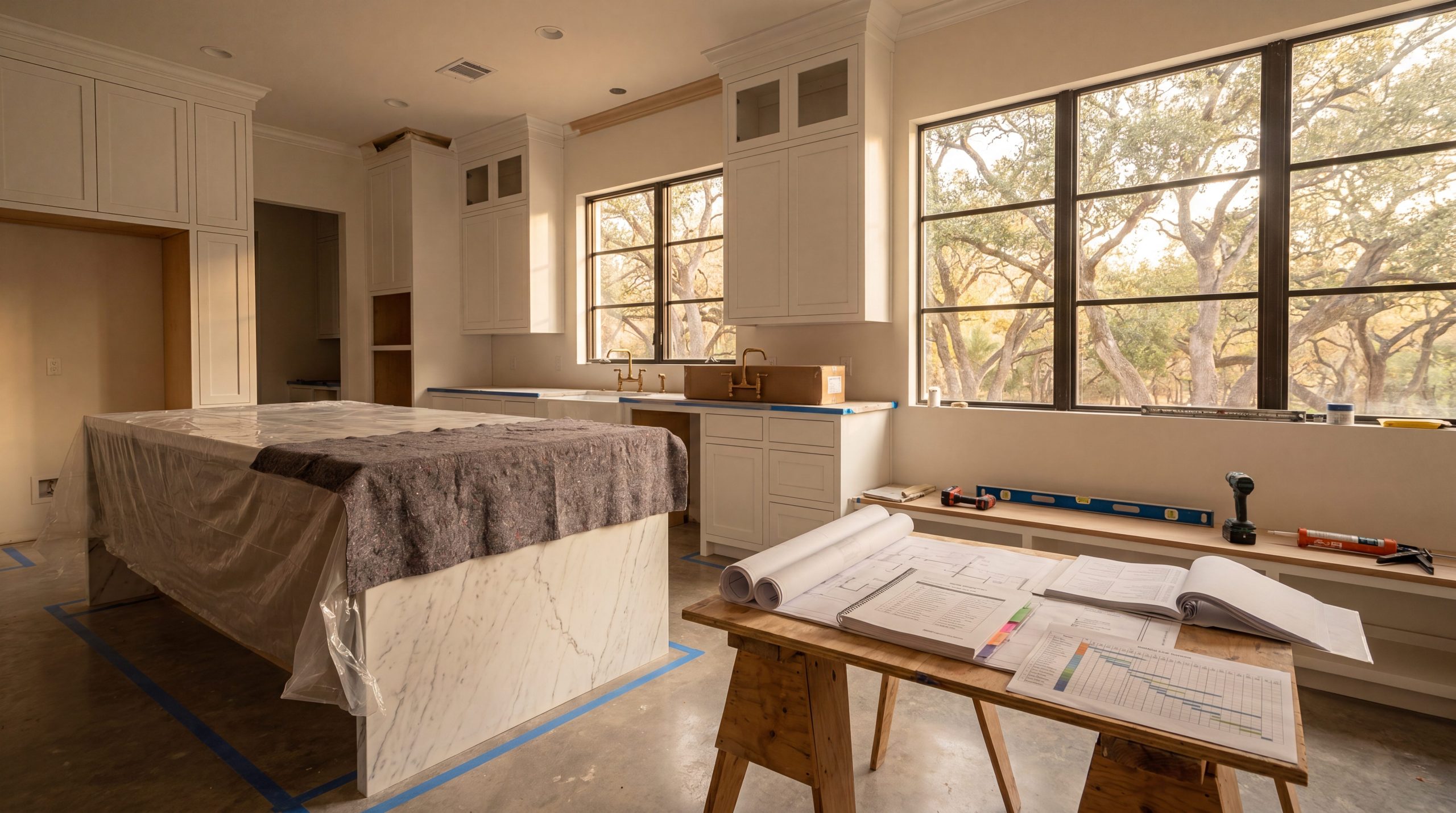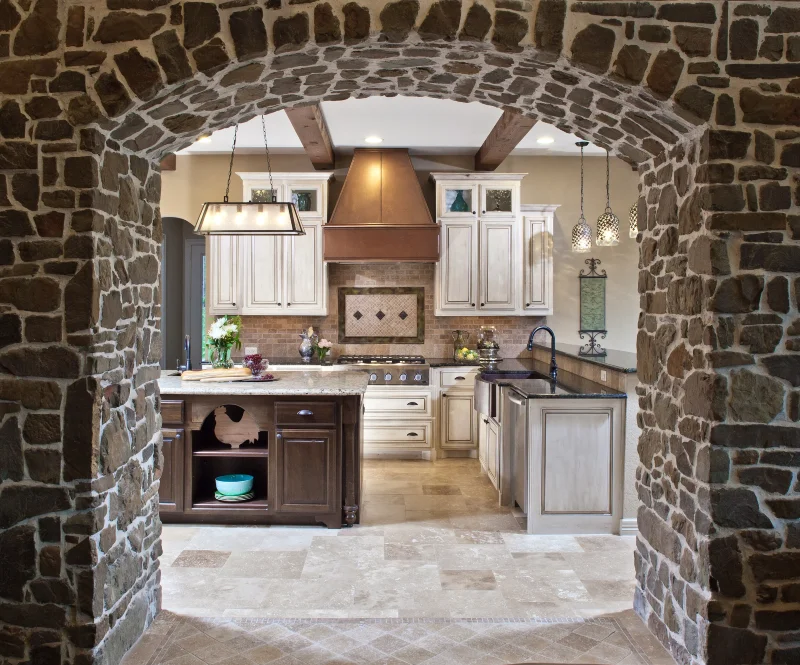
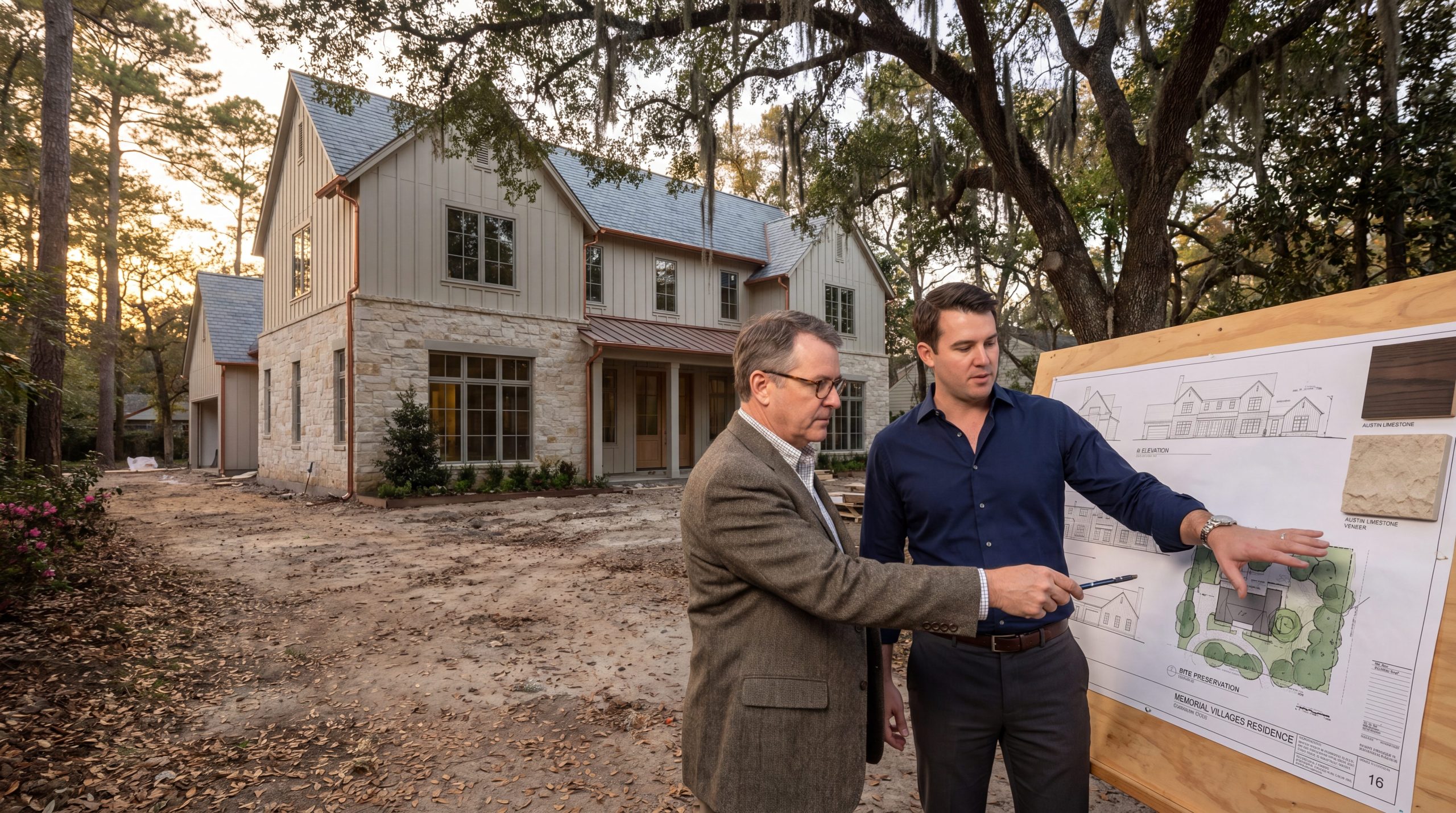
A Memorial Villages architectural review committee is the village-level board that approves custom home designs before a building permit is issued in Hunters Creek, Bunker Hill, Piney Point, Hedwig, Hilshire, or Spring Valley Village. For Memorial homeowners, each village ARC enforces its own setbacks, lot coverage, height, materials, and tree preservation — and a single missed standard can add three months to a Memorial custom home build.
Key Takeaways
- Six Independent Reviews, Not One Memorial-Wide Board. Each Memorial Village runs its own ARC — Hunters Creek, Bunker Hill, Piney Point, Hedwig, Hilshire, and Spring Valley — with distinct standards and meeting cadences.
- Deed Restrictions Run Parallel to City Permits. Memorial Villages homes are governed by recorded deed restrictions in addition to the Harris County building code and the village permitting office.
- Tree Preservation Drives Most ARC Comments. Live oak survey, critical root zone protection, and lot drainage are the three most-cited revision triggers across Bunker Hill Village ARC requirements and Piney Point Village building regulations.
- Most Memorial ARC Reviews Take 4 to 10 Weeks. Hedwig and Hilshire Village turn around inside 3 to 6 weeks; Piney Point and Hunters Creek typically run 6 to 10 weeks for a new build.
- A Pre-Submission Review Saves 6 to 12 Weeks. Submitting a draft package to the village ARC chair before formal submission surfaces revisions while drawings are still inexpensive to change.
- Single-Firm Submission Compresses the Calendar. A custom home builder that owns design, engineering, and permitting in one team manages every revision cycle without architect-builder handoffs.
What Is a Memorial Villages Architectural Review Committee?
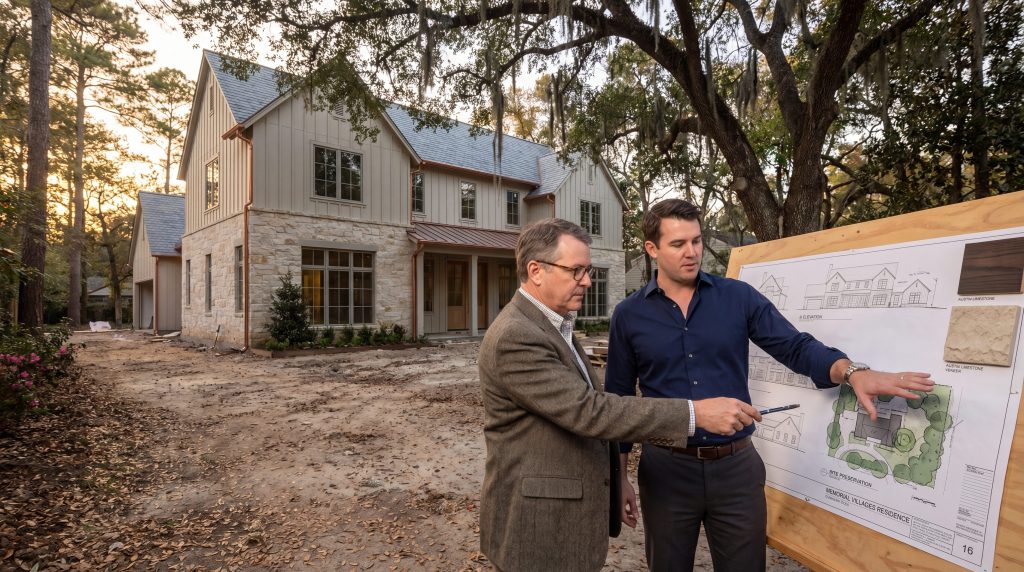
A Memorial Villages architectural review committee — sometimes called an architectural review board (ARB) or architectural control committee (ACC) — is a panel of resident volunteers and appointed professionals that evaluates exterior design, site planning, and material selections for any new construction, addition, or substantial exterior remodel inside a Memorial Village. The committee operates under the village's recorded deed restrictions and zoning ordinance, and its written approval is a precondition to the village building permit that authorizes ground-breaking.
For Memorial homeowners, two parallel reviews stand between architectural drawings and construction: the ARC review (deed-restriction and design compliance) and the village permit review (building code and zoning compliance). Both must clear before any work begins. The committee does not review interior layouts, but every exterior decision — façade material, roof pitch, fenestration, driveway location, fence line, tree removal — is squarely inside its scope.
Keechi Creek Builders has navigated all six Memorial Villages architectural review committees on behalf of homeowners since 2007. Brandon Lynch — KCB's founder, Texas A&M engineering graduate, and GMB, CGP, CGR, and CAPS — leads the firm's design and permitting practice inside the same team that constructs the home.
Why Six Separate Committees?
The six Memorial Villages incorporated as independent municipalities in the 1950s precisely so residents could control land-use decisions at the village scale rather than through Harris County or Houston. Each village adopted its own zoning ordinance, deed restrictions, and ARC structure. Today the Memorial Villages collectively represent six of the most affluent municipalities in Texas, and the ARCs are the operating mechanism that protects the architectural character driving property-value trajectory.
Because the villages are independent, a design approved in Hunters Creek Village is not automatically approved next door in Bunker Hill Village. A homeowner who relocates a build from one village to another effectively starts the architectural review process from scratch.
How Each Memorial Village ARC Reviews Custom Home Design
The table below summarizes what each Memorial Village architectural review committee prioritizes during a new-construction review. Specific numeric standards are codified in each village's zoning ordinance and deed restrictions and are subject to change.
|
Memorial Village |
Zip |
ARC Focus Areas |
Review Cycle |
|---|---|---|---|
|
Hunters Creek Village |
77024 |
Scale relative to adjacent homes, tree preservation, neighbor sightlines |
6-10 weeks |
|
Bunker Hill Village |
77024 |
Lot coverage limits, height caps, roof pitch |
4-8 weeks |
|
Piney Point Village |
77024 |
Deep front setbacks, style consistency, mature tree protection |
6-10 weeks |
|
Hedwig Village |
77024/77055 |
Exterior finish compatibility, smaller-lot tolerances, driveway |
3-6 weeks |
|
Hilshire Village |
77055 |
Neighborhood character preservation, personalized review |
3-6 weeks |
|
Spring Valley Village |
77055 |
Impervious cover, drainage plans, code enforcement |
4-8 weeks |
Spring Branch Independent School District (SBISD) serves all six villages — the underlying reason Memorial homeowners often anchor to a specific village rather than relocating outside the cluster. That school-zone anchoring intensifies the importance of getting the ARC review right the first time.
Hunters Creek Village ARC — Home Design Approval
The Hunters Creek Village ARC focuses on how a proposed home reads against the streetscape. Massing, two-story sightlines, and proximity to mature trees are routinely flagged. A common Hunters Creek Village home design approval comment requires reducing second-story massing on the street-facing elevation or relocating a driveway to preserve a heritage live oak.
Bunker Hill Village ARC Requirements
Bunker Hill Village ARC requirements emphasize lot coverage, height caps, and roof-pitch consistency with surrounding homes. The package includes a survey, elevations to scale, a materials sample board, and a site plan showing all hardscape. Bunker Hill is also strict about temporary construction signage during the build.
Piney Point Village Building Regulations
Piney Point Village building regulations enforce some of the deepest front setbacks in the Memorial Villages and the most stringent tree-protection standards. The ARC reviews exterior architectural style for consistency with the surrounding street, with particular sensitivity to oversized contemporary massing on lots historically occupied by traditional residences.
Hedwig, Hilshire, and Spring Valley Village ARCs
Hedwig Village ARC reviews move faster than the larger villages — smaller lots and streamlined documentation. Hilshire Village operates a small, personalized ARC focused on neighborhood character. Spring Valley Village is the most code-enforcement-intensive in the cluster, focused on impervious cover, drainage plans, and setback compliance.
Memorial Deed Restrictions and the Custom Home Process
Memorial deed restrictions are recorded private covenants that run with the land — they bind every successive owner of the lot regardless of what the village zoning ordinance separately allows. For a custom home in Memorial, deed restrictions typically address minimum house size, maximum height, setback supplements, permitted exterior materials, fence rules, and accessory structures. A Memorial deed restrictions custom home review reconciles the proposed design against both the recorded covenants and the village zoning ordinance — whichever is more restrictive controls.
For homeowners on a teardown-rebuild project, the existing home's footprint does not establish a grandfathered envelope. The replacement home is reviewed under current deed restrictions and current zoning, which routinely produces a smaller buildable envelope than the original 1950s or 1960s residence occupied.
The Six-Step Memorial Architectural Review Submission Process
The procedural sequence below describes how a Memorial custom home moves from concept to ARC approval to a building permit ready for ground-breaking. The exact forms and fee schedules vary by village, but the underlying workflow is consistent across all six Harris County Memorial Villages committees.
|
Brandon's Builder Insight After guiding submissions through every Memorial village, I have learned that the committee is not an obstacle, it is a checklist you can prepare for. The projects that stall are the ones that arrive with incomplete elevations or a setback nobody verified against the deed restrictions. I assemble the full package, survey, elevations, materials, and tree plan, before the first submission, because a clean first review can save six weeks. Knowing each village's specific preferences is half the work. |
Step 1 — Pre-Submission Conversation. Before formal drawings are complete, a phone call with the village ARC chair surfaces neighborhood-context concerns and recent precedents that are not codified in the deed restrictions. Skipping this is the single most common source of avoidable revisions.
Step 2 — Site Survey and Tree Inventory. A current boundary and topographic survey is paired with a certified tree survey identifying every protected tree, critical root zone, and proposed removal.
Step 3 — Schematic Submission Package. The first formal submission typically includes a site plan with setbacks and impervious-cover calculations; exterior elevations to scale; a roof plan; a tree-protection plan; a drainage plan; and a materials and color board.
Step 4 — ARC Meeting Review and Initial Comments. The committee meets on a published cadence — monthly in most villages. Comments are issued in writing, ranging from minor (relocate a downspout) to substantive (reduce second-story massing).
Step 5 — Revision Cycle and Final Approval. Substantive revisions sometimes require a second formal meeting; minor revisions are typically approved administratively. Final approval is documented in writing on village letterhead.
Step 6 — Village Building Permit Application. With ARC approval in hand, the project moves to the village building permit office for code review and permit issuance. Harris County coordination is required for utility tap permits, drainage permits, and certain right-of-way work.
Having navigated Harris County and Memorial Villages permitting for 17+ years, the KCB team treats each village's submission requirements as a checklist baked into schematic design — not a downstream problem to solve after construction documents are complete.
What Triggers an ARC Review?
Triggers are broader than most homeowners expect. New construction always triggers a full ARC review. Beyond that: any addition that changes the exterior envelope, a roof replacement that changes pitch or material, window pattern changes visible from the street, driveway expansion, fence installation, swimming pool construction, exterior repainting outside the approved palette, removal of a protected tree, and accessory structures.
|
Actionable Tip Before you assume your Memorial project is exempt, list every exterior change, including roofline, facade material, fences, and driveways, and check each against your village's review triggers. Even a material swap on a street-facing elevation can require approval. Mapping your triggers early tells you exactly when to submit and keeps your custom home schedule from stalling at permitting. |
Interior remodels — including a bathroom remodel or kitchen renovation — do not trigger ARC review unless they alter the exterior. Window relocations or HVAC equipment moves associated with an interior remodel can pull a project into ARC review unexpectedly.
How Long Does Memorial Architectural Review Take?
Total review from first ARC submission to final approval typically runs 4 to 10 weeks for a new Memorial custom home. Hedwig and Hilshire Village commonly approve complete packages inside 3 to 6 weeks. Bunker Hill and Spring Valley typically run 4 to 8 weeks. Hunters Creek and Piney Point — with the largest lots, deepest setbacks, and most complex tree-protection standards — typically run 6 to 10 weeks. A package returned for substantive revision adds 4 to 6 weeks; minor revisions clear administratively in 1 to 2 weeks.
Schedule extension cost is significant. An additional 6 weeks in ARC review translates to roughly $20,000 to $40,000 in construction loan carrying cost and temporary housing on a $2.5 million project — before any change-order cost from value-engineering the revised design.
Why Keechi Creek Builders for a Memorial ARC-Driven Custom Home Project
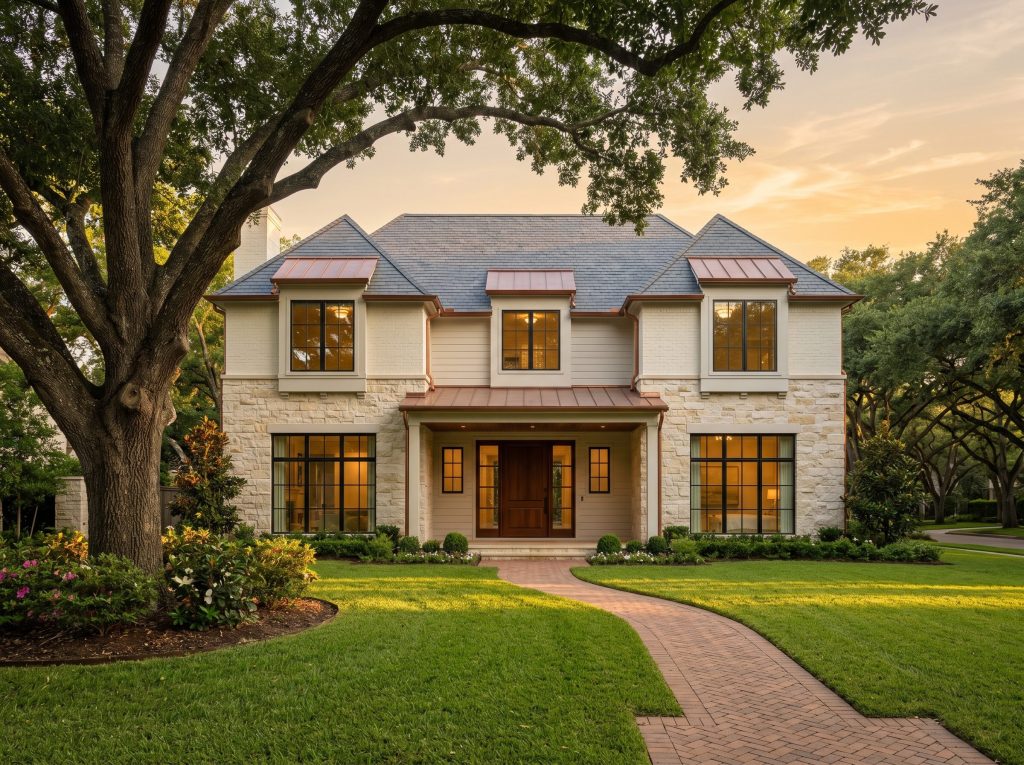
Keechi Creek Builders' Memorial custom home services cover the six Memorial Villages and the broader Memorial corridor — Memorial Close-In, Memorial Bend, Wilchester, Tanglewood, and the Memorial Park-adjacent neighborhoods extending to the Energy Corridor. The firm holds 32 industry awards including GHBA Custom Builder of the Year, multiple TAB Star Awards, GHBA PRISM Awards, and BBB Winner of Distinction, with active membership in the National Association of Home Builders (NAHB), Texas Association of Builders, Greater Houston Builders Association, and the National Kitchen and Bath Association.
Brandon Lynch's GMB, CGP, CGR, and CAPS credentials, combined with his Texas A&M structural engineering background, mean the same person reading a Hunters Creek Village ARC tree-preservation comment is the engineer interpreting the geotechnical report that will drive foundation design. For Memorial homeowners, that consolidation removes the single largest source of ARC-driven delay: handoffs between architect, engineer, and builder during the revision cycle.
Frequently Asked Questions About Memorial Architectural Review Committees
Do all six Memorial Villages have an architectural review committee?
Yes. Hunters Creek, Bunker Hill, Piney Point, Hedwig, Hilshire, and Spring Valley each operate an independent architectural review committee (sometimes ARB or ACC) under the village's deed restrictions and zoning ordinance. Each committee reviews exterior design, setbacks, materials, and tree preservation for any new construction or substantial exterior modification, and each village ARC must approve a project before the village permit office issues a building permit.
Are deed restrictions the same as zoning regulations in the Memorial Villages?
No. Deed restrictions are private recorded covenants enforced by the village and the property's neighbors; zoning is public regulation enforced by the village government. Both apply simultaneously to a Memorial custom home, and the more restrictive of the two controls any specific question. If zoning permits a 35-foot height and the deed restriction caps height at 30 feet, the deed restriction governs that lot.
How early should I engage with the village architectural review committee?
Engage the village ARC chair before construction documents are complete — ideally during schematic design. A 30-minute pre-submission conversation typically surfaces neighborhood-context standards and recent precedents that are not codified in the deed restrictions. That conversation prevents the most common ARC outcome: a substantive revision request that costs 4 to 8 weeks of redesign at architectural fees.
What happens if the village ARC requires revisions to my custom home design?
Revisions are normal — most Memorial custom homes go through at least one cycle. Minor revisions (relocate a downspout, adjust a fence detail) typically clear administratively in 1 to 2 weeks. Substantive revisions (reduce second-story massing, change exterior material, relocate the driveway) return to a full committee meeting 4 to 6 weeks later. A single design-build firm manages each revision inside one team rather than through architect-builder handoffs.
Does ARC approval guarantee my village building permit will be issued?
No. ARC approval is one of two required clearances. After ARC approval, the project moves to the village building permit office for code review, structural plan review, and permit issuance. The two reviews address different questions — design compliance vs. code compliance — and both must clear before construction can begin.
Do interior remodels in the Memorial Villages trigger architectural review?
Generally no, unless the remodel changes the exterior of the home. A kitchen renovation, bathroom remodel, or interior reconfiguration that does not alter windows, doors, roof, exterior walls, HVAC equipment location, or other publicly visible elements typically proceeds with a village building permit only. Confirm scope with the village ARC before drawings are finalized if the remodel touches the exterior at all.
Start Your Memorial Custom Home With Clear ARC Strategy
From village ARB approval through final walkthrough, Keechi Creek Builders coordinates every design, engineering, permitting, and construction decision for Memorial custom home projects inside one integrated team. For Memorial homeowners weighing a teardown-rebuild or new construction in Hunters Creek, Bunker Hill, Piney Point, Hedwig, Hilshire, or Spring Valley Village, the next step is a discovery conversation about lot specifics, program goals, and the applicable village ARC. Schedule an in-home design-build consultation with Brandon Lynch.
Call (281) 914-4951 to talk through your Memorial custom home and its architectural review path with our team first, and we will map your village's requirements and assemble a submission built to pass on the first review. If you would rather begin in writing, send us a message through our contact page at https://www.keechicreekbuilderstx.com/contact-us/, and Keechi Creek Builders will respond within 24 hours to start the conversation.