Magnolia, Texas operates under a dual-jurisdiction building code system where properties inside City of Magnolia limits follow 2021 International Codes (I-Codes) with 2023 NEC electrical standards, while properties in unincorporated Montgomery County follow different permitting requirements administered through the county's Environmental Health department. Determining which jurisdiction governs your lot is the first regulatory decision that affects every aspect of your custom home project, from permit timelines to septic requirements.
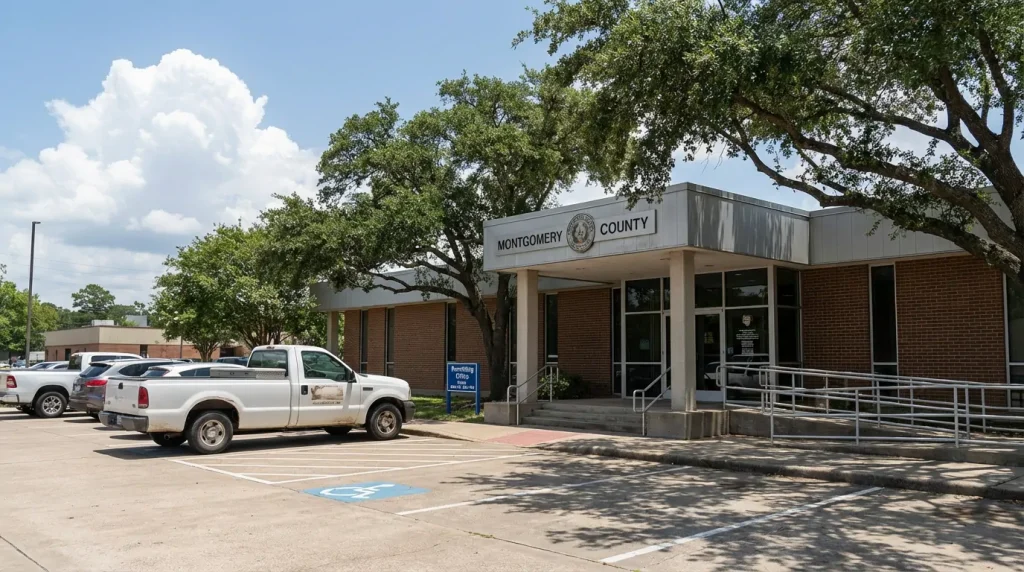
Key Takeaways
- Your address doesn't determine your jurisdiction: A Magnolia mailing address covers a much larger area than the City of Magnolia's approximately 5 square miles of incorporated city limits. Many properties with Magnolia addresses are actually in unincorporated Montgomery County with different building codes.
- Code versions differ between jurisdictions: The City of Magnolia adopted 2021 I-Codes and 2023 NEC as of August 2024 through Ordinance O-2024-014. Montgomery County's requirements focus primarily on development permits, floodplain compliance, and septic regulation rather than comprehensive building code enforcement.
- Permit processes work differently: City permits require plan review for all residential construction with compliance inspections. County development permits focus on floodplain management, address verification, and septic system approval, with the Montgomery County Fire Marshal handling fire code compliance.
- Septic vs. sewer determines site costs: Properties inside city limits typically connect to municipal sewer. Properties in unincorporated areas almost always require on-site septic systems (OSSF) permitted through Montgomery County, adding $8,000-$15,000+ to site preparation.
- Floodplain rules apply everywhere: Montgomery County requires structures in or within 100 feet of the Special Flood Hazard Area to be elevated at least 2 feet above Base Flood Elevation, with licensed surveyor or engineer Elevation Certificates required.
- A builder familiar with both systems saves months: Navigating the wrong jurisdiction's permit office, submitting incomplete applications, or missing septic requirements delays your construction timeline by weeks or months. Local expertise isn't optional here.
How Do You Determine Which Jurisdiction Governs Your Lot?
This is the question most Magnolia homeowners get wrong initially. You'd think a Magnolia address means you're in the City of Magnolia. It doesn't.
The City of Magnolia's incorporated limits cover approximately 5 square miles, with an extraterritorial jurisdiction (ETJ) extending about half a mile beyond that. But the Magnolia mailing address served by the postal system covers a dramatically larger area. Neighborhoods like Thousand Oaks, large sections of FM 2978 corridor acreage, and many equestrian properties carry Magnolia addresses while sitting in unincorporated Montgomery County.
Why does this matter for your custom home? Because the permit application, code version, plan review process, inspection schedule, and septic requirements change completely based on which side of that jurisdictional line your property falls on.
Two ways to verify your jurisdiction:
- Call the City of Magnolia directly at the Planning & Permits department and provide your property address. They'll confirm whether you're inside or outside city limits.
- Use the City's interactive zoning map accessible from the City of Magnolia website homepage. This shows incorporated boundaries, ETJ areas, and zoning districts.
We check jurisdiction as the first step on every Magnolia project. It's a 10-minute task that prevents months of downstream confusion. You'd be surprised how many homeowners (and some builders) discover mid-process that they've been filing with the wrong authority.
What Building Codes Apply Inside City of Magnolia Limits?
The City of Magnolia adopted the 2021 International Codes (I-Codes) and the 2023 National Electrical Code (NEC) on August 13, 2024 through Ordinance No. O-2024-014. These are the current enforceable standards for all residential and commercial construction within city limits.
That adoption includes the International Residential Code (IRC), International Building Code (IBC), International Mechanical Code (IMC), International Plumbing Code (IPC), International Energy Conservation Code (IECC), and International Fire Code (IFC). All codes are published by the International Code Council and represent the most current residential construction standards available.
For custom home builders, this means several practical requirements:
- Full plan review is required before construction. Submit construction documents to the city for compliance review, which typically takes about two weeks.
- Separate trade permits are required for plumbing, electrical, HVAC/mechanical, and other specific work after the building permit is issued.
- Inspections at every phase are mandatory. The city inspects foundation, framing, rough-in (plumbing, electrical, mechanical), insulation, and final before issuing a Certificate of Occupancy.
- Permits expire after 180 days if construction doesn't commence or is suspended for 180+ days.
One detail many homeowners miss: if your project requires any Montgomery County approvals (such as fire marshal compliance or county road culvert permits), those must be obtained in addition to city permits. The City of Magnolia and Montgomery County operate independently.
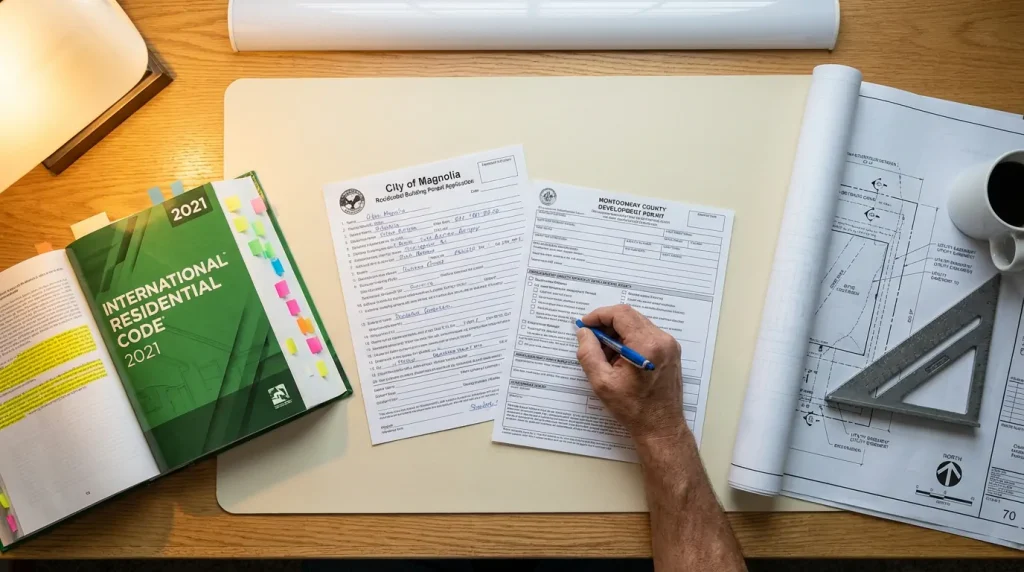
What Are the Building Requirements in Unincorporated Montgomery County?
Here's where it gets interesting for homeowners on acreage. Unincorporated Montgomery County does not enforce building codes in the same comprehensive manner as the City of Magnolia.
The Montgomery County Permit Office requires Development Permits for all proposed development in unincorporated areas. Development is defined broadly and includes constructing buildings, grading, clearing, and filling. But the county's permitting focus is primarily on floodplain management compliance, septic system approval (OSSF), fire code adherence, and address verification rather than the full building code plan review process that cities perform.
What does this mean for your custom home project in unincorporated Montgomery County?
- Development permits are required for any new construction, but the review process centers on floodplain compliance and site development rather than structural plan review.
- No comprehensive building code inspection occurs at the county level for residential construction. This means your builder's self-imposed quality standards and engineering oversight become critically important.
- Septic permits are mandatory through the OSSF (On-Site Sewage Facility) department for any property not connected to municipal sewer. The system must be designed by a licensed installer and approved before construction begins.
- Fire code compliance is handled through the Montgomery County Fire Marshal's office. Commercial buildings require fire code permits, though single-family residential does not require fire sprinklers.
- Floodplain elevation requirements apply regardless of jurisdiction. Properties in or within 100 feet of the Area of Special Flood Hazard must elevate structures at least 2 feet above Base Flood Elevation.
- New floodplain regulations took effect October 1, 2025, updating submittal requirements and permitting processes.
The practical implication? When you're building on 5 acres of gorgeous acreage off FM 1488 in unincorporated Montgomery County, your builder's internal quality control systems matter more than usual. There's no city inspector catching framing deficiencies or verifying insulation installation. Your builder either maintains those standards voluntarily or they don't.
What's the Side-by-Side Comparison?
| Requirement | City of Magnolia | Unincorporated Montgomery County |
|---|---|---|
| Building code version | 2021 I-Codes, 2023 NEC | No comprehensive building code enforcement |
| Permit required | Yes, full building permit | Yes, Development Permit |
| Plan review | Structural, mechanical, electrical, plumbing | Floodplain compliance, site development |
| Inspections | Foundation, framing, rough-in, insulation, final | Septic, floodplain elevation verification |
| Sewer/Septic | Municipal sewer connection (typical) | On-site septic (OSSF) required |
| Fire code | Part of adopted I-Codes | Montgomery County Fire Marshal (commercial) |
| Permit duration | 180 days from issuance | 180 days from system entry |
| Zoning | Unified Development Code applies | No county zoning (deed restrictions/HOA govern) |
| Tree removal | May require permit in city limits | Generally unrestricted (check HOA) |
| Driveway/Culvert | City review required | Precinct Commissioner approval may be required |
| Typical permit timeline | ~2 weeks for approval | Varies by completeness of submittal |
This table is something we wish we'd had when we started building in Montgomery County 19 years ago. It would have saved countless phone calls to the wrong offices.
Why Does This Dual-Jurisdiction System Create Problems for Homeowners?
The short answer: because most builders treat Magnolia as a single permitting environment. They're wrong.
We've consulted with homeowners who lost 6-8 weeks because their previous builder filed building permit applications with the city for a property in unincorporated county. Others didn't discover septic requirements until the foundation was already designed for a sewer connection that didn't exist. One family in the FM 2978 corridor learned about their lot's floodplain classification after signing a construction contract with a builder who never checked.
These aren't rare exceptions. They're predictable consequences of working with builders who treat "Magnolia" as one regulatory environment instead of two.
The fix is straightforward: jurisdiction verification before design begins. A builder with genuine local expertise checks jurisdiction, floodplain status, septic requirements, and HOA restrictions before the first line is drawn on a floor plan. At Keechi Creek Builders, this regulatory analysis happens during the initial consultation, not after problems surface.
How Does Your Builder's Local Expertise Affect Permit Timelines?
Permit timelines in Magnolia depend almost entirely on submittal quality. The City of Magnolia states approvals typically take about two weeks "depending on the project or if any revisions are needed." Montgomery County's Development Permits process on a similar timeline for complete submittals.
The key phrase is "complete submittals." Montgomery County explicitly states that incomplete applications will be rejected. All required fields must be filled, all supporting documents included, and all site information verified. A rejection means resubmitting from scratch.
Builders who navigate building a custom home in Magnolia regularly have the process dialed in. They know which documents each office requires, which supplementary approvals need to be secured first (county road culvert verification in Precinct 4, for example), and which common errors trigger rejections.
Builders who don't? They learn on your timeline and your budget.
Frequently Asked Questions
Is my property in the City of Magnolia or unincorporated Montgomery County?
Your mailing address alone doesn't determine jurisdiction. The City of Magnolia's incorporated limits cover approximately 5 square miles, while the Magnolia mailing address covers a much larger area. Use the City of Magnolia's interactive zoning map or call the Planning & Permits department directly to confirm whether your property falls within city limits, the ETJ, or unincorporated Montgomery County.
What building codes does the City of Magnolia enforce?
The City of Magnolia adopted the 2021 International Codes (I-Codes) and 2023 National Electrical Code (NEC) through Ordinance O-2024-014 on August 13, 2024. These include the International Residential Code, International Building Code, International Mechanical Code, International Plumbing Code, International Energy Conservation Code, and International Fire Code for all residential and commercial construction.
Does unincorporated Montgomery County have building codes?
Unincorporated Montgomery County does not enforce comprehensive building codes like incorporated cities do. The county requires Development Permits focused on floodplain management, septic system compliance, and fire code adherence. There is no county-level structural plan review or construction phase inspection for residential properties, making your builder's internal quality standards especially important.
How much does a septic system cost for a Magnolia custom home?
On-site septic systems (OSSF) for custom homes in unincorporated Montgomery County typically cost $8,000 to $15,000 or more depending on soil conditions, system type, and home size. The system must be designed by a Texas Commission on Environmental Quality (TCEQ) licensed installer and permitted through Montgomery County before construction begins. Soil testing and percolation rates determine which system types are suitable for your specific lot.
What are the floodplain requirements in Montgomery County?
Montgomery County requires structures in or within 100 feet of the Area of Special Flood Hazard to be elevated at least 2 feet above the Base Flood Elevation (BFE). Licensed surveyor or engineer Elevation Certificates are required to verify compliance. New floodplain management regulations took effect October 1, 2025, updating permitting processes and submittal requirements for all development within floodplain areas.
How long does it take to get a building permit in Magnolia?
Permit approval timelines depend on jurisdiction and submittal completeness. The City of Magnolia typically approves permits within approximately two weeks for complete applications. Montgomery County Development Permits process on a similar timeline. Incomplete submittals are rejected outright by both jurisdictions, requiring resubmission. Working with a builder experienced in both jurisdictions' requirements prevents rejection delays.
Do I need a permit for a fence, pool, or garage in Magnolia?
Within City of Magnolia limits, yes. Fences, pools, driveways, garages, generators, solar panels, and most exterior improvements require permits. In unincorporated Montgomery County, residential permits focus on structures and development rather than individual trade work. However, HOA architectural review requirements may impose additional approval steps regardless of jurisdiction. Always check both governmental and HOA requirements before construction.
Conclusion
Magnolia's dual-jurisdiction building code system is the single most important regulatory factor that custom home buyers need to understand before selecting a lot or a builder. Whether your property falls inside the City of Magnolia's 5-square-mile incorporated limits or in unincorporated Montgomery County determines your code version, permit process, inspection standards, and septic requirements. A builder who doesn't know which side of that line your lot sits on isn't ready to build your home. The most efficient path through this regulatory landscape is working with a builder who has navigated both jurisdictions for years, not one who will figure it out on your project.