Building a custom home in Cypress, TX requires navigating a dual-governance regulatory system that trips up even experienced buyers. Harris County controls building permits and inspections. Master-planned communities like Bridgeland and Towne Lake add a second layer of Architectural Review Board oversight. Understanding both systems before you purchase a lot protects your investment and prevents costly surprises.
Key Takeaways
- Dual-Governance Reality: Cypress custom home builds must satisfy both Harris County engineering permits and your community's Architectural Review Board (ARB) requirements, creating a two-track approval process most out-of-market builders don't understand.
- Lot Selection Determines Everything: Soil conditions, flood zone classification, utility easements, and setback requirements in Cypress vary dramatically between master-planned communities and private acreage, directly affecting foundation cost and home design.
- Harris County Permitting Timeline: Residential building permits through Harris County Engineering Department typically require 4-8 weeks for review and approval, with additional time for structural and MEP plan reviews that most builders underestimate.
- MUD Tax Impact Is Significant: Municipal Utility Districts fund Cypress infrastructure through property tax rates that can add $0.50-$1.50+ per $100 of assessed valuation on top of Harris County taxes, a cost many buyers overlook entirely.
- ARB Approval Precedes County Permits: In Bridgeland, Towne Lake, and other Cypress MPCs, your home design must receive Architectural Review Committee approval before you can even submit plans to Harris County for building permits.
- Builder Regulatory Fluency Matters: A builder with hands-on experience navigating both Harris County permitting processes and multiple Cypress MPC design review boards eliminates the regulatory bottlenecks that delay construction timelines by months.
Why Does Cypress Require Two Layers of Building Approval?
Cypress sits in unincorporated Harris County. That means no city government reviews your plans. Harris County's Engineering Department handles building permits, structural inspections, and code compliance for all residential construction in the area.
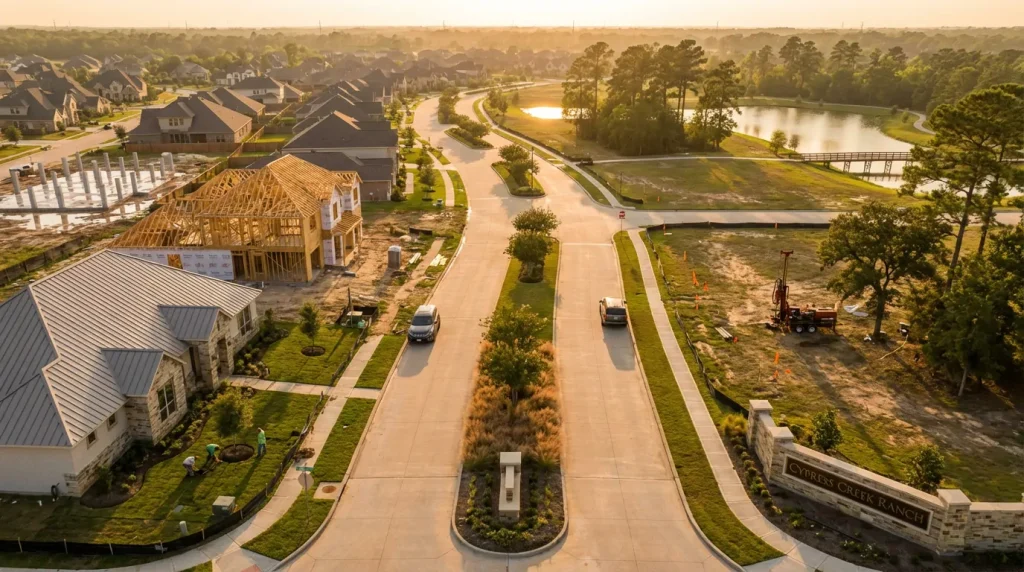
But here's where it gets complicated. Most custom home lots in Cypress are inside master-planned communities governed by their own Architectural Review Boards. Bridgeland (developed by Howard Hughes Holdings) and Towne Lake (developed by Caldwell Companies) each enforce design standards that go well beyond county code.
Your home must satisfy both authorities. The county cares about structural integrity, fire safety, and code compliance. The ARB cares about elevations, materials, setbacks within the community, and whether your design "fits" the neighborhood aesthetic. We've guided clients through both approval tracks across multiple Cypress communities, and the process demands a builder who understands the specific requirements of each governing body.
A builder whose primary experience is in The Woodlands or Memorial won't automatically know Bridgeland's specific material restrictions or Towne Lake's lakefront setback requirements. That local fluency is what separates a smooth 4-week approval from a frustrating 12-week cycle of revisions and resubmissions.
What Does the Harris County Permitting Process Look Like for Custom Homes?
Harris County's Engineering Department reviews all residential building permits for unincorporated areas including Cypress. The process involves submitting complete construction documents (architectural plans, structural engineering, MEP systems) and waiting for plan review approval before breaking ground.
Here's the typical timeline we see for custom homes in the Cypress corridor:
| Permit Phase | Typical Duration | What's Reviewed |
|---|---|---|
| Plan Submission & Initial Review | 2-3 weeks | Structural, architectural, site plan |
| Corrections & Resubmission (if needed) | 1-3 weeks | Engineer's response to review comments |
| Final Approval & Permit Issuance | 1-2 weeks | Final stamps, fee payment, permit card |
| Total Range | 4-8 weeks | Complete permit package |
The reality? Most delays happen because builders submit incomplete packages. Missing structural calculations, incomplete drainage plans, or site plans that don't match the surveyor's plat create correction cycles that add weeks.
Our approach at Keechi Creek Builders is front-loading the engineering work. Brandon Lynch, GMB, CAPS, CGP (Texas A&M construction science) reviews every permit package before submission because an engineer's eye catches the issues that trigger rejection letters. That discipline consistently keeps our permit timelines at the shorter end of that 4-8 week range.
How Do Architectural Review Boards Work in Cypress Communities?
If you're building in a master-planned community, the ARB (sometimes called the ARC, Architectural Review Committee) reviews your home plans before Harris County ever sees them. This isn't optional. You cannot submit for a county permit until the community approves your design.
Each community has its own standards. Bridgeland, for example, publishes detailed design guidelines covering exterior materials, roof pitch minimums, garage placement, fencing, and landscape requirements. Towne Lake's lakefront sections have additional restrictions on elevation heights and dock placements.
The ARB review process typically involves:
- Submitting exterior elevations, site plans, material selections, and color palettes
- Committee review during scheduled monthly or bi-monthly meetings
- Written approval, conditional approval with required modifications, or denial with explanation
- Resubmission if conditions aren't met (adds 2-4 weeks per cycle)
Here's what catches people off guard. The ARB doesn't just approve your floor plan. They evaluate how your home relates to neighboring properties, whether your materials meet community minimums (some communities require minimum percentages of masonry on front elevations), and whether the home's scale matches the lot.
We've navigated ARB submissions in Bridgeland, Towne Lake, and other Cypress MPCs enough times to know what each committee prioritizes. That experience means we design with approval in mind from day one, rather than designing in a vacuum and hoping the ARB agrees after the fact.
What Should You Evaluate Before Buying a Lot in Cypress?
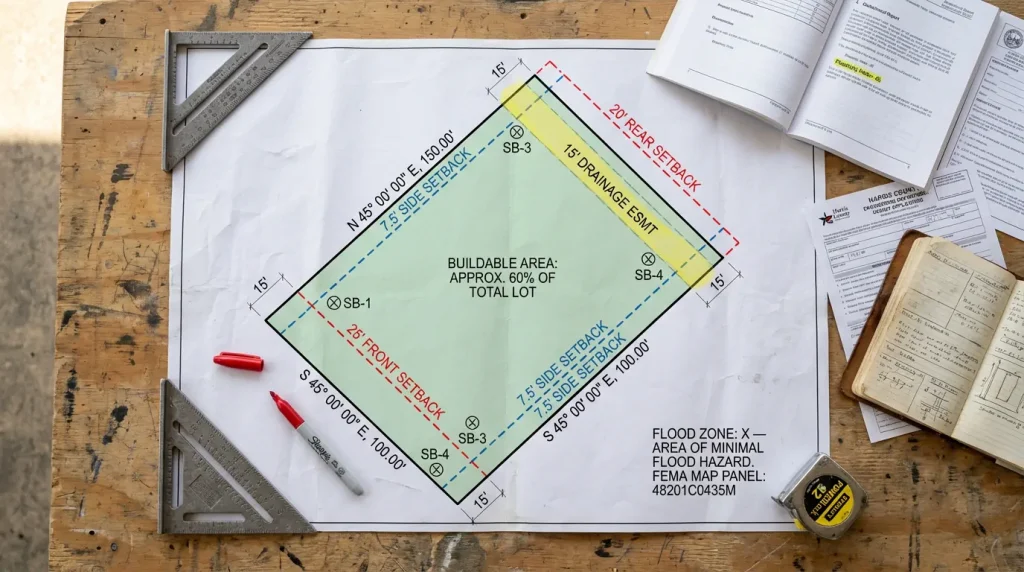
Lot selection is the single decision that constrains or enables everything that follows. A gorgeous lot with hidden problems can add $50,000-$100,000+ to your construction budget before a single wall goes up.
Before committing to any lot in Cypress, evaluate these factors:
Soil Conditions and Geotechnical Report. Cypress sits on Gulf Coast clay soils that expand and contract with moisture. A geotechnical investigation reveals the Plasticity Index (PI) of your soil, which directly determines your foundation system. Higher PI values mean more expensive pier-and-beam or drilled pier foundations. We've built on lots in Cypress where soil conditions varied dramatically between properties on the same street.
Flood Zone Classification. Check FEMA's Flood Insurance Rate Maps for your specific lot. Cypress experienced significant flooding during Hurricane Harvey. Some lots in Zones AE or A require elevated foundation designs, flood insurance, and additional engineering that increases cost and extends timelines. The Harris County Flood Control District maintains local data that supplements federal maps.
Utility Connections and MUD Infrastructure. In Cypress, Municipal Utility Districts (MUDs) provide water, sewer, and drainage infrastructure. Your lot's MUD determines tap fees, connection availability, and the additional property tax levy that funds district operations. Some MUDs have capacity constraints that delay connections. Know your MUD before you close.
Setback Requirements and Building Envelope. Between community deed restrictions and county requirements, your actual buildable area may be significantly smaller than the lot's total acreage. Front, side, and rear setbacks in some Cypress communities consume 30-40% of the lot's area. We review the survey plat and deed restrictions together to calculate the true building envelope before you commit.
How Do MUD Taxes Affect Your Custom Home in Cypress?
MUD taxes are the single most misunderstood financial factor in Cypress custom home construction. Most buyers from inside the Houston city limits have never encountered MUD taxation, and the numbers can be eye-opening.
Municipal Utility Districts are special-purpose governmental entities created to fund infrastructure (water treatment, wastewater, drainage, roads) in unincorporated areas like Cypress. They recoup infrastructure costs through property tax levies assessed on every home within the district's boundaries.
Your total Cypress property tax bill typically includes:
| Taxing Entity | Approximate Rate (per $100 assessed value) |
|---|---|
| Harris County | $0.35-$0.40 |
| Cypress-Fairbanks ISD (CFISD) | $1.10-$1.20 |
| Harris County Flood Control | $0.03-$0.04 |
| MUD District | $0.50-$1.50+ |
| Other (ESD, PID, etc.) | $0.05-$0.15 |
| Total Estimated Range | $2.03-$3.29+ |
That MUD line item varies enormously. A mature MUD with bonds largely retired might charge $0.50 per $100. A newer MUD still funding infrastructure buildout could charge $1.50 or more. On a $1.2 million custom home, the difference between those rates is over $12,000 per year in property taxes.
We walk every client through the specific MUD tax analysis for their lot before they sign a purchase contract. The numbers matter, and they're rarely discussed by real estate agents or production builders.
What's the Difference Between Building in a Cypress MPC vs. Private Acreage?
This is one of the most consequential decisions in your Cypress custom home journey. Both paths lead to a personalized residence, but the experience and constraints are fundamentally different.
Master-Planned Communities (Bridgeland, Towne Lake, Miramesa) offer developed infrastructure, community amenities (pools, trails, recreation centers), established school zones, and curated neighborhood aesthetics. The trade-off is design restriction. ARB guidelines limit your materials, colors, architectural style, and sometimes even your builder selection. Lots are typically smaller (0.15-0.40 acres) and priced at a premium.
Private Acreage (unincorporated Harris County) offers maximum design freedom. No ARB. No mandatory materials. No restrictions on architectural style beyond Harris County code. Lots are larger (1-5+ acres), often more affordable per square foot, and allow features impossible in MPCs (equestrian facilities, detached workshops, extensive outbuildings). The trade-off is infrastructure responsibility. You may need to drill a private well, install a septic system, or fund road improvements.
| Factor | Master-Planned Community | Private Acreage |
|---|---|---|
| Design Freedom | ARB-restricted | Nearly unlimited |
| Lot Size | 0.15-0.40 acres typical | 1-5+ acres typical |
| Infrastructure | MUD-provided | Owner responsibility |
| Amenities | Community pools, trails, centers | Self-created |
| Permitting | ARB + Harris County | Harris County only |
| Timeline Impact | ARB adds 4-8 weeks | No ARB delay |
| Resale Considerations | Community brand premium | Value in acreage |
Neither option is inherently better. The right choice depends on your priorities. We've built in both settings across Cypress, and we help clients evaluate the full picture before they commit to a path. If you're weighing these options, our article on Bridgeland vs. Towne Lake vs. private lots breaks down the community-specific differences in detail.
How Does a Builder's Local Knowledge Protect Your Custom Home Investment?
The regulatory complexity of building a custom home in Cypress, TX isn't a barrier. It's a filter. Builders with genuine Cypress experience navigate it efficiently. Builders without it burn your time and money learning on the job.
Here's what local knowledge looks like in practice. A builder who's submitted plans to Bridgeland's ARB multiple times knows that the committee meets on the second Thursday of each month, that late submissions get pushed to the next cycle, and that specific elevation styles get conditional approvals requiring particular material swaps. That's not information you find on a website. It comes from doing the work.
At Keechi Creek Builders, Brandon Lynch's engineering background means we approach Cypress permitting and HOA approvals with a level of technical preparation that eliminates most correction cycles. We review structural calculations before the county does. We design with ARB preferences already factored in. We identify lot constraints during site evaluation, not after you've closed on the property.
That's the difference between a 12-month build timeline and an 18-month frustration. For clients exploring the custom home building process in Cypress, understanding this regulatory landscape is where confidence begins.
Your Cypress custom home builder should be the guide who makes this complexity disappear, not someone who discovers it alongside you.
Frequently Asked Questions
How long does it take to get a building permit in Cypress, TX?
Building permits through Harris County Engineering Department typically take 4-8 weeks from complete plan submission to permit issuance. If your lot is in a master-planned community, add 4-8 weeks for ARB approval before county submission. Incomplete packages or plan corrections extend timelines further. Working with a builder experienced in Harris County submissions reduces delays significantly.
Do I need ARB approval before applying for a Harris County building permit?
Yes. In Cypress master-planned communities like Bridgeland and Towne Lake, Architectural Review Board approval is required before submitting plans to Harris County for building permits. The ARB evaluates exterior design, materials, and site plan compliance with community standards. County review only begins after you receive written ARB approval.
What are MUD taxes and how do they affect my Cypress custom home?
Municipal Utility Districts levy property taxes to fund infrastructure (water, sewer, drainage) in unincorporated areas like Cypress. MUD rates range from approximately $0.50 to $1.50+ per $100 of assessed value, depending on the district's bond obligations. On a $1.2 million home, this translates to $6,000-$18,000+ annually in MUD taxes alone.
What soil conditions should I know about before building in Cypress?
Cypress sits on Gulf Coast expansive clay soils with high Plasticity Index values. These soils expand when wet and contract when dry, creating foundation movement risk. A geotechnical investigation before construction determines the required foundation system (slab-on-grade with post-tension cables, drilled piers, or hybrid approaches). Soil conditions vary significantly between lots, even within the same community.
Can I build a custom home on private land in Cypress without HOA restrictions?
Yes. Private acreage in unincorporated Harris County outside master-planned communities has no HOA or ARB oversight. Your design is subject only to Harris County building codes and any existing deed restrictions. This provides maximum architectural freedom but also requires you to manage infrastructure (wells, septic, drainage) that MPCs provide through MUD-funded systems.
How much does it cost to build a custom home in Cypress, TX?
Custom home construction in Cypress typically ranges from $200 to $400+ per square foot, depending on design complexity, finish level, lot conditions, and foundation requirements. A 3,500 sq. ft. custom home on favorable soil conditions might start around $700,000, while a 5,000 sq. ft. home with premium finishes, challenging soil, and lakefront lot premiums can exceed $2 million. Foundation engineering costs are a particularly important variable that varies by lot.
What makes building in Cypress different from other Houston suburbs?
Cypress's unique dual-governance structure (Harris County + MPC Architectural Review Boards), expansive clay soil conditions, MUD-funded infrastructure, and the presence of multiple master-planned communities with distinct design standards create a regulatory environment unlike any other Houston submarket. Understanding these Cypress-specific factors before purchasing a lot or selecting a builder is essential.
Your Custom Home Starts with Understanding the Landscape
Building a custom home in Cypress, TX is one of the most rewarding investments you can make. The communities are thriving, Cypress-Fairbanks ISD consistently ranks among the state's strongest districts, and the corridor's mix of master-planned amenities and private acreage offers something for every vision.
But the regulatory complexity is real. Dual-governance approval, MUD tax structures, Gulf Coast soil challenges, and community-specific design restrictions mean that your choice of builder matters as much as your choice of lot. The right guide transforms complexity into confidence, keeping your timeline on track and your investment protected.
At Keechi Creek Builders, we've spent 19 years building that local expertise across Houston's most demanding submarkets. When you're ready to explore building your custom home in Cypress, we'll help you navigate every layer of this process with clarity and precision. Schedule a consultation to start the conversation.