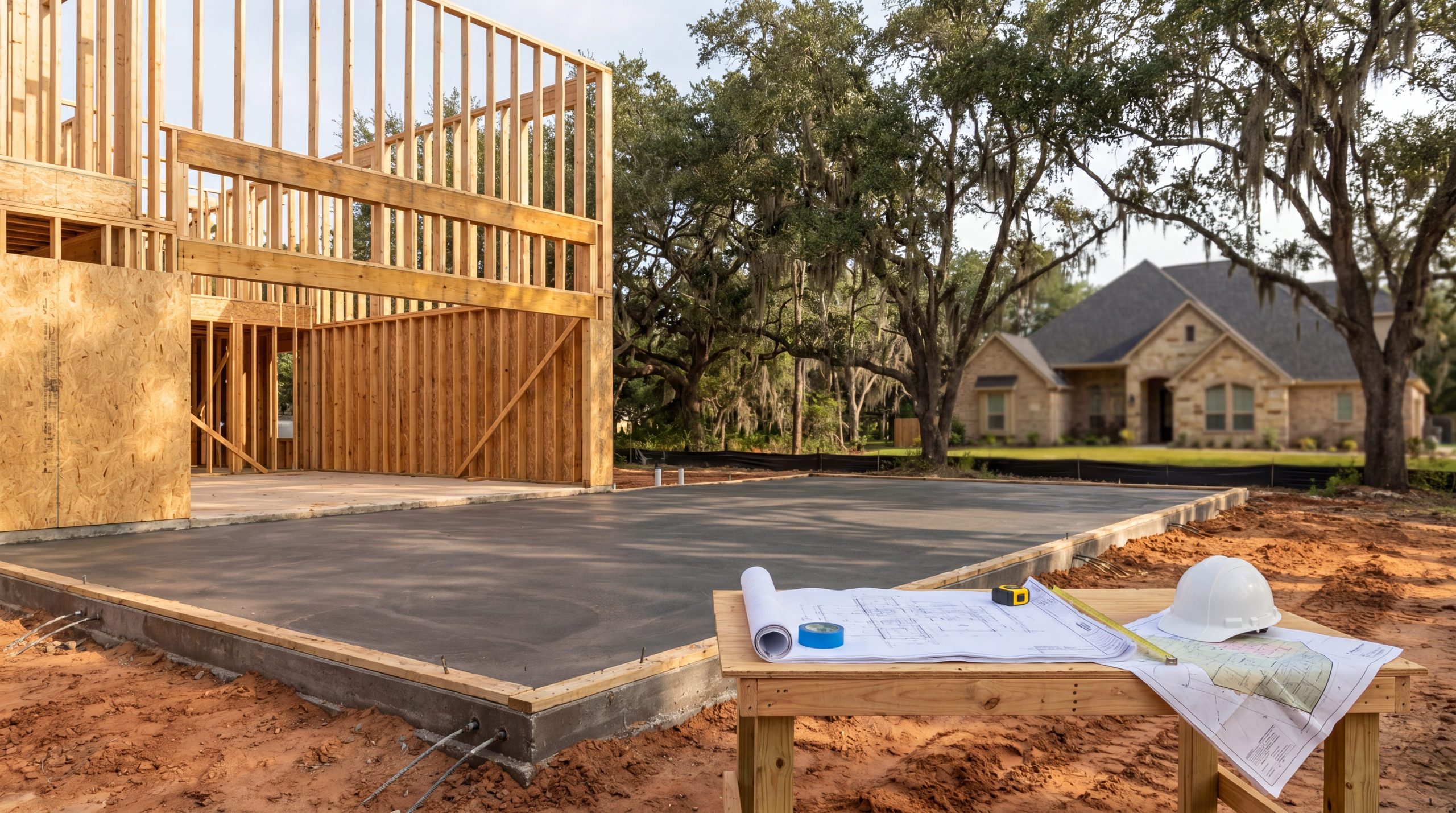
The questions to ask a custom home builder before signing a contract fall into six categories — credentials and licensing, references and recent projects, contract structure and allowances, communication and project management, subcontractor and quality control, and warranty and post-build support. For Cypress, TX homeowners, the right questions also surface community-specific experience with Bridgeland's Design Review Committee, Harris County permitting, and Beaumont Formation clay soil engineering — the local realities a generic interview misses.
Key Takeaways
- Interview Six Categories: A complete builder interview covers credentials and licensing, references and recent projects, contract structure and allowances, communication and project management, subcontractor and quality control, and warranty and post-build support — skipping any one of these creates blind-spot risk before you sign.
- Cypress Context Matters: A builder who has navigated the Bridgeland Design Review Committee, Harris County Engineering Department permitting, and Beaumont Formation clay soil knows the questions you should ask before you ask them — and the wrong answers tell you more than the right ones.
- References Should Be Recent and Local: Ask for three completed-project references from the past 18 months in Cypress or northwest Houston, including one project the builder will admit was difficult — vague or aging references are the first red flag.
- Contract Type Drives Risk: Fixed-price versus cost-plus versus design-build contracts allocate risk very differently — understand which model the builder uses, how change orders are documented, and how allowance overruns are billed before signing.
- Communication Cadence Is a Predictor: A weekly owner meeting, a single named point of contact, and a documented progress-tracking process predict on-time delivery far more reliably than promises about speed.
- Warranty Structure Reveals Confidence: A builder who self-services warranty work in-house rather than outsourcing to a third party is putting their reputation on the line for a decade — that posture matters more than the warranty document itself.
What Credentials and Licensing Questions Should You Ask First?
The first interview block establishes whether the builder is qualified to operate in Cypress and Harris County at all. The National Association of Home Builders publishes a consumer-resources framework that recommends starting with licensing, insurance, and credential verification before any conversation about design or budget. For Cypress homeowners, the questions break down as follows.
- How long have you been in business under your current entity name? Builders rebrand to escape complaint histories. A continuous 10-plus-year track record under the same legal entity signals stability. Keechi Creek Builders has operated continuously since October 3, 2007, under BSL Interests LLC.
- What licenses, insurance certificates, and bond documents can you produce on request? A reputable builder produces a current Certificate of General Liability Insurance, Workers' Compensation coverage, and any required Harris County contractor documentation without hesitation.
- What industry credentials do you and your team hold? Look for NAHB designations — Graduate Master Builder (GMB), Certified Aging-in-Place Specialist (CAPS), and Certified Green Professional (CGP) — plus relevant memberships in the Greater Houston Builders Association (GHBA) and the Texas Association of Builders (TAB). Brandon Lynch holds all three NAHB designations, and KCB maintains a Better Business Bureau A+ rating since 2011.
- Are you experienced with the regulatory bodies governing my project? For a Cypress build, that means Harris County Engineering Department permitting in unincorporated jurisdictions, the Harris County Flood Control District drainage review, and the architectural review committee governing your specific community — most often the Bridgeland Design Review Committee, the Towne Lake Architectural Review Board, or the equivalent body for Canyon Lakes West, Dunham Pointe, Miramesa, Cypress Creek Lakes, Coles Crossing, or Fairfield.
If the builder cannot answer all four of these without rehearsal, the interview is effectively over.
How Should You Vet References and Recent Project Examples?
References are where most homeowners under-investigate and where most regrets begin. A short reference list, references all more than three years old, or builders who request several days to "get permission" before sharing contacts are all warning signs.
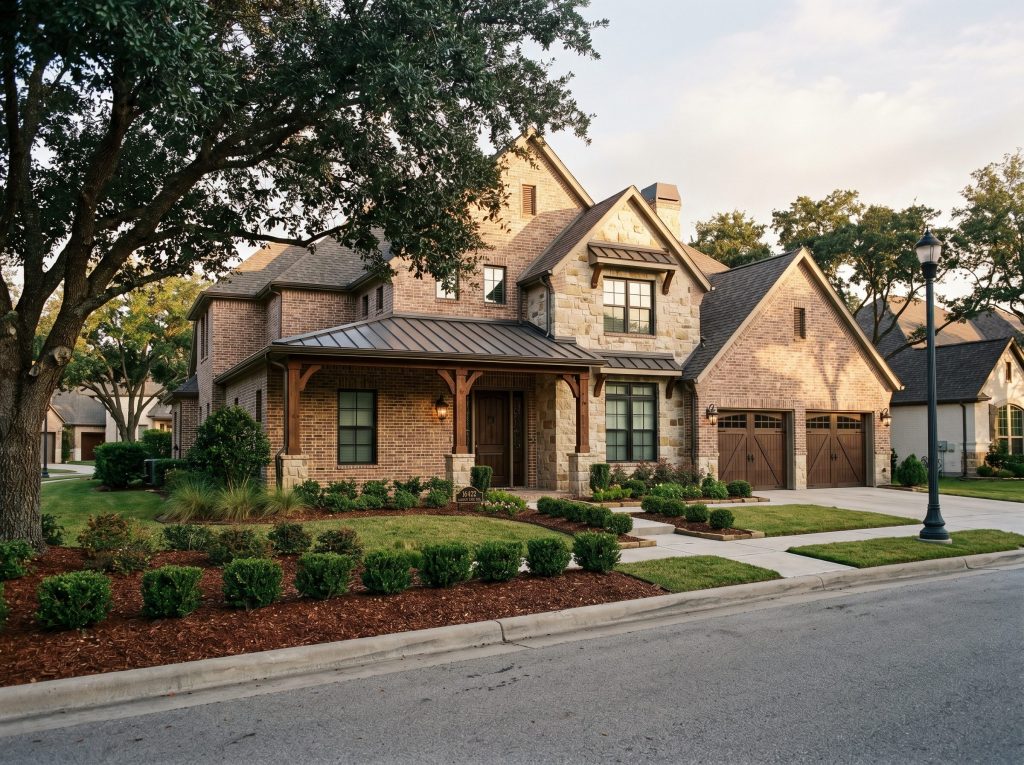
- Can you provide three completed-project references from the past 18 months? Recent references reflect the builder's current crew, current subcontractors, and current communication culture — not the practices of an earlier team.
- Can I drive by completed homes and meet a current client mid-project? A builder confident in their work invites prospective clients to walk a finished home and visit an active jobsite. A reluctance to facilitate site visits is the strongest single signal that the builder's claims do not survive on-site observation.
- Can you share an example of a project that ran into trouble and how you resolved it? Every builder has a difficult project; only honest builders will discuss one. The answer reveals problem-solving discipline, accountability culture, and how the builder behaves when the client is unhappy.
- What does your client say about you 12 months after move-in? Post-move-in service quality separates the builder you want from the one whose phone stops working after the punch list is signed.
For Cypress homeowners, prioritize references within Bridgeland, Towne Lake, Canyon Lakes West, Dunham Pointe, Miramesa, Fairfield, or Coles Crossing. A builder with neighborhood-specific references has demonstrated the ability to navigate the Design Review Committee or Architectural Review Board that governs your future project.
What Should You Ask About the Contract, Allowances, and Pricing?
Contract structure is where most budget surprises originate. The three dominant contract models — fixed-price, cost-plus, and design-build — allocate risk very differently, and the right model depends on how the project is defined when the contract is signed.
|
Brandon's Builder Insight In 19 years building in Cypress, the question I most respect from a prospective client is 'Can I see your standard allowance schedule for a home in my size range?' An honest builder will hand it to you on the spot. The allowance schedule is where a low-baller's bid hides — vague allowances absorb the price escalation later as change orders. Our schedule for a Bridgeland or Towne Lake build is line-itemed because the design-build model only works when the numbers are visible. If a builder cannot produce that schedule in the first meeting, the rest of the interview is just sales. |
- What contract model do you use, and why is it the right fit for my project? A fixed-price contract sets a total price upfront and shifts overrun risk to the builder, but it depends on completed design documents and may discourage flexibility. A cost-plus contract bills actual materials and labor plus a fixed fee, offering transparency but requiring trust. A design-build contract — KCB's preferred model — integrates design, engineering, and construction under a single agreement, eliminating the architect-to-contractor handoff that historically generates most disputes.
- What does your allowance schedule look like? Insist on an itemized allowance schedule — cabinetry, countertops, flooring, fixtures, appliances, lighting, plumbing fixtures, exterior materials — rather than a single lump sum. Real numbers per line item let you compare bids apples-to-apples and reveal where the budget can flex without surprise.
- How are change orders documented, approved, and billed? A clean change-order process produces a written change-order document with cost, schedule impact, and your signature before the work is performed. Anything less invites disputes.
- How do you handle material price escalation between contract signing and installation? In a market where lumber, steel, and appliance pricing can shift 10–20% in a quarter, the contract should specify who bears escalation risk and what the threshold is for renegotiation.
- What is your draw schedule, and how is each draw verified? Tie draws to verifiable milestones — foundation complete, framing complete, dry-in, mechanical rough-in, drywall, trim, final — not to calendar dates. The bank financing your build typically requires the same structure.
How Do You Evaluate Communication, Project Management, and Quality Control?
Communication discipline predicts on-time delivery and client satisfaction more reliably than any other variable. Ask the questions that reveal whether the builder runs a structured process or improvises.
- Who will be my day-to-day point of contact? A single named project manager — supported by a superintendent on-site — produces clearer accountability than a rotating cast of office staff. Ask the project manager's name, tenure, and current project load.
- How many homes will your team be building during my construction window? Capacity matters. A small custom shop that takes on too many simultaneous projects produces the same neglect symptoms as an oversized production builder — missed inspections, late material orders, slipped milestones.
- What is your communication cadence? A weekly owner meeting — in person or virtual, with a written agenda and minutes — beats reactive texting every time. Ask to see a sample meeting minutes document from a current project.
- How do you handle on-site quality control? Multi-stage inspection — superintendent daily, project manager weekly, owner mid-project — catches deficiencies before they are buried under finishes. Ask to see the quality control checklist.
- What project management software or client portal do you use? A real-time digital portal where you can see schedule, photos, decisions log, and budget is now the industry baseline. Builders still working from spreadsheets and texts will struggle with the documentation a Cypress custom home deserves.
For a Cypress build, also ask: How do you sequence Harris County permitting and the Design Review Committee submittal so they run in parallel rather than back-to-back? Builders who treat these as consecutive workstreams add four to eight weeks to the timeline.
What Subcontractor and Quality-Control Questions Should You Ask?
The builder you sign with is rarely the person framing your walls, running your wire, or finishing your trim. Subcontractor selection and management is where craftsmanship lives or dies.
- Are your subcontractors employees, long-term partners, or low-bid hires per project? Long-term subcontractor relationships produce consistent quality; low-bid rotation produces inconsistency. A builder should name their lead framing crew, electrician, plumber, HVAC contractor, and finish carpenter — and explain how long the relationship has lasted.
- What is your subcontractor vetting process? Ask whether the builder verifies insurance, runs background checks, and audits work product on a recurring basis.
- How do you handle subcontractor disputes or non-performance? A real answer involves clear contractual language, replacement protocols, and a willingness to pay the cost of bringing in a new sub mid-project if quality slips.
- Who supervises the site daily, and what is the supervision-to-jobsite ratio? A dedicated site superintendent for every two-to-three concurrent jobs is industry baseline; one superintendent stretched across six jobs is not.
What Warranty and Post-Construction Questions Should You Ask?
The warranty conversation reveals how a builder thinks about the relationship after move-in. A short, vague, or outsourced warranty signals a builder who treats handoff as the end of the relationship.
|
Actionable Tip Before you sign anything, ask each finalist builder for the contact information of one client who completed their warranty year and is now living in the home — not a recent move-in. Call that client and ask: 'How responsive was the builder during the warranty year, and would you hire them again?' The answer is the single most predictive data point in the entire interview process. |
- What does your warranty cover, and what is the term for each category? Industry baseline is the 1-2-10 structure — one year for workmanship and materials, two years for mechanical, electrical, and plumbing systems, and ten years for major structural defects. Texas builders typically reference Texas Property Code Chapter 27 for the statutory framework.
- Do you service warranty work in-house or through a third party? In-house warranty service signals confidence and accountability. A builder who hands you off to a third-party warranty company at move-in is structurally separating themselves from the work they built.
- What is your one-year walkthrough process? A real builder schedules a structured 11-month or 12-month walkthrough with the homeowner, documents every concern, and resolves them before the warranty year expires.
- How are post-warranty service requests handled? A builder who maintains relationships with past clients for repairs, additions, and second-generation projects has built a business model around lifetime value rather than one-time transactions.
What Cypress-Specific Questions Should You Ask Any Custom Builder?
A generic interview guide misses the questions that matter most for a Cypress project. Add these to every conversation.
- Are you on the approved builder list for the community where I want to build? Bridgeland, Towne Lake, and several other Cypress communities maintain approved-builder requirements. Confirm in writing.
- What is your experience with Howard Hughes Corporation's Bridgeland Design Review Committee? A builder with multiple Bridgeland submittals knows the recurring DRC red flags — masonry percentages, garage door articulation, roof pitch combinations — and resolves them in design rather than revision.
- How do you engineer foundations for Beaumont Formation expansive clay soil? A post-tensioned slab engineered to a specific geotechnical report is non-negotiable in Cypress. Ask when in the process the soil borings are pulled and how that data informs the slab design.
- What is your familiarity with Harris County Engineering Department permitting and the Harris County Flood Control District drainage review? Unincorporated Harris County permitting differs from the City of Houston process, and HCFCD review applies to most Cypress lots near the Cypress Creek watershed.
- Is your team trained in [Cypress-Fairbanks ISD](https://en.wikipedia.org/wiki/Cypress-Fairbanks_Independent_School_District){target="_blank" rel="noopener"}-zone construction logistics? Driveway closures, school-traffic-hour material deliveries, and Bridgeland's HOA construction-hour restrictions all affect schedule.
Frequently Asked Questions
How many builders should I interview before choosing one?
Three is the practical floor; five is the upper limit before diminishing returns. Interview enough finalists to compare contract structures, communication cadences, and reference quality side-by-side, but not so many that the comparison loses focus. For a Cypress custom home, schedule each interview as a 60–90 minute conversation with the project manager and the principal builder, not just a sales meeting — the chemistry test matters as much as the question-by-question answers.
Should I ask for a written proposal at the first meeting?
Not for a custom home. A first meeting should produce a budget range, a preliminary scope conversation, and a process explanation — not a fixed proposal. Custom home pricing depends on design documents, soil borings, and material selections that take 8–12 weeks to develop. Any builder who hands you a fixed-price quote at the first meeting is either lowballing to win the contract or planning to recover margin through change orders later.
What is the single biggest red flag during a builder interview?
Reluctance to share recent local references. Every other concern — pricing, contract structure, schedule — can be negotiated. A builder who cannot or will not produce three completed-project references within Cypress or northwest Houston from the past 18 months is signaling either limited recent experience or a track record they prefer not to surface. End the interview and move to the next finalist.
How do I verify the credentials a builder claims to hold?
NAHB designations like Graduate Master Builder, Certified Aging-in-Place Specialist, and Certified Green Professional are verifiable on the NAHB website by designee name. Better Business Bureau accreditation status is verifiable on the BBB website. State licensing for general contractors varies — Texas does not license general contractors at the state level, but most reputable builders are members of the Greater Houston Builders Association and the Texas Association of Builders, both verifiable through the association membership lookups.
Is it appropriate to ask about a builder's financial stability?
Yes. Ask whether the builder has ever filed for bankruptcy under any entity name, whether they maintain a line of credit sufficient to cover schedule disruptions, and whether they can provide a banker reference. A builder who is offended by these questions is not a builder you want managing a $1M-plus construction project. Financial instability is the leading cause of unfinished custom homes in the Cypress market.
Get Ready to Interview Your Cypress Custom Home Builder With Confidence
The right questions, asked early, are the difference between a custom home built to your standards and a project you spend two decades regretting. A Cypress custom home is engineered around clay soil, governed by a Design Review Committee, permitted through Harris County, and lived in by a family who deserved every honest answer the interview process could produce. Treat the builder interview as the most important conversation in the project, because it is.
Keechi Creek Builders welcomes the questions in this guide and the ones we have not anticipated. Brandon Lynch's engineering training through Texas A&M, the firm's 32 industry awards from the Texas Association of Builders and Greater Houston Builders Association, and 19 years of continuous Houston-area design-build experience are the foundation underneath every Cypress custom home we deliver.
Call Keechi Creek Builders first at (281) 914-4951 to start your builder interview conversation, or send a message through our contact page at https://www.keechicreekbuilderstx.com/contact-us/ — we will get back to you within 24 hours to answer every question on your list and a few you have not thought to ask yet.
Call Keechi Creek Builders first at (281) 914-4951 to start your builder interview conversation, or send a message through our contact page at https://www.keechicreekbuilderstx.com/contact-us/ — we will get back to you within 24 hours to answer every question on your list and a few you have not thought to ask yet.
Call Keechi Creek Builders first at (281) 914-4951 to start your builder interview conversation, or send a message through our contact page at https://www.keechicreekbuilderstx.com/contact-us/ — we will get back to you within 24 hours to answer every question on your list and a few you have not thought to ask yet.