The custom home building process in Cypress, TX follows a structured sequence of seven phases — from initial vision meeting through design development, permitting, construction, and final walkthrough — typically spanning 12 to 18 months for homes built in Harris County and Cypress-area master-planned communities like Bridgeland and Towne Lake. Brandon Lynch, a Texas A&M-trained Graduate Master Builder (GMB) and founder of Keechi Creek Builders, has guided families through this process for over 19 years across Greater Houston's most demanding submarkets.
Most families who begin researching how to build a house in Cypress TX run into the same frustration. Builder websites show glossy photos and vague three-step overviews ("Meet. Design. Move in.") that skip everything that actually matters. The reality? Building a custom home involves hundreds of coordinated decisions across seven distinct phases, and understanding what happens at each stage is the single most important thing you can do to protect your investment.
Here's the thing — the custom home building process doesn't have to feel overwhelming. When it's structured properly, with clear milestones and defined decision points, it becomes one of the most creatively rewarding experiences you'll have. We've seen it transform from a source of anxiety into something families genuinely enjoy.
The design-build delivery method, which places design and construction under a single contract and team, has become the dominant approach in residential construction for good reason. According to the Design-Build Institute of America, this integrated model reduces project delivery time and minimizes owner risk compared to traditional design-bid-build approaches.
Before walking through the timeline, it's worth understanding why delivery method matters so much in Cypress. The traditional path — hiring an architect to produce drawings, then bidding those plans to multiple builders — creates a structural communication gap that directly causes the budget overruns and timeline failures you've heard about from friends and colleagues.
In a design-build model, your builder and design team work together from day one. One contract. One team. One point of accountability from the initial concept sketch through your final walkthrough.
| Feature | Design-Build (Integrated) | Architect-Then-Bid (Traditional) |
|---|---|---|
| Number of contracts | One | Two or more |
| Design-construction coordination | Continuous, same team | Handoff between separate firms |
| Budget certainty during design | High — builder provides real-time cost input | Low — costs unknown until bid phase |
| Change order frequency | Minimal — issues resolved during design | High — design conflicts surface during build |
| Owner point of contact | Single project manager | Architect + builder + you as mediator |
| Timeline efficiency | Overlapping phases possible | Sequential — design must complete before bidding |
For Cypress specifically, this matters because the dual-governance permitting environment (Harris County + MPC Architectural Review Boards) adds regulatory complexity that benefits enormously from an integrated team navigating both tracks simultaneously. We've seen the architect-then-bid approach add three to six months to the Cypress permitting phase alone, simply because the architect and builder aren't collaborating on code compliance and ARB submittals in parallel.
Every custom home starts with a conversation — not a sales pitch. The vision meeting is where we sit down together (usually 60 to 90 minutes) to understand three things: how you live, what you need your home to do, and what constraints exist around your lot, budget range, and timeline.
This isn't about floor plans yet. It's about listening. What does Saturday morning look like in your family? Do you entertain outdoors? Are aging parents a consideration for the next decade? Are your kids approaching the age where they need separate wings?
During this phase, we also evaluate feasibility:
The deliverable from Phase 1 is a feasibility summary document that confirms whether your vision, lot, and budget are aligned — and if adjustments are needed, exactly where.
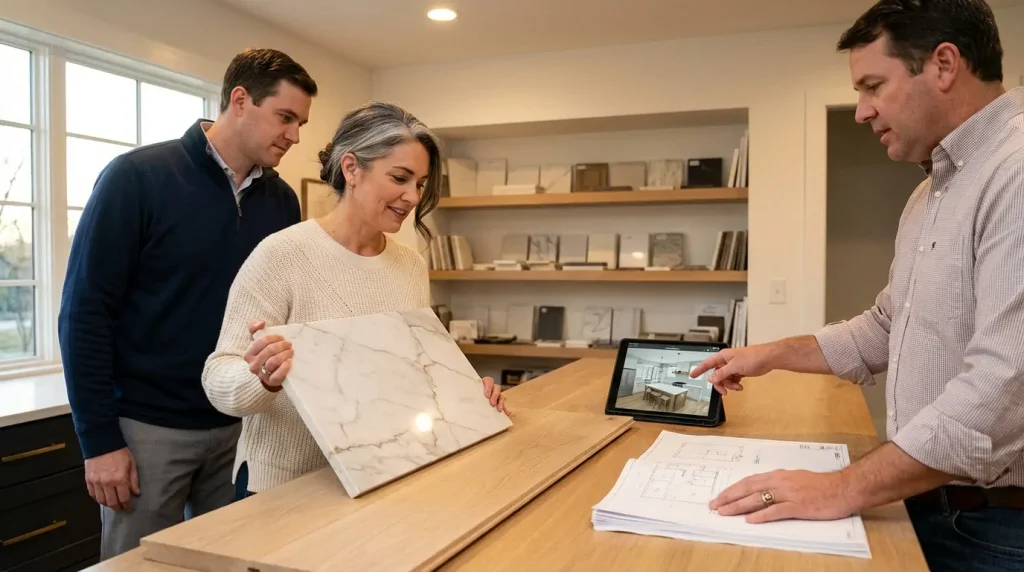
Phase 2 is where creativity meets engineering. This is the act of creation that makes custom home building fundamentally different from selecting options in a semi-custom floor plan catalog.
Working with our design team, you'll move through three stages of increasing detail:
The 3D modeling stage is where we catch most client surprises — the good kind and the critical kind. "I didn't realize the hallway would feel this narrow" is a $0 fix in 3D modeling. During framing, that same discovery costs $15,000 to $40,000 to resolve.
This is also when we begin the engineering analysis. Brandon Lynch's Texas A&M construction science background directly informs how KCB approaches structural design — particularly for Cypress homes requiring steel beam spans, cantilevered elements, or elevated foundations on flood-prone parcels. Our team coordinates structural engineering, MEP (mechanical, electrical, plumbing) design, and energy modeling in parallel with architectural development.
Here's where Cypress gets uniquely complex. Unlike building within Houston city limits (which has its own streamlined — some would say minimal — permitting), Cypress sits in unincorporated Harris County, governed by the Harris County Engineering Department for floodplain compliance, development permits, and structural review.
But that's only half the equation. If you're building in a master-planned community — and approximately 60% of new custom homes in the Cypress corridor are built within MPCs — you also need Architectural Review Board approval.
Bridgeland operates under the Howard Hughes Corporation's Design Review Committee, which mandates specific exterior material palettes, roof profiles, minimum square footage by section, and landscape design standards. Towne Lake has a similar process through the Caldwell Companies Architectural Control Committee, with its own set of Tuscan and Mediterranean-influenced guidelines for lakefront sections.
The permitting phase typically runs 6 to 12 weeks for straightforward builds and 3 to 4 months for properties with floodplain encroachment, complex drainage solutions, or multiple ARB revision rounds. This is the phase where having your builder, architect, and engineer operating as a single team pays the biggest dividend — because permit revisions requested by Harris County can be resolved in the same design session that addresses ARB feedback, rather than bouncing between separate firms.
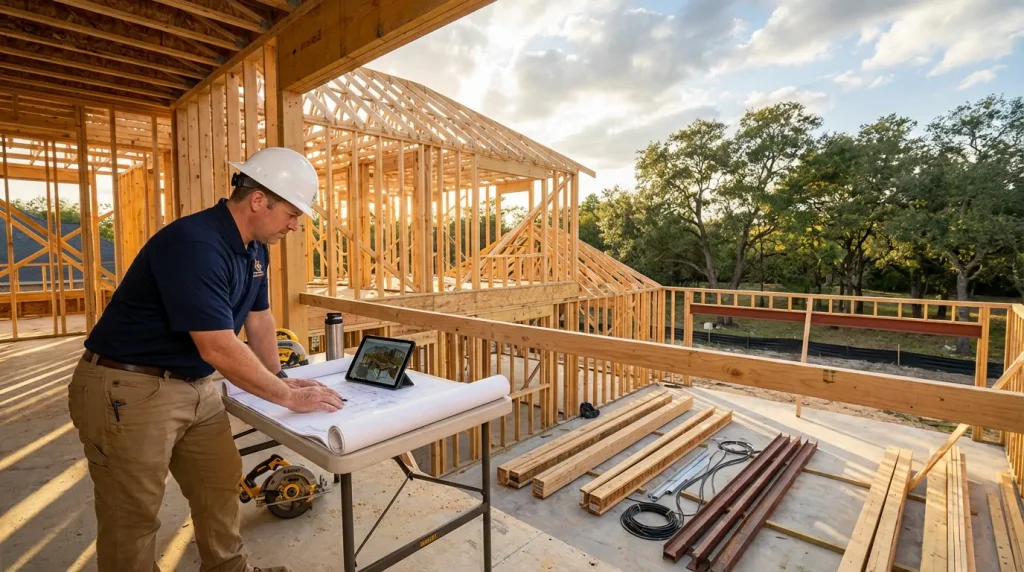
Construction on a custom home in Cypress generally follows five major milestones after permits are approved:
Foundation — For most Cypress lots, this means a post-tensioned slab on drilled piers. The expansive Beaumont Clay soils common throughout Harris County's western corridor require piers driven 15 to 25 feet to reach stable bearing strata. According to Texas A&M AgriLife Extension research on Texas soils, the shrink-swell behavior of these clays is the leading cause of foundation distress in Greater Houston homes — making engineering quality at this stage non-negotiable.
Framing and structural — Walls go up, roof trusses are set, and the home takes its three-dimensional shape. This is when you'll begin to feel the spaces and volumes you designed in Phase 2. We schedule an owner walk at framing completion so you can experience your home before walls are closed.
Mechanical rough-in — HVAC ductwork, plumbing lines, and electrical circuits are installed inside walls and ceilings. This is an invisible but critical layer that determines how your home performs for decades.
Interior finishes — Drywall, paint, cabinetry, countertops, flooring, tile, fixtures. This phase involves the highest volume of owner decisions, and it's where design fatigue most commonly sets in. Our approach? Front-load finish selections during Phase 2 design, so construction-phase decisions are confirmations rather than discoveries.
Final systems and commissioning — HVAC startup, plumbing testing, electrical panel verification, appliance installation, landscape and irrigation activation. Every system is tested independently before your walkthrough.
Throughout construction, we conduct weekly owner meetings — not courtesy check-ins, but structured sessions covering budget variance tracking, schedule status against the critical path, upcoming decisions, and photo documentation of progress. This is how 19 years of Keechi Creek Builders project management experience translates into your peace of mind.
Decision fatigue is the silent killer of the custom home experience. We've watched families who started the process excited and energized become frustrated and disengaged by month six — not because of construction problems, but because nobody structured the hundreds of decisions they'd need to make.
The reality? A 3,500-square-foot custom home in Cypress involves approximately 200 to 400 individual selection decisions — from foundation pier spacing to cabinet hardware finish. Without a system, those decisions pile up and create timeline delays, change orders, and regret.
Here's how our design-build process addresses this directly:
The final walkthrough isn't a formality. It's a 3- to 4-hour systematic review of every room, every system, every finish in your completed home. We walk through with a detailed punch list, testing every fixture, switch, and surface.
After the walkthrough, we schedule any punch list items for completion (typically 5 to 10 business days), then coordinate your certificate of occupancy with Harris County and, if applicable, your MPC management company.
But here's where most builders disappear — and where the KCB experience is fundamentally different. After you receive your keys, you get access to our post-construction concierge program:
Building a custom home in Cypress isn't just a construction project. It's the creation of something permanent that reflects exactly who you are and how you choose to live. With the right process and the right partner, that creation can be as rewarding as the result.
Ready to explore how this process would work for your specific vision? Keechi Creek Builders offers a no-obligation vision meeting to assess your project's feasibility and answer every question you have.
The custom home building process in Cypress follows seven phases: vision meeting and feasibility assessment, architectural design with 3D modeling, Harris County permitting and MPC Architectural Review Board approval, foundation and site work, framing and structural construction, interior finishes and systems, and final walkthrough with certificate of occupancy. The entire sequence typically takes 12 to 18 months from signed contract to move-in, depending on design complexity and permitting timelines.
Custom homes in the Cypress corridor typically take 12 to 18 months from contract signing to completion. The design and permitting phase accounts for 3 to 5 months, with construction running 9 to 13 months depending on home size, structural complexity, and seasonal weather conditions. Properties within master-planned communities like Bridgeland or Towne Lake may add 4 to 8 weeks for ARB approval cycles.
Design-build is a project delivery method where a single firm handles both architectural design and construction under one contract. Unlike the traditional approach of hiring a separate architect and then bidding plans to builders, design-build provides continuous coordination, real-time budget feedback during design, and a single point of accountability. The Design-Build Institute of America reports this approach reduces project delivery time and minimizes cost growth compared to traditional methods.
Yes. Cypress falls within unincorporated Harris County, requiring development permits from the Harris County Engineering Department for floodplain compliance, structural review, and site development. If building in a master-planned community, you also need Architectural Review Board approval, which governs exterior design, materials, landscaping, and minimum square footage. Harris County permits typically take 6 to 12 weeks, with ARB processes adding 4 to 8 weeks for initial submissions and revisions.
Custom home construction in Cypress ranges from approximately $185 to $350+ per square foot as of 2025-2026, depending on design complexity, material specifications, lot conditions, and finish quality. A 3,500-square-foot custom home on a prepared lot typically falls between $650,000 and $1,225,000 for construction costs alone, excluding land acquisition. Factors including foundation engineering requirements for Houston's clay soils, MPC compliance costs, and site preparation significantly influence total project investment.
A true custom home starts with a blank architectural canvas — every room, dimension, material, and system is designed from scratch around your specific vision and lifestyle. Semi-custom homes begin with a builder's existing floor plan template, allowing modifications to finishes, some layout adjustments, and upgrade selections but within predefined structural parameters. The distinction matters because semi-custom builds carry inherent design limitations that may not surface until the selection process.
Houston's Gulf Coast geography produces expansive clay soils — primarily Beaumont Clay — that swell when wet and shrink when dry, creating ground movement that can crack conventional slab foundations. Engineered foundation systems, typically post-tensioned slabs on drilled piers extending 15 to 25 feet below grade, anchor past this active zone to stable bearing soil. According to Texas A&M research, soil movement is the leading cause of structural distress in Greater Houston residential construction. Proper geotechnical evaluation and foundation engineering are non-negotiable for any Cypress custom build.