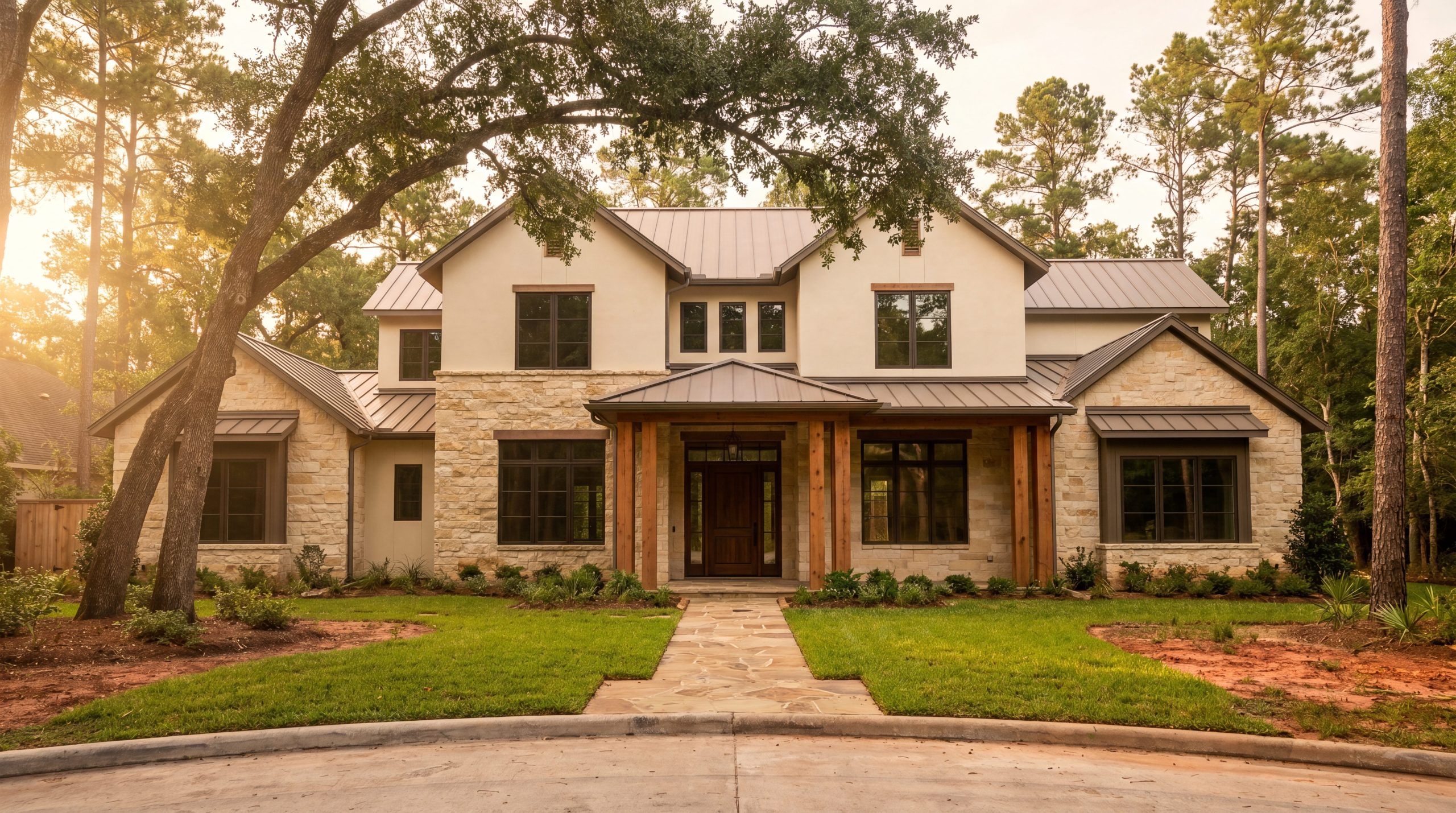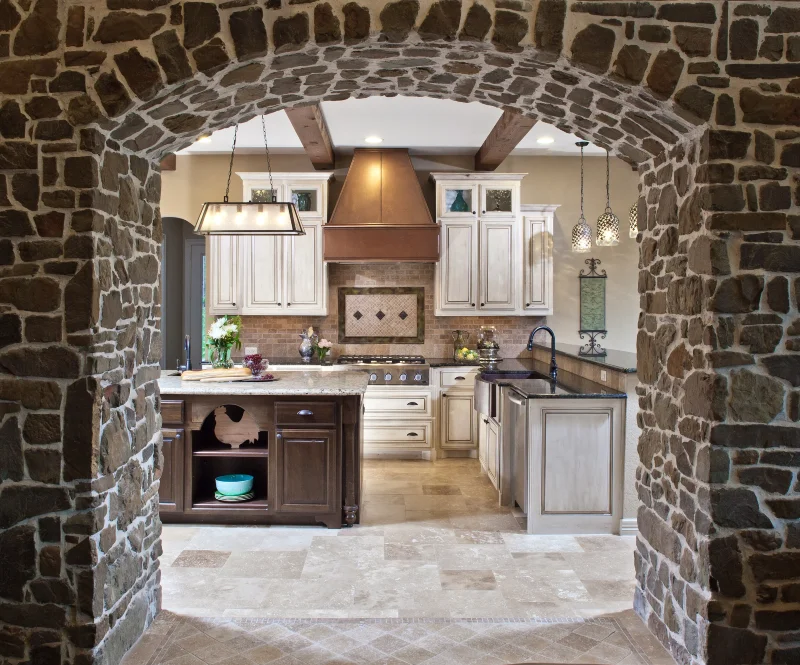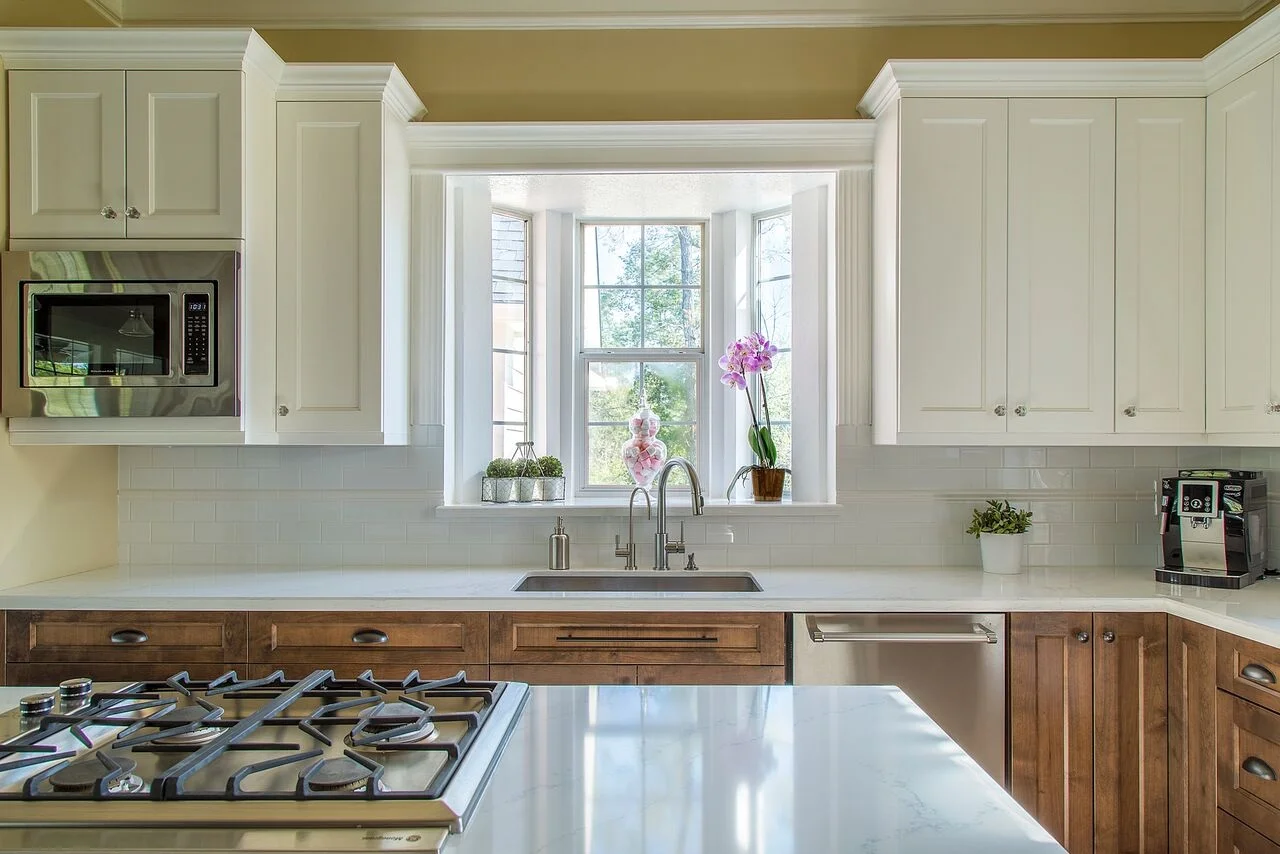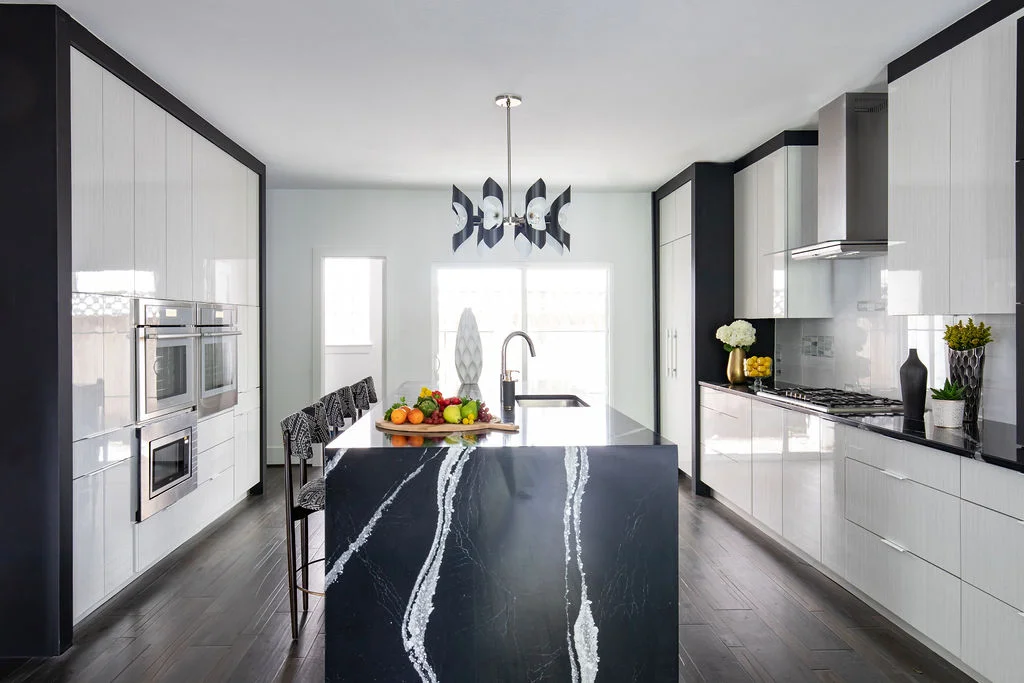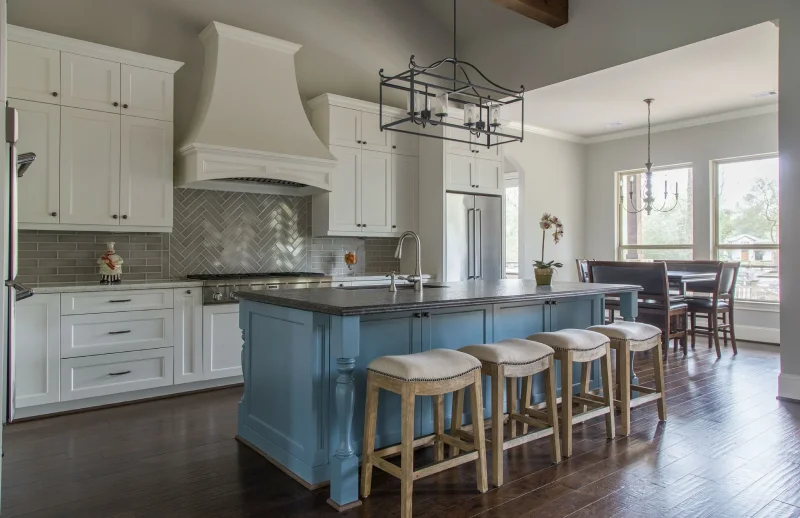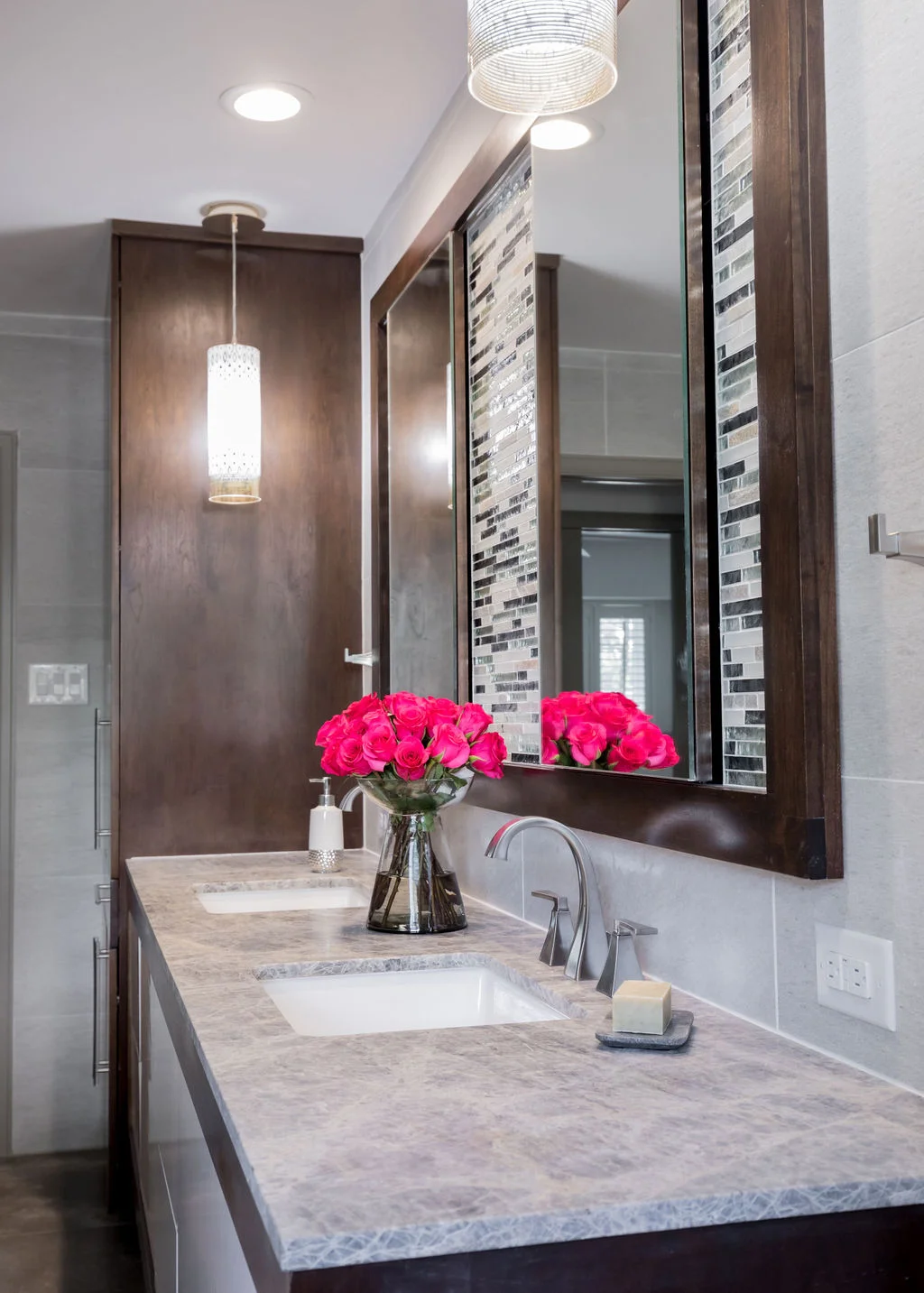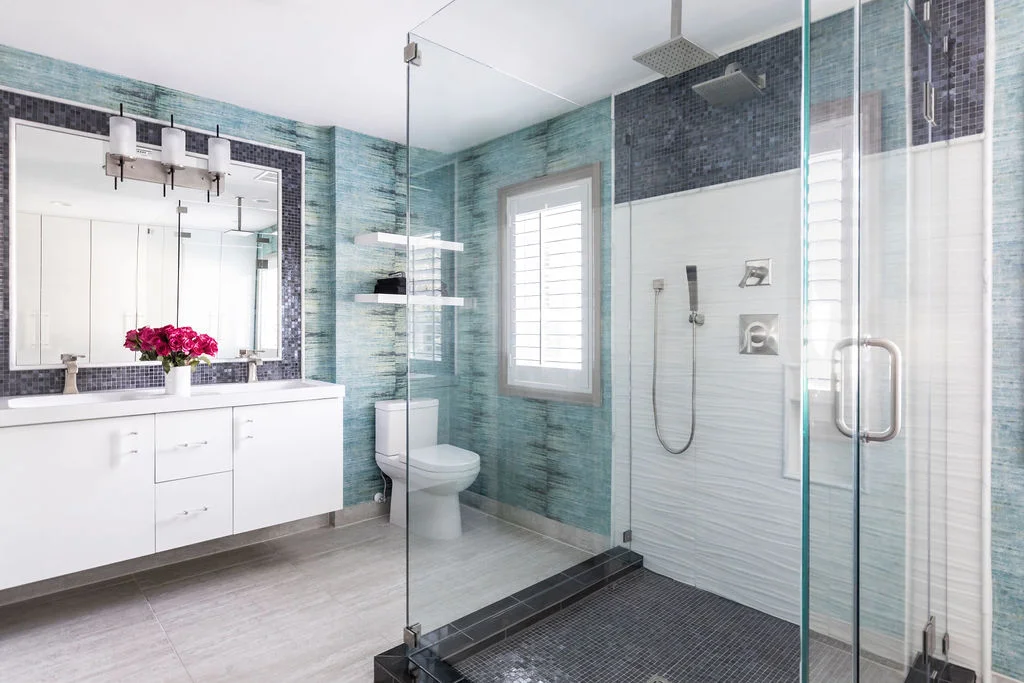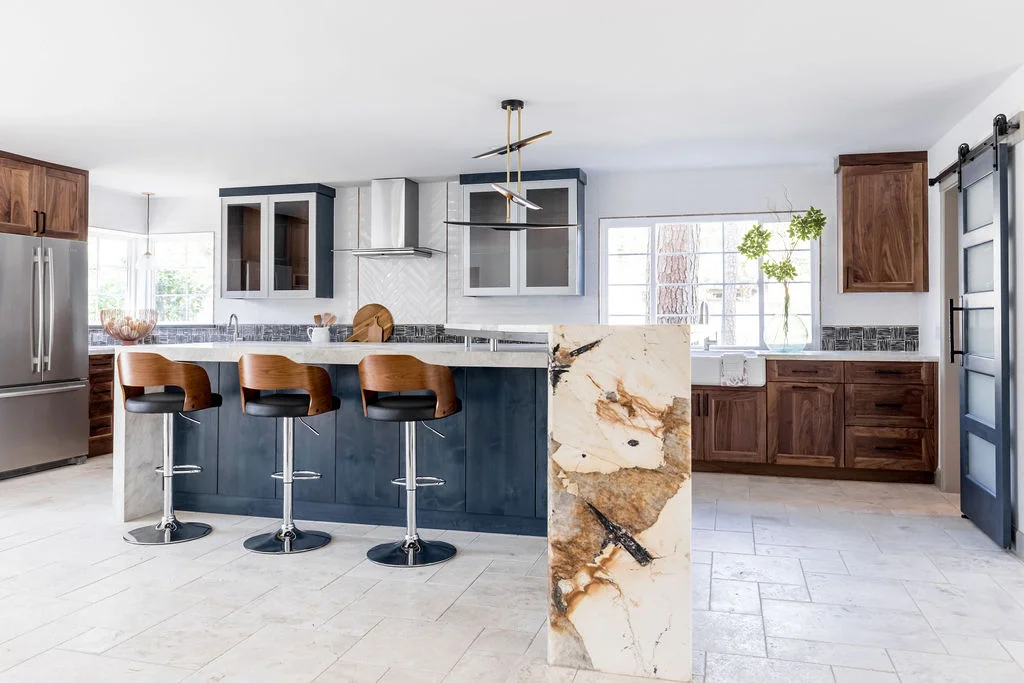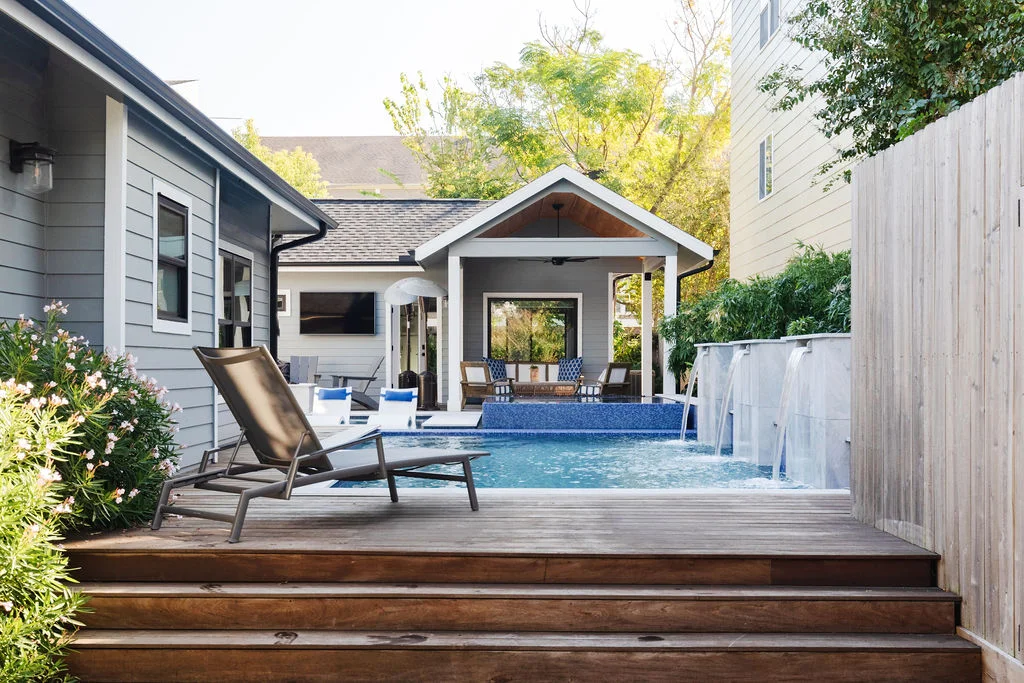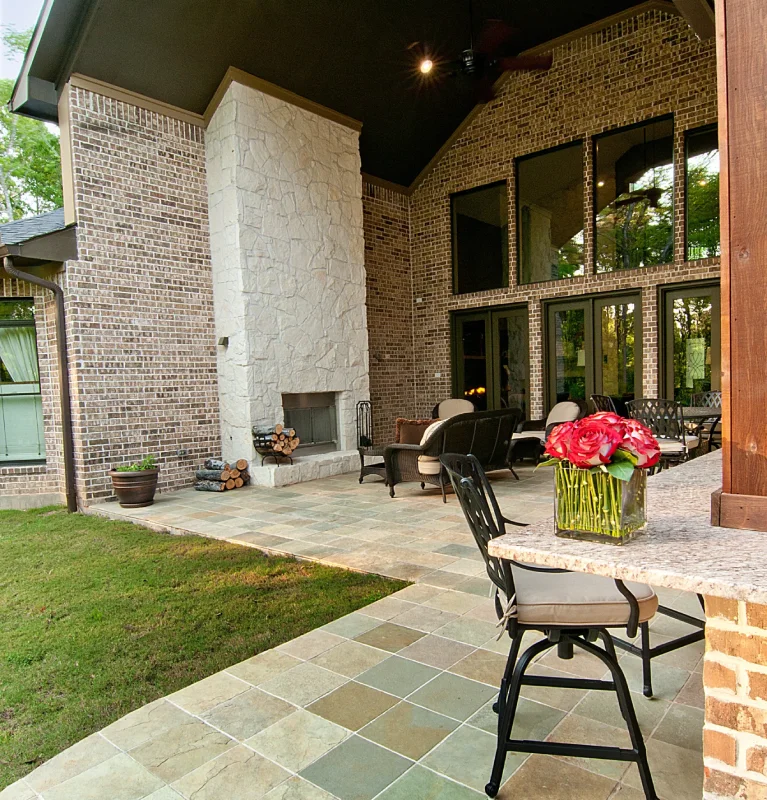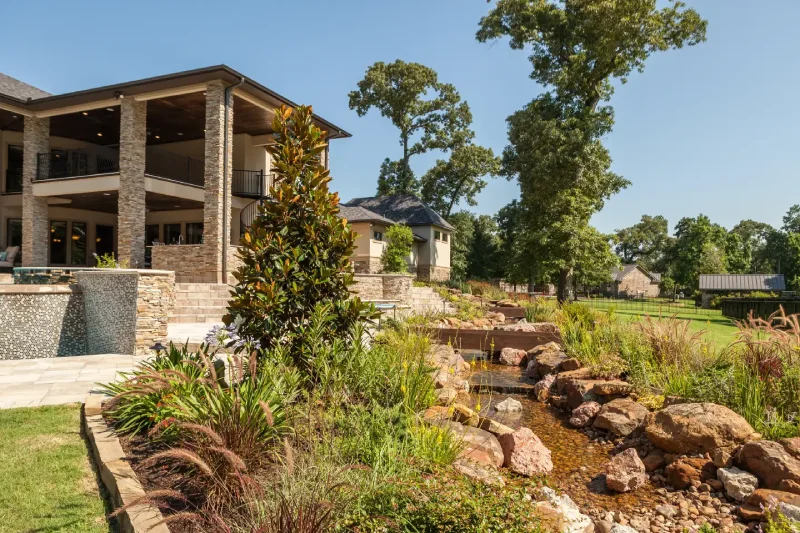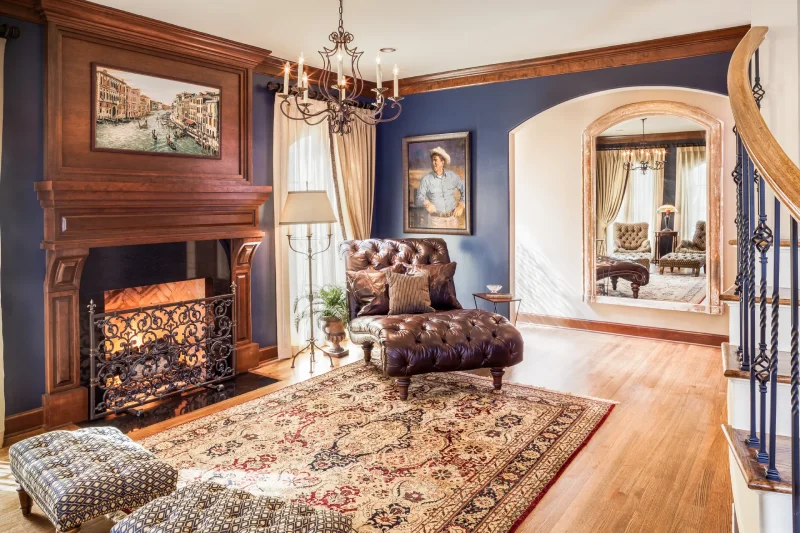
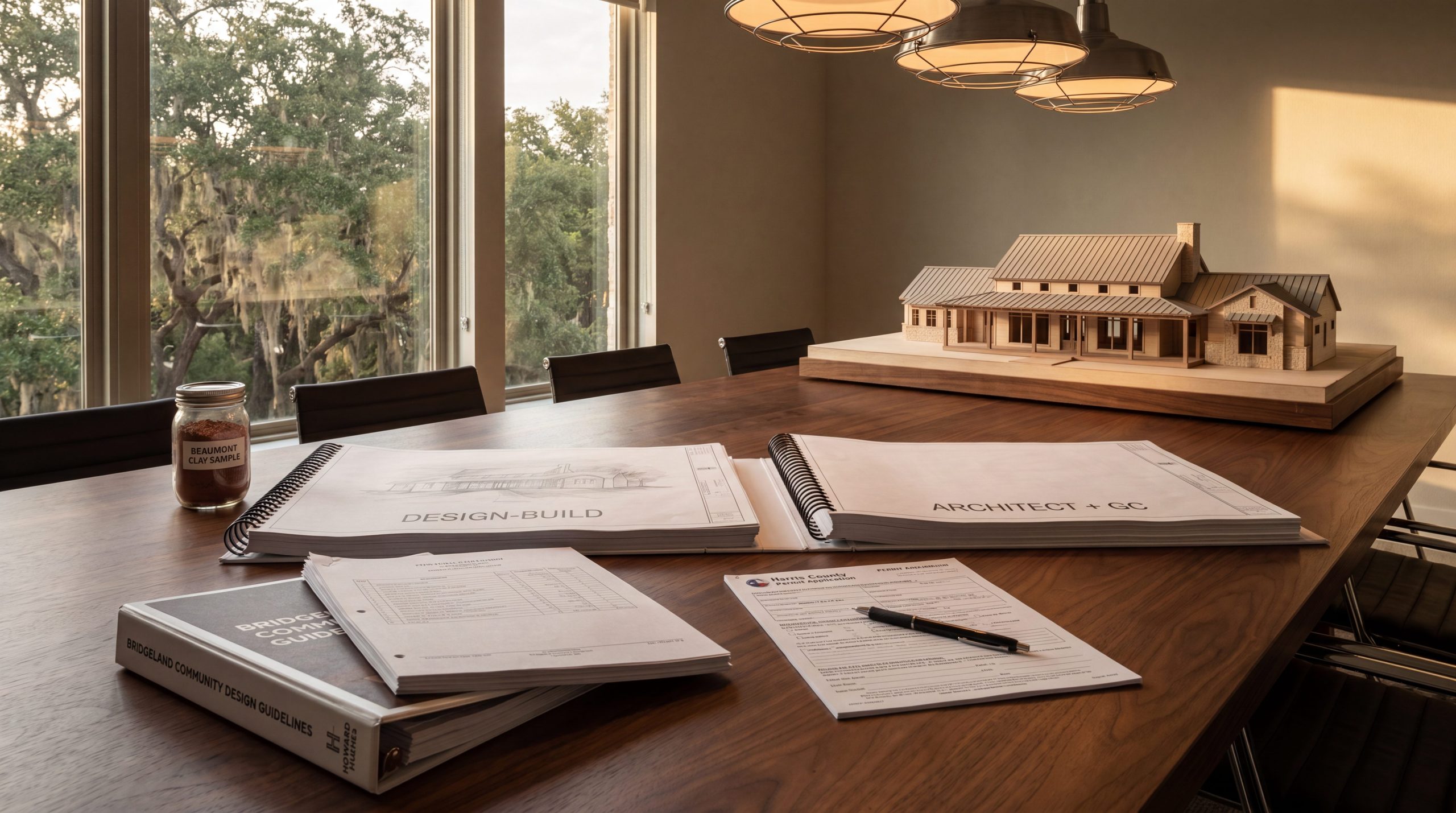
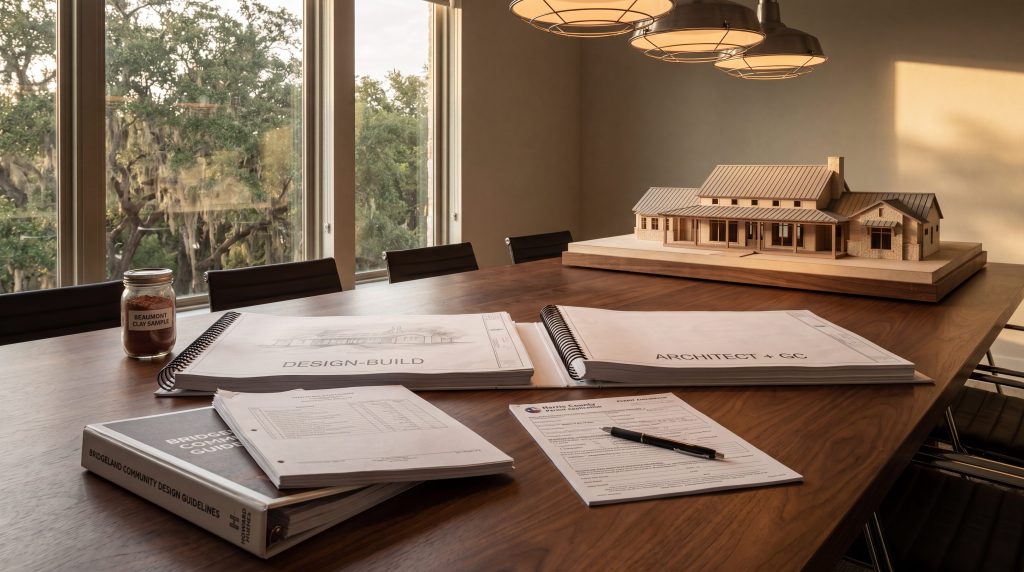
The design-build model is right for most Cypress custom home projects because it places architectural design, structural engineering, and construction under one contract — eliminating the coordination gaps that drive cost overruns and timeline slippage in the traditional architect plus general contractor approach. For homeowners building in Bridgeland, Towne Lake, or unincorporated Harris County parcels, that single-source accountability also streamlines Howard Hughes Corporation Design Review Committee submittals and Harris County permitting. The architect + general contractor route remains the better fit for a narrow set of projects: signature-architect commissions, owners with unlimited budget and schedule flexibility, or those who already hold finalized construction documents.
Key Takeaways
- Single Contract vs. Two Contracts: Design-build is one firm under one contract owning design, engineering, and construction; the traditional model splits those roles across an independent architect plus a separately-bid general contractor.
- Budget Discipline Built In: A design-build team prices choices in real time during design, while the architect-plus-GC sequence routinely surfaces budget surprises after drawings are finalized and bids come back high.
- Schedule Compression: The Design-Build Institute of America reports design-build delivers projects faster than design-bid-build because pre-construction overlaps with design rather than running sequentially.
- Cypress Regulatory Fit: Harris County permitting plus master-planned community Architectural Review — particularly Bridgeland's Howard Hughes Corporation Design Review Committee — runs more smoothly through one integrated team than between independent professionals.
- Engineering Embedded: A design build remodeler Houston area homeowners trust for engineering depth catches expansive clay soil, drainage, and energy-code issues during design — not as change orders during framing.
- When Traditional Still Wins: A signature architect commission, projects with finished construction documents, or genuinely unlimited budget and timeline still favor architect + general contractor; for most Cypress families on a real budget, design-build is the better delivery method.
What Is the Difference Between Design-Build and the Architect + General Contractor Model?
Design-build and the traditional architect + general contractor approach are two distinct project delivery methods for custom home construction. In a design build custom home Houston families hire one design-build firm that holds both architectural design and construction under a single contract — one team for design and construction, one method of accountability. In the traditional method — architect-led design-bid-build — the homeowner contracts a licensed architect to produce drawings, then bids construction to several general contractors separately and signs a second contract with the chosen general contractor. The American Institute of Architects recognizes both delivery methods, and the Design–Build entry on Wikipedia documents the design and construction integration's roots in master-builder traditions predating the 20th-century separation of design and construction professions. Whether your project is a custom home or a major renovation, the same delivery-method choice applies.
For Cypress homeowners, the difference shows up in every weekly meeting. With design-build, the person sketching the great-room ceiling height is on the same payroll as the person framing it. In the architect-plus-GC sequence, those are two separate offices — and when the framer asks the architect a question, that question carries a fee meter.
How Do the Architect + General Contractor and Design-Build Processes Differ?
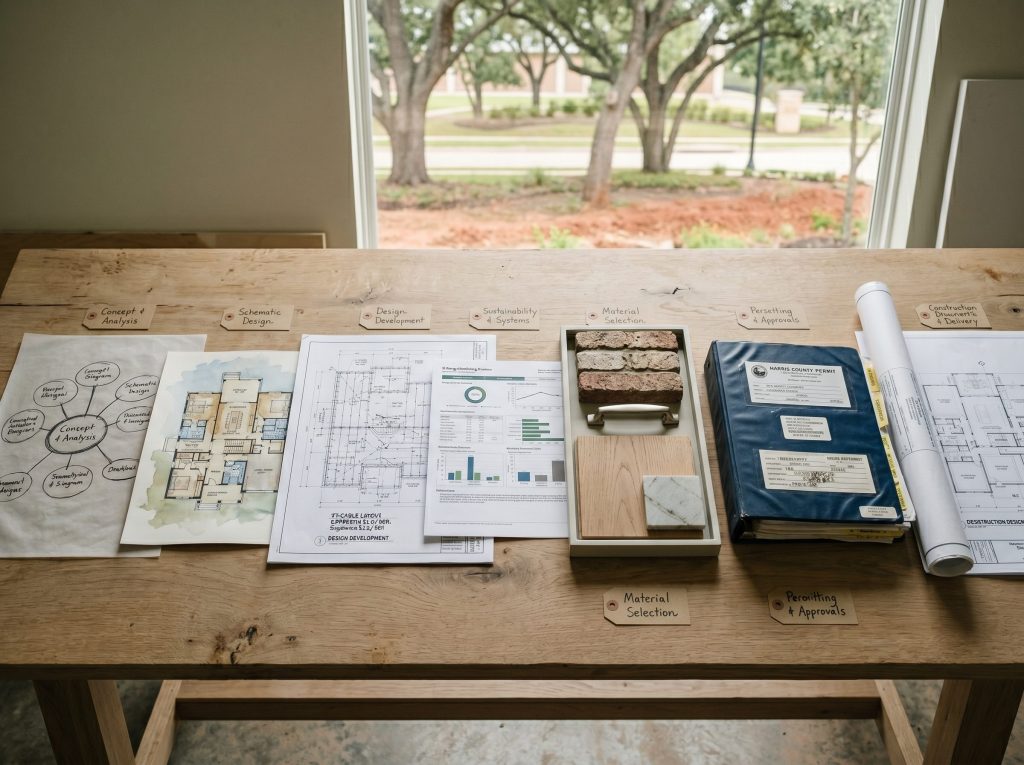
In the traditional sequence, the homeowner engages a licensed architect, develops construction documents over four to seven months (architect fees typically 8 to 15 percent of project cost), bids the work to three or four general contractors, then signs a second construction contract with the chosen builder. After construction starts, the architect continues in a construction-administration role at additional fees — placing architect and contractor in adjacent rather than aligned positions. When a buildability question or budget conflict surfaces, the homeowner mediates between professionals with no shared incentive to resolve it quickly. For families building in Bridgeland, Towne Lake, Canyon Lakes West, Dunham Pointe, or Coles Crossing, that mediation work compounds — ARB submittals need to satisfy both aesthetic guidelines and Harris County structural requirements, so revisions bounce between the architect's office and the contractor's preconstruction team for weeks.
A design build custom home Houston area firm functions as one team across the entire project. The design team, the construction team, the architect and builder, and the in-house engineering lead participate in the same discovery conversation, the same site visit, and the same budget framework. Schematic design and pre-construction run in parallel rather than sequentially. Material selections, foundation type, structural span limits, and energy-code compliance are priced as choices are made — not after drawings are finalized. The single contract concentrates accountability across design and construction teams: one phone number, no daylight between design intent and field execution, no triangulation between separate offices billing separate fees. Working with a design-build firm streamlines what is otherwise the homeowner's coordination burden — the designer and builder are colleagues, not separate vendors.
|
Decision Factor |
Design-Build (One Contract) |
Architect + General Contractor (Two Contracts) |
|
Contract structure |
One firm, one agreement, one source of accountability |
Independent architect contract + separate construction contract |
|
Budget visibility |
Real-time pricing during design |
After full documents go out for competitive bid |
|
Schedule |
Design + pre-construction overlap |
Sequential: design → bid → contract → build |
|
Change handling |
In-house team absorbs and re-prices |
Architect amends drawings (added fee) + contractor change order |
|
Bridgeland HHC DRC + Harris County permitting |
Managed end-to-end by one team |
Coordinated between two firms with separate fee schedules |
|
Construction-document depth |
Sufficient + buildable, refined during construction |
Maximum specification depth before bidding |
|
Designer–builder relationship |
Aligned (same firm, shared incentives) |
Independent (separate contracts, separate priorities) |
|
Best-fit project |
Most custom homes on a defined budget |
Signature-architect commission; truly unlimited budget |
What Are the Real Advantages of Design-Build for a Cypress Custom Home?
The structural advantages show up across three dimensions: budget certainty, schedule discipline, and regulatory navigation. Budget transparency happens during design, not after it. Because the construction team is at the table from schematic design forward, every meaningful choice gets priced as it is made — live construction cost numbers, not estimates tested months later when bids come back. Penn State and the Construction Industry Institute have both published research showing design-build delivers lower cost growth and lower schedule growth than design-bid-build. A seasoned design build remodeler Houston area homeowners have worked with for two decades absorbs that cost data into every design conversation.
Schedule compression is built into the model. Phases overlap rather than running end-to-end. While interior elevations and interior design selections are refined, the construction team is securing long-lead window orders and submitting the Harris County permit application — overlap that streamlines the path from concept to closeout for any Cypress area project. The National Association of Home Builders and the Design–Build Institute of America both document this schedule advantage.
Engineering risk gets caught in design. Cypress sits on expansive clay across Beaumont Formation soils, with elevation and drainage requirements set by the Harris County Flood Control District. In an architect-plus-GC sequence, structural engineering is typically a subconsultant engagement under the architect — and the eventual builder inherits whatever specifications the engineer produced. In a design build remodeler Houston area homeowners can trust for engineering depth, foundation design, drainage grading, and energy modeling are evaluated against constructability and cost throughout design. Issues resolve on paper, not as $40,000 change orders during framing.
How Do Cypress Communities and Bridgeland's Design Review Committee Affect Your Choice?
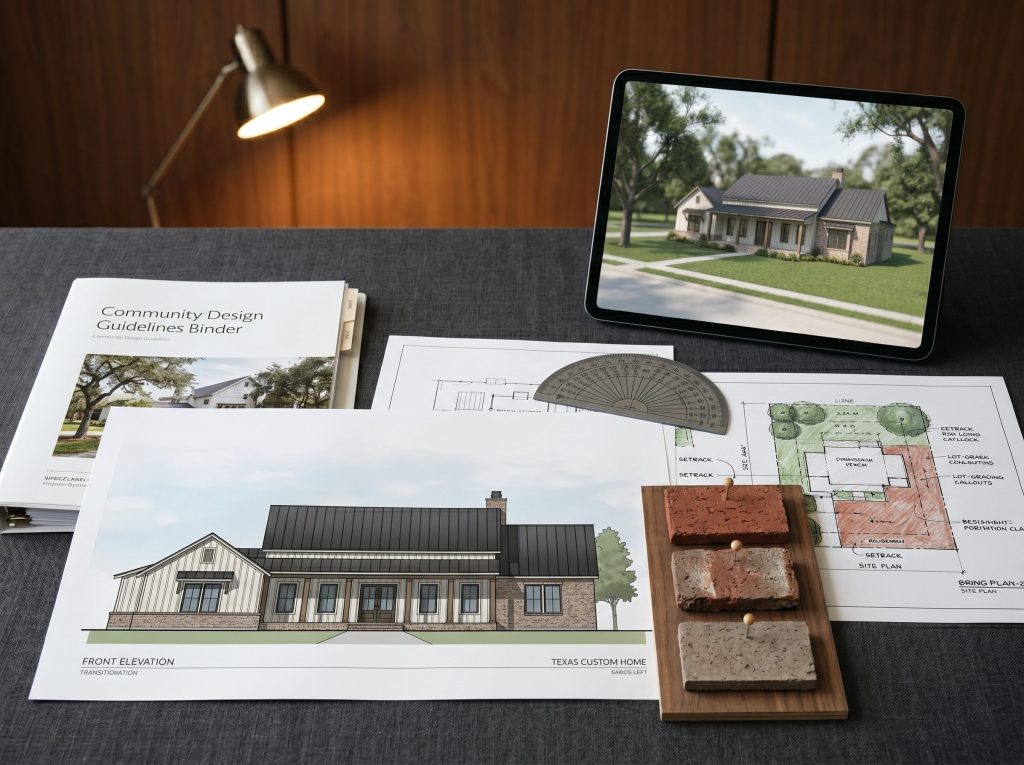
Cypress's master-planned communities add a layer of governance that pushes the delivery-method decision toward design-build. The Howard Hughes Corporation Design Review Committee — which oversees architectural review for Bridgeland — sets standards for elevations, materials, landscape, lot grading, and exterior color. Towne Lake operates a separate architectural review process. Canyon Lakes West, Coles Crossing, Cypress Creek Lakes, Dunham Pointe, Miramesa, and Fairfield each maintain their own HOA-based ARB layered on top of Harris County, Texas permitting. That dual-governance environment rewards the model where one team owns both submittal tracks. A Bridgeland DRC revision asking for a deeper porch overhang or a brick blend with a specific Texas-Cobble allocation has structural, drainage, and budget implications. When the design team and construction team are the same team, it is one revision cycle priced and re-submitted — not three professionals billing for the same conversation.
|
Cypress Community |
Architectural Review Body |
Delivery-Method Implication |
|
Bridgeland |
Howard Hughes Corporation Design Review Committee |
Frequent revision cycles favor integrated team |
|
Towne Lake |
Towne Lake architectural review |
Lakefront engineering benefits from in-house structural |
|
Canyon Lakes West |
HOA-based ARB |
Established standards; either model workable on simple lots |
|
Coles Crossing |
HOA-based ARB |
Mature lot conditions; integrated team helpful for additions/teardowns |
|
Dunham Pointe |
HOA-based ARB |
Newer development; both delivery methods active |
|
Miramesa |
HOA-based ARB |
Standard MPC review; design-build streamlines budget alignment |
|
Unincorporated Harris County (off-MPC) |
Harris County Engineering + HCFCD only |
County-only review; either model viable |
When Does the Architect + General Contractor Route Still Make Sense?
The traditional method remains the better fit in a few specific situations, and we tell prospective clients so directly.
- Signature architect commission. If the primary value of your project is the design philosophy of a specific named architect, independent engagement preserves that singular vision.
- Existing construction documents. If you already hold a permit-ready set of construction documents and only need a builder to execute, a construction-only contract with a general contractor is more efficient.
- Unlimited budget and schedule. If your project has no budget ceiling and no completion deadline, the sequential design-bid-build process allows maximum design exploration before commitment.
- Specialty technical projects. Highly unusual structural systems sometimes benefit from independent architect-led oversight with specialty contractors competing for trade packages.
For most Cypress homeowners, the custom home delivery method comparison comes down to budget discipline and accountability. The design-build vs general contractor Texas conversation in the residential space is increasingly resolved in design-build's favor — and the same architecture firm vs design-build firm questions surface for every Keechi Creek Builders prospect we meet, whether it is a ground-up custom home or a whole-house remodel.
|
Brandon's Builder Insight In 19 years building custom homes across northwest Houston, I have watched the same pattern play out repeatedly on architect-plus-GC projects: the design loves the lot, the lot fights the design, and nobody on the design side owns the cost of the conversation. On our design-build projects in Cypress, my engineering team flags expansive clay soil and HCFCD elevation issues during schematic design — when revising them costs an afternoon of redrawing, not a $35,000 change order during framing. That is the structural advantage of one contract, one team, one accountability line. |
How Should You Decide Between Design-Build and Architect + General Contractor?
Walk through these five questions — your answers should make the right delivery method obvious.
- Is budget discipline a real constraint? If you cannot absorb a 20–30% overrun, design-build's real-time cost feedback during design is the dominant advantage.
- How regulatory-heavy is your site? Building in Bridgeland with HHC DRC, Towne Lake's architectural review, or any community with active ARB favors single-team submittal management.
- Do you have months of slack in the schedule? If you need to be in the home by a specific date — school year start, relocation deadline — the schedule compression of design-build matters.
- Is the architect a named-value commission? If you are buying the design voice of a renowned architect, independent engagement is the right structure. Otherwise design-build delivers comparable quality with better cost control.
- How much coordination work do you want to own? Two-contract delivery puts the homeowner in the coordination seat. Design-build moves that work onto one firm — be honest about how much project-management bandwidth you have.
|
Actionable Tip Before signing any custom home contract in Cypress, ask the firm to walk you through a real Bridgeland HHC DRC submittal they handled — including how revisions were priced and how Harris County structural corrections were absorbed. The honesty of that walkthrough — what changed, what it cost, who paid — tells you more about delivery-method execution than any sales conversation. |
Frequently Asked Questions
Is design-build more expensive than hiring an architect and general contractor separately?
Design-build is typically not more expensive on total project cost. Architect fees of 8–15 percent, construction-administration fees, change orders from design–construction conflicts, and schedule-delay costs all add up in the traditional model. Design-build consolidates design, engineering, and construction management under one contract and often reduces total expenditure through real-time construction cost optimization during design.
Can I hire an architect and use a design-build firm at the same time?
Some design-build firms accommodate an owner-selected architect under a modified collaboration. That hybrid can work, but it partially recreates the coordination gaps design-build was created to solve. If you want to hire an architect you already trust and have the design-build firm execute construction, discuss the scope first — including who owns construction-document accuracy, who handles revisions, and how fees split when issues surface during design development or in the field. Many homeowners ultimately choose a single design-build firm to keep the design process and construction under one accountability line.
Does design-build limit my creative control over the design?
Design-build does not limit creative control over the design or interior design choices; it informs them. The design process is collaborative with multiple revision rounds, 3D walkthroughs, and your approval required at each milestone. What changes is the cost reality behind each choice — informed by real construction knowledge as the design evolves rather than introduced months later through bids. The design-build team brings the construction cost data into the conversation as the homeowner makes design decisions.
How long does a design-build custom home in Cypress take?
A typical Cypress design-build custom home runs 12–18 months: design 3–4 months, Harris County permitting 4–8 weeks, construction 8–12 months — with phases overlapping. The traditional architect-plus-GC sequence typically adds 2–4 months because design, bidding, contractor selection, and construction run end-to-end rather than in parallel.
Does design-build work in Bridgeland, Towne Lake, and other Cypress master-planned communities?
Yes — design-build works particularly well because Howard Hughes Corporation Design Review Committee submittals in Bridgeland, Towne Lake's architectural review, and HOA-based ARBs in Canyon Lakes West, Coles Crossing, and Cypress Creek Lakes all benefit from one team owning both design content and construction commitments. Cypress projects move through review tracks as one coordinated submittal rather than a relay between separate firms.
What should I ask when comparing the two delivery methods?
Ask how each option handles budget management during design, how change orders are priced, who owns Harris County permit corrections, how Bridgeland or Towne Lake ARB revisions are absorbed, and whether they can provide a guaranteed-maximum-price contract after design development. Ask for references from completed Cypress custom homes in your budget range.
Choose the Delivery Method That Matches Your Cypress Project
The right answer depends on your budget discipline, the regulatory weight of your Cypress community, your schedule pressure, and how much coordination work you want to own personally. For most families building a custom home in Bridgeland, Towne Lake, Canyon Lakes West, Dunham Pointe, or anywhere in unincorporated Harris County, the integrated design-build model is the structure that protects budget, compresses schedule, and concentrates accountability — one team, one contract. Keechi Creek Builders pairs that integrated delivery with engineering depth honed across the custom home builder in Cypress, TX market and a sibling-service track record in the kitchen remodeling Cypress TX corridor.
Talk to a design-build expert today: Call Keechi Creek Builders at (281) 914-4951 to talk through which delivery method fits your Cypress custom home, or send a message through our contact page and we will respond within 24 hours to start the conversation.